Saturday, June 29

"Firing into the Brown" #53 - more Lines, Beinheim and stuff..

"So Carnehan weeds out the pick of his men, and sets the two of the Army to show them drill and at the end of two weeks the men can manoeuvre about as well as Volunteers. So he marches with the Chief to a great big plain on the top of a mountain, and the Chiefs men rushes into a village and takes it; we three Martinis firing into the brown of the enemy".

Kipling "The Man Who Would Be King"

Time for another update..
~~~~~~~~~~~~~~~~~~~~~~~~~~~~~~~~~~~~~

In 1931 work on an airport for Portsmouth started (I'm old enough I can remember it being there, and small aircraft landing/taking off, in fact this was one of them [clicky]). In order to get the necessary space though, part of the eastern end of the Hilsea lines were demolished. 

Following shows men of the Royal Engineers using explosives and heavy plant to remove the fortification and a map showing the area demolished. The lines used to go all the way to where the current Eastern Road is and right to the foreshore.


...and a contemporary map showing the extent of the lines before the airport...

OS Six-inch England and Wales, 1842-1952

...and what it looks like now, following... 😏 


Yellow line marks the end of the current Lines - all the ramparts and bastions to the right/east of it were demolished..  first for the aforementioned airport, and when the airport went out of use, the current housing estate..  somewhat interestingly, that green corridor leading towards to the yellow line marks the line of the old moat - all the houses to the north/upper of it would have been on the old shooting range..

~~~~~~~~~~~~~~~~~~~~~~~~~~~~~~~~~~~~~ 

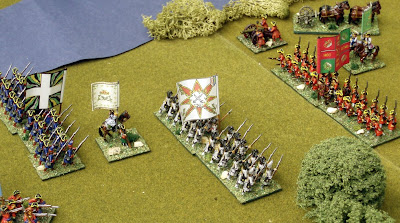
Beinheim Regiment.. (or Bynheim, Beynheim, Behnnhemn or Beijnheim depending on your sources 😏)

Colonel's Colour from 1696 to 1701
- Copyright: Kronoskaf
Another in my occasional series on the "regiments of renown" - or rather those regiments that I pounded out in that first flurry of painting at the beginning of the War of the Spanish Succession project, but didn't then have time to do a potted history on..

More properly known as IR (Infantry Regiment) 674a - the number indicates that they were the first regiment (from the "A" at the end) founded in 1674 - the regiment was paid for by the Gelderland province.

As it turns out they were the only regiment raised that year, and originally they were known as Regiment van Wijnbergen (as is normal for the period they were named for the Colonel, in this case the splendidly named Ditmar van Wijnbergen Heer van Horssen en de Poll

So where does Beinheim come in you may ask, well Johan van Beynheym first makes an appearance in the rolls in 1680 as Major. In 1688 he was Lieutenant Colonel, Colonel Commander in 1694, full Colonel of the regiment in 1696 (when Winbergen died I think), by 1701 brigadier, and three months before the battle for the Schellenberg in 1704, he was promoted Major General - he was to enjoy the promotion for only three months as he was killed in action at the Schellenberg. 

Beinheim front..

Their new Colonel would be a man called Everhard van Deelen, who from what I can tell was a major in the regiment from 1694, I'm going to assume casualties at the Schellenberg were such that he was made de facto Colonel in time for Blenheim..

Beinheim on the right

At Blenheim the regiment served in the centre under Charles Churchill, they were probably on the right, in the front line division of  Lieutenant General Horn, and in the Brigade of Major General Johan van Pallandt. The other regiments in the brigade consisted of these:
  • Schwerin Infantry Regiment, Colonel Kurt Christof, Graf von Schwerin (Mecklenburg - Prussian Meith Regiment) (547 men)
  • de Varenne Infantry Regiment, Jacques l'Aumonier, Marquis de Varenne (Prussian) (461 men)
  • Wulffen Infantry Regiment (Prussian) (591 men)
  • Erbprinz von Hessen-Kassel Infantry Regiment, Erbprinz von Hessen-Kassel (Prussian) (540 men)
"Shortly after 3 p.m., the Prince of Holstein-Beck and Major-General Pallandt were directed to secure the village itself, but their Dutch troops were quickly thrown back by the émigré Irish regiments of Clare, Dorrington and Lee. The leading regiments of Goor and Beynheim were routed and dispersed, many being taken prisoner: ‘So warmly received that after a sharp dispute they were forced to retire,’ Francis Hare recalled. The Dutch infantry fought doggedly, but were driven away step by step in a bayonet-stabbing and musket-butt-wielding contest with the Irish" (from Prussian Army at Blenheim 1704 - Weapons and Warfare)

Uniform circa 1700 - Copyright: Richard Couture

Operational History:
  • 1701 - In garrison at Maastricht; 
  • 1702 - on the Rhine, no major actions; 
  • 1703 - capture of Trabach, Bonn; 
  • 1704 - Schellenberg where it formed part of Marlborough’s advanced guard in the Beynheym’s Brigade, Blenheim; 
  • 1706 - Ramillies, siege of Ath; 
  • 1719 - part of the army which covers the Siege of Douai
..nothing further mentioned after Douai - but van Deelen remained Colonel of the regiment until 1714, and in 1709 was promoted Brigadier.

Facing their nemesis once again as at Blenheim..

So..  these guys were painted sometime in 2015, can't be more precise than that..  figures are Minifigs

Sources:

~~~~~~~~~~~~~~~~~~~~~~~~~~~~~~~~~~~~~ 

 Laters, as the young people are want to say...


Saturday, June 22

"Firing into the Brown" #52 - "Springing Zeke", Italy and stuff..

"So Carnehan weeds out the pick of his men, and sets the two of the Army to show them drill and at the end of two weeks the men can manoeuvre about as well as Volunteers. So he marches with the Chief to a great big plain on the top of a mountain, and the Chiefs men rushes into a village and takes it; we three Martinis firing into the brown of the enemy".

Kipling "The Man Who Would Be King"

Time for another update..
~~~~~~~~~~~~~~~~~~~~~~~~~~~~~~~~~~~~~

Some gaming has been going on.. 😏

Background/narrative:

Following his capture [clicky], Corp has taken Zeke to the Union camp, where after come cursory questioning Zeke has been locked up in an old log cabin on the fringe of the camp.

There are three horses in the paddock tied to the rail in the corner nearer the cabin as the next morning he'll be taken to a prisoner of war camp a days ride away.

Elsewhere however, Robbie and Buck have taken it upon themselves to try and rescue their friend and have approached the Union camp under cover of darkness. It's the early hours of the morning, they're hoping that the cover of darkness, and surprise, will aid their endeavour. 

Oblivious to all of this, Corp is in the camp sleeping off the effects of  the last of Zeke’s rotgut whiskey, but has assigned Seth and Zack to guard Zeke until the morning.

Game mechanics/setup:

  • I'm using Ruthless [clicky] again - Ruthless-Fastest-Rules-in-the-West-3.pdf (fireballforward.com) ..they're free gratis, but more importantly they drive a fantastic narrative (and for me - with most of my wargaming being solo - the narrative is becoming more and more important, if the rules don't make a good narrative then I lose interest 😏)
  • To rescue Zeke from the cabin, either Robbie or Buck need to get to the front door of the cabin and expend one action (“unlock the door”), after that Zeke can act as required but is considered unarmed until either Robbie gives him his gun (an action), or he manages to pick one up from anyone else (also an action).
  • To simulate the effects of surprise neither Seth or Zack can move until either 
    1. Robbie or Buck fires, or 
    2. Robbie or Buck get within 6” of the cabin, but
    3. there is a chance that Robbie or Buck might be heard anyway, so roll once per turn (D10); on a 1 or 2 they are heard. 

  • Once Robbie or Buck are discovered, the alarm is triggered and they then have 15 moves to get Zeke away before reinforcements from the camp arrive. 
  • As it is dark, all shooting outside of 6" range is at -1.
  • Ground is considered good - bushes and fences don't block line of sight but provide cover, the rock outcrops, the cabin and the horses do block line of sight and also provide cover.

Table set up - those Airfix fences around the paddock must be the better part of over 50 years old.. 😀   

Solo amendments and experiments:

Rather than deal a hand of 5 cards per side (or in this case per character, as I am using the rule writers  suggestion to allow individual activation, rather than everyone on the same side activating on one card):
  • at start of turn just turn over one card from the top of the deck and place it by each character, then action in sequence as normal
  • to allow the "jump the gun" action to work (as the characters don't have a deck of five to play cards from) I just used an opposed D10 roll - if the guy being shot at rolls higher, he gets to fire first if his weapon is loaded (NB. Snapshot trait adds to the die roll)
  • to allow the "recovery from unconscious" action to work (again, because the characters don't have a deck of five to play cards from) 
    • I allow any character on the same side to exchange cards 
    • I also give the unconscious character one roll per turn to recover (D10); 1 or 2 and they recover.
Game:

Move 1: No need to pull cards providing the Rebel characters don't go within 6" of the cabin, but at the end of the turn they dice to see if they have been heard - and they fail miserably, throwing a 1 on a D10!

Robbie and Buck stealthily approach the cabin - all is quiet apart from the buzz of the insects. Robbie leans over and quietly whispers in Buck's ear that he needs him to take care of the guard out back while he does the same with the one in front. Pausing only to hitch Zeke's gun more comfortably on his back, Robbie moves off to his right, only to be almost deafened by the sound of a can rattling across the gravel just behind him..  what the hell?!

Move 2: Robbie or Buck are discovered, so cards are dealt to all characters. Both Union characters get by far the best activation cards allowing both of them to respond first. Given they have only just activated I thought it fair that there should be some kind of spotting rule given the dark, and the surprise - in the spirit of the rules I made this a 50% on a D10, and in both cases the Union characters passed. Robbie or Buck both rolled high and beat the Union to the draw - unfortunately, they then both missed! In return , Seth misses, but Zack's shot caused a serious wound on Buck (Zack threw a 10 on a D10!)

Startled into alertness by a sound he's just heard, Seth scrambles quickly to the corner of the cabin facing the direction the noise has come from, a quick scan of the gloom and he spots Robbie and both fire at almost the same moment - the bullets whizz past. On the other side of the cabin, Zack has also spotted Buck and they also both fire at the same time. Buck cries out and drops to the ground motionless
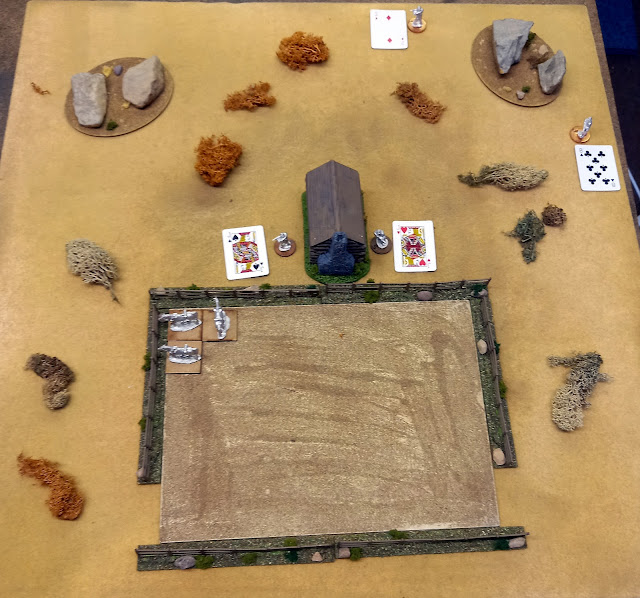
Start of move 2 - Robbie (2♦), Buck (8♣), Seth (J♠), Zack (J♥)

Move 3: Again the Union players draw well and both get the initiative, the good news is that Robbie pulls a 4 which he swaps with Buck hopefully allowing him to recover providing they get the opportunity to do that (in the game rules a 4 allows recovery from unconsciousness). Seth fires, hits, and then threw a 10 on a D10 (two 10's in two moves for the Union players!!) for the wound dropping Robbie like a stone! NB. On this occasion Robbie was unable to "beat the draw" as he was unloaded at the time. Zack's higher initiative meant he got to Buck and covered him before he could fully recover. 

Start of move 3 - Robbie (2♠), Buck (4♥), Seth (K♦), Zack (6♣)

Move 4: Game over - Seth activates first and crosses the ground to cover Robbie who is still unconscious. Both Robbie and Buck are disarmed and join Zeke in the cabin..

Things are not going well for the rescue party.. Robbie can see Buck is down and showing no signs of moving. Across the clearing he sees Seth reload and fire - and then nothing, all goes black..

When he comes back to consciousness it is to find himself lying on a dirt floor in what looks like the inside of the cabin, with Buck kneeling over him, a canteen of water in his hand. In the other corner Zeke watches them both, resignation writ large on his face.

Butchers bill - just the two serious wounds - one each on Robbie and Buck

Excellent game but good Lord, the Confederate players were unlucky! Getting heard on move 1, missing all their shots, and then the absolute laser shooting by the two Union players and it was all over before they even got going... and all of those results were on 10% and 20% chances..  unbelievable - but sometimes that's the way the games goes!

Love these rules - their 'tinker quotient' is high - and the solo amendments worked well, and I've already thought of some further enhancements (deal two/three/four cards and allow the character to use the best..  etc.)

Now I get to figure out how the three can escape.. but let's get some paint on them first!! 😀

~~~~~~~~~~~~~~~~~~~~~~~~~~~~~~~~~~~~~ 

The latest from the prolific pen of James Holland - his output considering the detail he goes into, and the level of research he has clearly done is remarkable.. Like his Burma book, this one deals with a largely overlooked, and less "glamourous" campaign (than say, western Europe, Russia or even North Africa), that of the invasion of Italy.

After the success of the invasion of Sicily, and knowing that they would be invading France the next year, Italy was always intended to be a sideshow, but with some clear aims..  get Italy out of the war, divert German forces from Russia and North West Europe, and finally, in support of the Allied aim to get absolute air supremacy over the the D Day invasion, the installation of strategic bomber bases in Italy, that could reach the aircraft factories in southern Germany more easily than they could from Britain. The Allies also expected to be in Rome by Christmas.

On the whole by the end of '43 (and this book only covers the period between the invasion in September, and the end of December) the Allies did magnificently..  Italy did surrender as a result of the invasion (in truth they were a spent force anyway), and the Allies also managed to get strategic bomber bases built and operating (albeit ineffectively due to weather conditions), but the German forces driven by a slew of Hitler no surrender, no retreat orders, resisted fiercely and the campaign turned into one of the most brutal campaigns of the war.

The terrain was awful, one mountain range after another, all of which the Germans reinforced, but which due to the terrain meant that the Allied doctrine of "steel not flesh" couldn't be pursued - their advantage in armour and air support was stifled, by terrain, and by weather which was cold wet and interminably raining..  it was down to the Allied infantry to win the battles..  casualties on both sides were enormous as they fought and defended endless shattered villages and cities, in intense heat and, towards the end, frigid cold and relentless rain. 

As usual, and the reason I like his books so much, Holland provides a picture of the campaign through countless first person accounts on both sides, and from all types of people, civilians, airmen, tankers, gunners, fallschirmjäger, but most of all the PBI ('poor bloody infantry') on both sides..  

Excellent .. very much recommended, and I am hoping fervently, that as the book ends just as the Allies get to Monte Cassino, there'll be a 'volume 2'... 

Steve the Wargamer rates this one a solid 10 out of 10

~~~~~~~~~~~~~~~~~~~~~~~~~~~~~~~~~~~~~ 

Laters, as the young people are want to say...

Saturday, June 15

"Firing into the Brown" #51 - "Fabius", Mosquito's and stuff..

"So Carnehan weeds out the pick of his men, and sets the two of the Army to show them drill and at the end of two weeks the men can manoeuvre about as well as Volunteers. So he marches with the Chief to a great big plain on the top of a mountain, and the Chiefs men rushes into a village and takes it; we three Martinis firing into the brown of the enemy".

Kipling "The Man Who Would Be King"

Time for another update..
~~~~~~~~~~~~~~~~~~~~~~~~~~~~~~~~~~~~~

Another local picture - following - prompted an enjoyable rabbit hole of an investigation into a WW2 operation I had never even heard of, but very apt given the recent Anniversary..

Picture courtesy Imperial War Museum (IWM H38270)

Those are Sherman's of the 50th (Northumberland) Infantry Division driving ashore from landing craft on my local beach at Hayling Island (!) in May 1944 as part of an exercise called 'Operation Fabius'...  

Fabius occurred a week after the probably better known "Exercise Tiger", which was the one in Devon at Slapton Sands that tragically resulted in a number of deaths from both friendly fire, and the interception of the Allied ships by German E-Boats. Like Tiger, Fabius was an attempt to simulate as closely as possible the physical conditions the troops would likely meet on D-Day. 

Hayling was chosen for the 50th because the sand on the beach was considered to be of a very similar type to that on 'Gold' beach where the 50th would be landing.

The division had embarked on landing craft at Southampton, then sailed out to sea, went anti-clockwise around the Isle of White, before then simulating a full-scale amphibious landing on the beach at Hayling. The men encountered beach obstacles, smoke, pyrotechnics, and a mock enemy but the objective was to land, clear the beaches, and then push beyond Hayling Island towards Havant and Rowlands Castle.

Click to embigen - "Easy Red" marks the landing zone - map showing the southern part of Hayling Island, scale 1:12,500, defence overprint, produced by 30th Corps, British Army. 'Enemy defences' are printed in red along the seafront. This map belonged to Mr Oliver H. Perks, who was a Forward Observation Officer with 90th Field Regiment, Royal Artillery, part of 231 Brigade, 50th Division.

The exercise was planned to start on 2 May 1944, but bad weather delayed it to the next day (which in itself was a portent of what was to come), and it consisted of six separate exercises:

  • Fabius 1: elements of the 1st Infantry Division and 29th Infantry Division (United States) practised amphibious landing at Slapton Sands. This was the rehearsal of the landing on Omaha Beach.
  • Fabius 2: this one - where elements of the 50th Infantry Division practised landings at Hayling Island. This was the rehearsal for the landing on Gold Beach.

  • Fabius 3: elements of the 3rd Canadian Infantry Division practised landings at Bracklesham Bay. This was the rehearsal of the landing on Juno Beach.
  • Fabius 4: elements of the 3rd Infantry Division and associated units practised landing at Littlehampton. This was the repetition of the landing on Sword Beach.
  • Fabius 5 and 6: practice for American and British forces working on build up of forces and supplies on Allied beaches.

Together they formed the largest amphibious training exercise of the war but given the closeness of the date to the actual landings, it really was a familiarisation exercise rather than any attempt to improve or change what had already been planned.

~~~~~~~~~~~~~~~~~~~~~~~~~~~~~~~~~~~~~

I'll be honest and say I only bought this to take advantage of a "two'fer" deal (in which I also bought Holland's "The Savage Storm" see a later post for a review of that). There wasn't anything else I wanted, and one of my mates had said he was reading it so I thought I'd take the punt.. glad I did on the whole..  funny old book, though!

If you are expecting a concise history of the development and operational use of the de Havilland DH.98 Mosquito during WW2 you'll only be partially happy. There is some stuff about the development of the plane, it's unique design, the friction and opposition Havilland faced both from RAF procurement and the War Office, and their decision to go ahead and develop the plane anyway, but not an enormous amount.  

Thank goodness they did go ahead though! 

All in all, almost 8000 of them were built, and they served in all theatres of the war (though the Far East did give early issues with the construction type until more effective glues were developed) and served in an amazing variety of roles (Light bomber, Fighter-bomber, Night fighter, Maritime strike aircraft and Photo-reconnaissance aircraft) - as White says - strap two Rolls Royce Merlin engines to a ply wood airframe, and the plane was an absolute rocket. 

Most of the book though is about how the plane was used in the Nordic theatre, in particular Denmark, in support of underground and resistance activity. The book becomes more about how the SOE developed it's organisation there, in what was an unusual situation in Denmark as officially it was not at war with Germany. Undoubtedly the best parts are the descriptions of the raids by Mosquito's of  No. 140 Wing RAF into Denmark - Operation Carthage [clicky] was the raid on Gestapo HQ in Copenhagen also the earlier raid on  Gestapo HQ in Aarhus [clicky]

His writing style is a little "dramatic" at times (examples being 'hit the tit' when describing releasing the bombs, 'opening the gate' when talking about throttle, etc.) and also, the timeline is jumbled, and he's all over the place geographically - there's an even better story waiting to be told if he could just organise it - he also needed to decide what his book was going to be - either about the plane, or a history of the Danish underground, either of which would have been excellent in their own right..  Steve the Wargamer rates this one as an 8/10..

~~~~~~~~~~~~~~~~~~~~~~~~~~~~~~~~~~~~~
 
 Laters, as the young people are want to say...

Saturday, June 8

"Firing into the Brown" #50 - Science Museum, "Corp makes a break for it", and stuff..

"So Carnehan weeds out the pick of his men, and sets the two of the Army to show them drill and at the end of two weeks the men can manoeuvre about as well as Volunteers. So he marches with the Chief to a great big plain on the top of a mountain, and the Chiefs men rushes into a village and takes it; we three Martinis firing into the brown of the enemy".

Kipling "The Man Who Would Be King"

Time for another update..
~~~~~~~~~~~~~~~~~~~~~~~~~~~~~~~~~~~~~

Most enjoyable trip to the smoke for the grandson during half term - his Mum had got tickets for the Science Museum and wondered if myself and the current Mrs Steve the Wargamer also fancied a trip - in the words of the immortal Fluff Freeman, "not 'arf!", we said.. 😀

To my immortal shame I've never previously been to the Science Museum, and I would say without a shadow of a doubt that's been a definite loss on my part, as the place is fascinating..  the museum is huge and comprises a loosely connected bunch of collections and exhibitions at the heart of which is their technological significance, so there are galleries on the steam engine (brilliant) and the birth of the industrial revolution, then computing, medicine, mathematics - stuffed full of original examples of the subject..  Babbage's Differential machine was amazing, as were some of the Boulton and Watt Steam engines, but the exhibition that got me most enthused was on the top floor where they had an exhibition on the development of flight - everything from Montgolfier to the Space Race..

In no specific order then, these caught my eye.. 

First ever Hawker Siddeley P1127 - following - this was the prototype/test bed plane for what later became the production Harrier Jump Jet - this specific one is serial # XP831 which was the first of the first of those prototypes (and amazingly is the actual plane, not a replica..  😮)


Lots more information on the plane, and the program, here [clicky] and here [clicky]

I was also interested enough to find out why there was an Ark Royal crest on the side, and found out this very plane was the first ever to make a vertical landing on an aircraft carrier - Ark Royal as it happens... 


Next..  the War Office gave this - following - to the museum in 1945 - it's a captured V1, which the museum first exhibited in 1946 as part of an exhibition of enemy technology..  apparently it was very popular.. this one they cut away the sides of, so that people could see how the thing worked more clearly..  the 'orange balls' b.t.w. are high pressure fuel tanks for the rocket engine..


 "Nicht auftreten" - "don't step here" 😏


Following - no mistaking that barn door nose, and one of my favourite WW1 planes.. an SE5A scout in civilian colours. This one was built in 1917 and saw Royal Flying Corps service as ‘F937’ with 85 Sqn,  but after the war was sold privately, and was registered as ‘G-EBIB’ and modified for skywriting [clicky]. It then flew with the Savage Skywriting Company between 1922 and 1934.


Three legends in one shot - following - Supermarine Spitfire, Spitfire and Hurricane (bottom to top), all originals..


Mad as a bucketful of frogs..  a Messerschmitt Me-163B-1A Komet (following), Werknummer 191316, "Yellow 6" - one of 21 captured by the British at the end of the war and used for evaluation. They had a  stupidly small operational window, something like 10 minutes of fuel, but also 'exhilarating' to handle according to one of the RAF's top test pilots (Eric "Winkle" Brown)..  

"Brown recalled that the noise made by the Komet’s rocket motor was “absolutely thunderous… It was like being in charge of a runaway train; everything changed so rapidly and I really had to have my wits about me”. The fighter zoomed up to 32,800ft (10,000m) in 2.75 minutes at a 45° angle — “exhilarating”, according to Brown. Once the limiting Mach number of 0.82 was reached, the effects of compressibility became apparent: heavy buffeting and a strong nose-down trim change. Once the fuel was completely exhausted, Brown glided down to a “very comfortable” dead-stick landing".

They landed using that skid at the front - take off used a detachable trolley, that fell away once the plane was airborne..  madness...


Hurricane following - to be specific Hawker Hurricane Mk 1, serial no. L1592 / W/O 5422, possibly the only existing Hurricane to retain fabric covered wings. Built in 1938 by Hawker this one fought over Dunkirk and in the Battle of Britain, but was attacked by a Bf-109E in August 1940, and damaged in a forced landing near Croydon following the attack. She was repaired and served with the RAF until the end of the war. Her claim to fame though, is that she appeared in both the film "Angels One Five", and an episode of  Monty Python's Flying Circus, "The Light Entertainment War" 😁


Following - Spitfire Mk1a P9444 - built in 1940 by Supermarine Aviation at the Wooston Works, Southampton, and fitted with a Merlin III engine. First flight was in April and it was then assigned to 72 Squadron in June. Flew in Battle of Britain but sustained serious damaged on landing, following P/O Elliott passing out due to lack of oxygen in the July of the same year. Although it was repaired it never again flew operationally. Eliott by the way survived, but had to bale out (safely) over Kent in September the same year when his (next) Spitfire was shot down over Hartfield, Sussex. Then he was wounded two days later following combat over the Thames Estuary. I was pleased to read he survived the war, won a DFC, married, had children and eventually died at a good age as a retired Air Vice Marshall.. 😊 More on him here [clicky]


Last of all - following - Supermarine Rolls Royce Seaplane, S.6.B. S.1595 (the actual plane, though it does have a dummy engine). This one was the winner of the Schneider Trophy in 1931, designed by Mitchell (he of Spitfire fame) it was powered by a supercharged Rolls-Royce 1900 hp engine. Two weeks after winning the trophy, this plane then set a world speed record of 407.5 mph - the fastest ever vehicle on earth at the time. So much of what would later become the Spitfire was owed to this machine - stunning plane..


...enough planes for now...

~~~~~~~~~~~~~~~~~~~~~~~~~~~~~~~~~~~~~ 

Prompted by a post on a fellow Bloggerati's site [clicky], I recently downloaded a copy of these:

Ruthless-Fastest-Rules-in-the-West-3.pdf (fireballforward.com) 

..they're free gratis, and a quick read through prompted me to get some of the little metal men out and try a straight forward and simple man on man gunfight..  just to see how they work.. following shows some of the mechanics, and how it drives the narrative (and for me - with most of my wargaming being solo - the narrative is becoming more and more important, if the rules don't make a good narrative then I lose interest 😏)

For this game then, our old 'friends' from Long Bute Farm [clicky] are reunited.. 

Following his capture (at the end of the game) Corp has been held by the Confederates in one of their cavalry encampments, but he manages to escape by overpowering the guard coming with his evening meal, and pausing only to take the guards carbine, is now making his way back to friendly (Union) lines. 

Unfortunately for him however, Zeke has been out foraging for something for the pot, and sees him moving quickly back towards Union lines. Suspecting the worst Zeke has gone in pursuit, but is unable to raise the alarm as the camp is too far away to hear him. As Corp crosses a small sandy clearing, Zeke shouts to him to stop, and knowing he can't escape without opening himself up to a clear shot, Corp dives for cover, loads his Sharps, and makes ready. On the other side of the clearing Zeke does the same..

Still unpainted..  for shame! Corp top left, Zeke bottom right..  all ground is open, bushes provide cover but do not block line of sight..

"Ruthless" is a card driven game and uses a standard card deck (minus Jokers)..  each side gets 5 cards and the side playing the highest from their set wins initiative and moves; normally each player would have 4 or 5 characters, but with one a side (as in this case) it moves quickly, each character then has two actions per turn (three if they have a seven card to play)

  • 1st Move: (C: 6 Clubs vs Z: 8 Clubs) Zeke wins the initiative, but both Aim (which is 1 action) and Fire (also 1 action) - both miss (short range, need a 6+ on a D10, there are some modifiers of which the important one for our two protagonists is that Zeke has rolled a sharpshooter character trait, giving him +1 on the roll)
  • 2nd Move: (9 Diamonds vs Ace Diamonds) Zeke wins again, both Reload (1 action) and Fire (1 action), Zeke misses, but Corp shooting second, hits, but only a graze. Zeke takes a 'toughness test' (think of it as a morale check) but fails and becomes 'Lily Livered' (in more usual terms, Zeke is Shaken/Disordered 😁)
So in narrative terms this is what I see in my head so far (I blame too many episodes of "High Chaparral" 😏)

Across the clearing in the lessening light of early evening, Zeke sees the dammed blue belly dive for cover behind some scrub following his shout.. how on earth did he manage to get away, anyway? Zeke pauses for thought, the camp is too far away to have any possibility of them providing support, and with the amount of shooting going on in the no man's land between the two armies no one will bat an eyelid at another few shots. Looks like it's down to him to bring the Yankee back. Raising his Sharps to his shoulder he thanks the fates he's loaded already, and taking aim he shoots but curses when he see's the bullet kick up dust at Corp's feet.. the Yankee is clearly made of stern stuff though and Zeke ducks involuntarily as a bullet zips past. Cracking open the carbines chamber Zeke reloads and quickly shoots, but again misses.. "dammit" he curses, but just then a second shot from the Yankee grazes his arm. Ducking down into cover, he gathers his wits, takes a deep breath and for the first time wonders if he's taken on too much?
  • 3rd Move: (6 Spades vs 7 Hearts) Zeke wins again and this time gets 3 actions (he played a 7 card), he takes a 'Get Your Courage Up' test (1 action) to remove the effect of being 'Lily Livered' which he passes (in the game they take this to be having a swig of whisky.. 😏), then Reloads (1) and Fires (1) and hits Corp but again to no effect! Corp takes a toughness test for having been hit,  and passes then reloads, fires and misses. 
  • 4th Move: (3 Diamonds vs 5 Hearts), Zeke wins again (to account for playing solo, and being able to see both decks, I alternated who turned over a card and played first - Zeke had the better cards) he reloads and Fires and true to form, misses. Corp does the same and also misses but because he played a 3, it allows him to discard useless low level cards and replace them from the deck - a clever mechanic this, you have a to play a 3 (a low value card) so you know you're likely to lose the initiative in order to have the benefit of maybe getting better cards. Corp discards 3 cards.
Zeke sneaks a quick swig of the rot gut whiskey he bought from Charley, the quartermaster, that morning, and then splashes some of it on the wound before wrapping a neckerchief round it. Loading his carbine, he returns fire. It'll take more than some damned blue belly to stop him.. he fires, and is rewarded by hearing a grunt from the other side of the clearing, but also the sound of return fire - the Yankee was hit but clearly not badly. Zeke fires again without success..
  • 5th Move: (Q Diamonds vs 9 Hearts), Corp wins (finally picked up some good cards!), Reloads, Fires and Misses. Zeke does the same actions but hits. Corp takes a toughness test but this time fails and becomes Lily Livered.
  • 6th Move:  (Ace Clubs vs 8 Hearts), Corp wins and uses one of his mew cards, an Ace, to win the initiative, but it is also an automatic 'Get Your Courage Up', so he reloads and fires at full effect but misses - he clearly needs to do something different!  Zeke however, reloads and fires but hits (he threw a 10 on a D10, and added + 1 for that Sharpshooter trait), but after all that only grazes Corp. Despite that Corp still has to take a toughness test, and fails again - Lily Livered.
Zeke continues to exchange shots with the Yankee, the only good thing being that neither of them can shoot worth a damn he thinks sourly.. he shoots again though, and this time is again rewarded with a cry of pain from the other side of the clearing - has he done for the blue belly?

  • 7th Move: (Ace Spades vs 3 Hearts), Corp continues to mine those good cards he picked up a few moves prior, and wins - the Ace is an automatic 'Get Your Courage Up', so he reloads and fires at full effect and finally hits Zeke, wounding him in the leg. Zeke passes his toughness test and returns fire at full effect - reloads and fires but misses. As he has also played a 3, Zeke discards/replaces 2 cards

  • 8th Move: (King Spades vs Q Spades), Corp wins and changes tactics, he opts to move twice into base to base contact (he has a 'Skill with Bowie knife' character trait he hopes he can use!). Zeke attempts to shoot Corp as he advances (snapshot - what we'd call opportunity fire) but fails to get a shot off  (he needs a card in his deck higher in value than the King Corp played for initiative and didn't have one). The two men immediately engage in 'Fisticuffs' (hand to hand) - Corp plays a Q of Diamonds, but Zeke plays a 2 of the same suit - giving him a card driven benefit of "Low Blow" and automatically winning him the bout! Zeke inflicts a graze and a leg wound - Corp passes his toughness test to recover from the Lily Liver condition this caused..
Back comes the answer almost immediately, and Zeke feels a burning pain in his leg - dammit, leg wound! Ducking down into cover, he takes another swig of the rotgut and shoots back. Peering round the edge of the scrub he sees the Yankee running towards him across the clearing, raises his rifle to fire, but is too slow and the blue belly slams into him. As they circle each other in the growing gloom, Zeke lands a lucky kick, and the Yankee stumbles backwards, tripping on some rocks and falling badly, he's hurt bad but not done for yet, Zeke thinks.. 
  • 9th Move: (K Clubs vs Jack Hearts), Corp wins... moves into contact again for further fisticuffs. Zeke again attempts a snapshot (as his Sharp is still loaded) - both have Jack's but Zeke's takes precedence, so he shoots and hits Corp in the chest. Corp passes his toughness test, and batters Zeke causing damage to chest and arm. Using his 'Bowie Knife' trait Corp opts to make the chest wound a severe wound knocking Zeke unconscious. He moves forward, ties him up and takes him prisoner.
Corp battering Zeke..

The Yankee gets to his feet and comes at him again, this time with a wicked looking knife. Zeke fires wildly, and could have sworn he hit him, but a sudden blinding pain, and everything suddenly stops and goes dark. When he comes to, his face is dripping with what tastes like his whiskey, and struggling to stand he finds his arms tied, and the blue belly standing over him taking a swig from his canteen.. raising it in an ironic salute, the Yankee speaks.. "looks like the tables are turned, Reb"..

Game over! Well that was a lot of fun..  a simple but very clever set of rules giving huge amounts of narrative value, and playing well.. I mucked up the last snapshot test (I compared cards in the deck but what Zeke actually needed to do was beat Corps initiative card) but it didn't affect the outcome..

I'm not normally a card driven game fan - but there's something about a deck of cards that fits with a western skirmish game.. 😏

Butchers bill... that chest wound for Zeke was upgraded to Severe, causing unconsciousness..

I really must get some paint on the lads..  I feel the need to have another go with these rules with a few more per side.

Corp and Zeke (and their lads) will march again!

~~~~~~~~~~~~~~~~~~~~~~~~~~~~~~~~~~~~~~~~~~~~~~

Laters, as the young people are want to say...

Saturday, June 1

I have been to... HMS M33

Just back from a visit to Portsmouth Historic dockyard where this time I went to see a 'most interesting' ship, one I'd never actually visited before..  which is one of the joys of the year long ticket, you can go and see stuff that normally you'd miss out on due to time constraints.

HMS M33 (for such is she) would have been considered so insignificant she wasn't even given a name when launched, but she is an M29 class monitor (one of five) ordered in March 1915 from Harland and Wolf in Belfast, she was then commissioned in the June; just 12 weeks give or take. Unbelievably fast considering the number of other ships being built by H&W at the same time, but to be fair, she's pretty simple in construction terms, and not enormous..

Good overview of the layout..

Like Warrior, she owes her continued existence to a large dose of luck, but mostly an extraordinary variety of roles over the years that kept her just useful enough not to scrap.. of all the ships I've seen in the Historic Dockyard, this one along with Alliance (the submarine) and Victory is the one I enjoyed most - absolutely fascinating boat..  the volunteers clearly love her, and are also enthused! 

Unlike the other ships in the dockyard she has had what they call a "sympathetic" restoration - she has had a long, and at times hard, life with lots of physical changes made to her over the years, but the conservationists have returned her as much as they can to how she would have been when launched, but without replacing all the physical changes that have been made in the interim - no spit and polish, just a lot of work to stabilise corrosion and rot..  I think they've done an amazing job..

Bows on..

Note the towing eyes and guides on the waterline at the bow - there importance will become clearer following..

Stern - note also the shallow draft..

Not surprisingly, considering her type, M33 was a bombardment ship - designed to operate close in to shore and provide fire support for any land based operations..  as such, on launch, she was fitted with two 6"/152mm [clicky] guns which were capable of firing a 100lb shell. These were one of the most advanced naval guns in the Navy at the start of WWI, and usually fitted to Cruisers and Battleships - M33 (and her sister ships) had a bite and was clearly considered important enough to justify the use of the guns on such a small ship- I have read elsewhere that the guns were originally earmarked for a new class of battleship, but the design of the battleship changed so the guns became temporarily surplus..  serendipitous!

Main armament - this one at the stern - note also the secondary 6pdr quick firer for close quarters support under covers on the deck above..  oh, and Victory photobombing.. 😍

 No hydraulics - all shells were lifted from magazine to gun by man power.. example of the type of conservation.. enough to give you an idea of what the space was and how it worked, but otherwise a100+ year old ship - warts and all..

Aft magazine - there would have been another forward for the forward gun

Aft small arms magazine - just forward of the main magazine

I mentioned she was not enormous, and small she is; just over 170 foot long and only 30 foot wide, unbelievably though, her draft is only just less than 6 foot (1m 80cm in new money) - to put that in context that's only 3 foot more than my boat! She'd float in a puddle, but you'd need your seasick pills if you were in anything like a seaway as she would have rocked like a pig, they were also known for lifting the stern so high in any waves that the propeller would clear the water..  to account for this they tended to be towed if they had to go any distance..  

Aft upper deck - ships boat (a whaler) and the 6pdr quick firing gun just behind.. note the simple riveted deck plates

Searchlight/signal light was on rails and could be slid from one side of the ship to the other..

M33's first commission, under the command of Lieutenant-Commander Q.B. Preston-Thomas, was in support of the Gallipoli landings, and for that she was towed all the way, I can only imagine how hellish it must have been for the 5 officers and 67 crew while crossing the Bay of Biscay under tow... it also took a while, as they ran out of fresh provisions on the way and had to resort to tinned/preserved food well before eventually arriving in Malta 3 weeks later.

Speaking of which dining arrangements were spartan...

Three meals a day for the entire crew - including officers - was prepared on this range!


After Gallipoli (which she supported until the evacuation) she was at Salamis for the taking of the Greek fleet, but on return was then sent to Murmansk in 1919 as part of the force sent by the Royal Navy to support the North Russian Expeditionary Force against the Bolsheviks. This is the second ship in the Historic Dockyard where I have heard mention of this expedition (one of the MGB exhibits made mention of it as well, as Naval VC's were won there, must read up on it..

Representation of the crew as it would have been at Gallipoli

On her return to England, she was laid up at the Nore until 1924 when she was converted for mine-laying duties at Pembroke Dock. She was re-commissioned on 3 February 1925 and finally got a name, HMS Minerva, and then became a tender at the Portsmouth school of torpedo and anti-submarine warfare (HMS Vernon).

M33 in mine laying role..  guns gone

Officers quarters:

  Officers cabin - first lieutenant I think..  with ships cat (of which there was one 😏)

 Corridor for officers cabins - with shower space at the end


Captains cabin


Officers mess

By 1939, and the start of WW2, she was being used in Portsmouth for a variety of purposes including being used as a fuelling barge, she was finally hulked the following year before being converted into a boom defence workshop in 1943, when she lost her name and became C23(M), and was towed to the Clyde to become part of the boom defences for the remainder of the war.

The bridge:

Engine controls..  steering position is the platform to the right..

Helmsman stood up high so as to be able to see over any smoke from the forward gun firing..

Radio room - hugely important as this would have been the main means of receiving information on targets for firing at, and how their shells were landing..  like something out of Jules Verne..

Gunnery officers cabin was separate to the other officers - located just under the bridge

Gunnery officers cabin - other end..

She came back to Portsmouth from the Clyde in 1946 and continued (for over 40 years!) in her newest role as a floating workshop and office servicing local auxiliary craft, where she was based at Royal Clarence Yard in Gosport, but with her name changed once more to RMAS (Royal Maritime Auxiliary Service) Minerva. 

Warrant officers mess..

Crews quarters - with the exception of the Marines, the Warrant officers, and the officers - all of them slept in here..

Crews quarters - other side showing the mess arrangements typical of the Navy - you can see the same in Victory and Warrior..

Marines quarters

She was finally disposed of in 1987, when she was taken to Hartlepool for restoration in recognition of her importance as one of the last surviving examples of a Royal Navy WWI era warship.

Five Monitors during the Gallipoli campaign: M33 is second from the left (piccie copyright IWM)

Amazing ship...

Further references:

~~~~~~~~~~~~~~~~~~~~~~~~~~~~~~~~~~~~~ 

 Laters, as the young people are want to say...