Showing posts with label Mulberry. Show all posts

Saturday, August 1

"Firing into the Brown" #104 - Mulberry, coaches and stuff...

"So Carnehan weeds out the pick of his men, and sets the two of the Army to show them drill and at the end of two weeks the men can manoeuvre about as well as Volunteers. So he marches with the Chief to a great big plain on the top of a mountain, and the Chiefs men rushes into a village and takes it; we three Martinis firing into the brown of the enemy".

Kipling "The Man Who Would Be King"

Time for another update.. and while still glacial, so wargaming activity has taken place
~~~~~~~~~~~~~~~~~~~~~~~~~~~~~~~~~~~~~

First though - I was out on Gertrude this week and took these at the southernmost point of the journey, while slurping a flat white from the adjacent cafΓ©..


..a bunch of rocks to most, but for those of us in the know [clicky], those concrete blocks are some of  the remains of a WW2 Mulberry construction site - they built Phoenix (type C) caissons on this very beach - in fact I was sat on one of the anchor blocks to drink that coffee - amazing, eh?

Picture credit: Mike Beel collection

~~~~~~~~~~~~~~~~~~~~~~~~~~~~~~~~~~~~~ 

...and look what arrived in the post this week - now what could that mean?? 😁

~~~~~~~~~~~~~~~~~~~~~~~~~~~~~~~~~~~~~ 

 Laters, as the young people are want to say...

Saturday, July 25

"Firing into the Brown" #103 - BOTS, Arromanche and stuff...

"So Carnehan weeds out the pick of his men, and sets the two of the Army to show them drill and at the end of two weeks the men can manoeuvre about as well as Volunteers. So he marches with the Chief to a great big plain on the top of a mountain, and the Chiefs men rushes into a village and takes it; we three Martinis firing into the brown of the enemy".

Kipling "The Man Who Would Be King"

Time for a long overdue update.. 

I kind of feel the need to apologise for the lack of updates (no idea why but you do feel beholden to your reader [singular 😁]), but it's summer - one of the hottest in the UK (officially) since the long hot summer of 1976 (and that was a belter) but that means the loft is stuffy, sweaty and hot, and errr... the boat is not... 😏

~~~~~~~~~~~~~~~~~~~~~~~~~~~~~~~~~~~~~

πŸ˜‚
Ludicrous..  😁  Especially noteworthy is how the activity ramped up from about January last year - just as Google (who own the Blogger platform, and must be rubbing their hands at the size of the free  data lake on their doorstep) and the others were going big with their new AI tools.

(PS. My thanks to the Emperor Elector blog, though..  apparently they are still the fourth most popular way that people find this tiny little dark and dusty corner of the web! πŸ‘)

~~~~~~~~~~~~~~~~~~~~~~~~~~~~~~~~~~~~~ 

"I have been to"...  Arromanches!

Despite the lack of any meaningful wargaming activity, the current Mrs Steve the Wargamer and I have however managed to get away for three or four days in France, Normandy to be precise. Any hopes that it might be cooler there were dashed of course; temperatures in northern France while we were there were topping 38'C - oh well - the coach and the hotel had AC! 😏

This was an organised tour, and had attractions for both of us; based in Rouen (Joan of Arc was burnt at the stake there, and it was an English garrison/stronghold during the 100 Years War), we also visited Honfleur (tick - boats!), but while the draw for the memsahib was Monet's House and Gardens (including the lily pond) the draw for me was a trip to Arromanches (some military history at last!). 

More precisely Arromanches-les-Bains, the town was in the middle of Gold beach, but even more importantly was subsequently the site of the Mulberry B (British) artificial harbour..


The Museum is new, and replaces the old one, that I think I went to over 50 years ago - this one has only been open 3 or 4 years. The old one was demolished and is now gardens at the back of the current museum.

New museum left, old museum gardens behind it - if you look carefully there's a Sherman up on the hill to the right of the road..

Gold Beach was in the British (and Canadian) sector (see map above) and was allocated to the 50th Northumbrian "Tyne Tees" Infantry Division - there's a couple of reminders in front of the museum.. got to love an M3 half track ever since my Airfix days..  😁


...and of course a 25pdr with it's "TT" (Tyne Tees) divisional markings.. the second badge (44 in a red over blue square) indicates that this gun was in the third (of three) Field Artillery Regiments in the Division ..


...and so to the museum - how was it? In a word, rammed..  lots of people, but they have these excellent over the ears headsets, with a key pad allowing you to select each of the exhibits in turn, and have added information. The headphones are very good, but a bit awkward if you wear reading glasses as you have to take them on on and off with the glasses. 😏

There's a lot of information in there on the combatants of both sides, weapons , uniforms and so forth, but by far the greater focus is on the Mulberry, in fact it could probably be called the Mulberry Museum and nothing wrong with that, the subject is fascinating..

They have a huge amount of information and background on the construction and types of units that go to make up the Mulberry harbour (which I have touched on previously here [clicky] and here [clicky] as I have a local connection) but by far the most fascinating feature of the museum was a 1:72 scale model featuring all elements of the harbour..  roadway, caissons of various types (code name Phoenix) and block ships (code name Corncob) but for me the best but was showing how the Allies actually unloaded cargo..

Large transport unloading - note the wooden ramps to the Mulberry


Better view of same - in the background a floating pier head (known as Spuds) held in place by four legs that sat anchored to the sea bed


Better view of the pier head - to the left the road to the shore (code name "Whale") supported on barges (code name "Beetle") - the vehicles give an excellent idea of the scale of this damn thing - it was huge! There would have been other pier heads, floating piers and roadways  either side of this one, and in the centre at least one further road to the shore..


LCT (Landing Craft Tank - one of which we have also seen previously here [clicky]) unloading directly to the pier head..  


What an absolute feat of engineering - stunning!


...and this is what it would have looked like at the time...

"View of the Mulberry B harbour "Port Winston" at Arromanches in September 1944. Centre and left are "spud" pierheads with floating piers of "whales" and "beetles". At right is 2,000 ft (610 m) of "Swiss roll"." Piccie courtesy Wikipedia

"Swiss roll" by the way was the code name for a kind of lightweight flexible road/track system made of waterproofed canvas reinforced with slats and tensioned by cables - it would take up to a 7 ton truck...

A quite surprising amount of Port Winston survives despite over 80 years of Channel weather, and still visible from the beach - it was a bit breezy and hazy but the following shows the remains of the end of one of those two central roadways that services the pier heads


...and you'll have to embiggen this one (following) for a panoramic of the sweep of the harbour..  by the by..  you can also see why the Allies picked this coast for the invasion - at low tide huge sweeps of sand are revealed..


So how successful was it in in it's designed role? This Mulberry was used for ten months after D-Day, and  landed over two million men, four million tons of supplies and half a million vehicles  before it was fully decommissioned. Against that though the Americans (whose Mulberry was damaged beyond repair in storms) landed their supplies direct to the beaches. There is an interesting graph in the Wiki Mulberry article below that shows they were landing more on Utah beach alone than the Mulberry by DDay+30..  having said that - in the period up to then, when quick reinforcement was paramount, the Mulberry was key...

Very much recommended!

More reading:

~~~~~~~~~~~~~~~~~~~~~~~~~~~~~~~~~~~~~ 

 Laters, as the young people are want to say... hopefully not as long this time..  😏

Sunday, May 19

"Firing into the Brown" #48 - Phoenix, gun ports and stuff..

"So Carnehan weeds out the pick of his men, and sets the two of the Army to show them drill and at the end of two weeks the men can manoeuvre about as well as Volunteers. So he marches with the Chief to a great big plain on the top of a mountain, and the Chiefs men rushes into a village and takes it; we three Martinis firing into the brown of the enemy".

Kipling "The Man Who Would Be King"

Time for another update..
~~~~~~~~~~~~~~~~~~~~~~~~~~~~~~~~~~~~~

Spotted this on Farcebook the other day - never seen it before, but it touches on a subject I had a brief'ish mention of here [clicky] and it's a fascinating picture..

This is Hayling beach - just down the road from me, and at the entrance to Langstone Harbour - and the hive of activity you see is construction of Phoenix (type C) caissons destined for Normandy as part of the Mulberry Harbours. There were four built between '43 and '44, so I would guess this is probably sometime in late '43, or early '44 given the state of construction and the workers clothes. 

The building in the far distance is now the Ferryboat Inn pub. View hasn't changed that much despite the years...  and the concrete support blocks are still there...

Piccie courtesy Tripadvisor

~~~~~~~~~~~~~~~~~~~~~~~~~~~~~~~~~~~~~ 

Other blokes collects stamps, I collect gun ports... 😁

Was out on the bike the other day and wanted to see if any of the forward/front facing, gun ports were still visible on the Hilsea Lines despite the landscaping, and having been covered in the intervening years..  was surprised to find several - all bricked in of course, but one of them still has the remains of what must have been a steel shutter

No shutters but note the hinges for where they would have been


Look at that arch of bricks...

Remains of a steel shutter still visible.. note also the crappy quality of the brickwork to block the entrance compared to the others..  given the graffiti on this one I'd day that this one has been used for access more recently than the others by the "local youf"... 😏

~~~~~~~~~~~~~~~~~~~~~~~~~~~~~~~~~~~~~ 

 Laters, as the young people are want to say...

Friday, March 25

"Firing into the Brown" #12 - Mulberry's, books and stuff..

"So Carnehan weeds out the pick of his men, and sets the two of the Army to show them drill and at the end of two weeks the men can manoeuvre about as well as Volunteers. So he marches with the Chief to a great big plain on the top of a mountain, and the Chiefs men rushes into a village and takes it; we three Martinis firing into the brown of the enemy".

Kipling "The Man Who Would Be King"

Time for another update...  bit of a quiet week this week due to other demands on time - sailing season approaching, and also Genesis at the O2 on Thursday which I am looking forward to immensely..

~~~~~~~~~~~~~~~~~~~~~~~~~~~~~~~~~~~~~

Couple of book reviews to start off

Dick/Felix Francis (father/son) are my guilty secret - for some reason I do like their stories which almost always feature horse racing in one form or another but usually with some other main focus to provide the counter point to the story..  so in the past his books have featured horse racing along with among other things architecture, jewels, stock broking, portrait painting,  and all sorts.. for this novel the hero of the story suffers from anxiety and mental issues - the story flips between past and present, and the (likeable) hero of the story eventually arrives at an understanding at his past, and why he has suffered the issues he has..  compassionate view of what it is like to suffer from an anxiety based mental issue, in a readable story, that also features the Cresta skeleton bob course..  brilliant..  8/10


First read this I don't know how long ago, forty plus for sure, but among a handful of authors I keep returning to, Nevil Shute* is 100% a story teller - not all authors are, or have the skill, but basically he tells tales that suck you in..  in this particular case a very ordinary man is given a task that takes him far outside of his normal sphere of life and experience..  he is a guy who writes for a model engineering magazine, and is particularly skilled as an engineer, but lives an ordinary life until his sister and her husband are killed in a shipwreck on the other side of the world, and then has to come up with a plan as to how he can afford to support their daughter..  how he does that is a superb and uplifting read.. super recommended .. 9/10

*he's also a bit of a local hero, as he lived and worked in Portsmouth for some time - in fact one of the roads I use to get to work (Norway Road) is named after him.. 


 ~~~~~~~~~~~~~~~~~~~~~~~~~~~~~~~~~~~~~

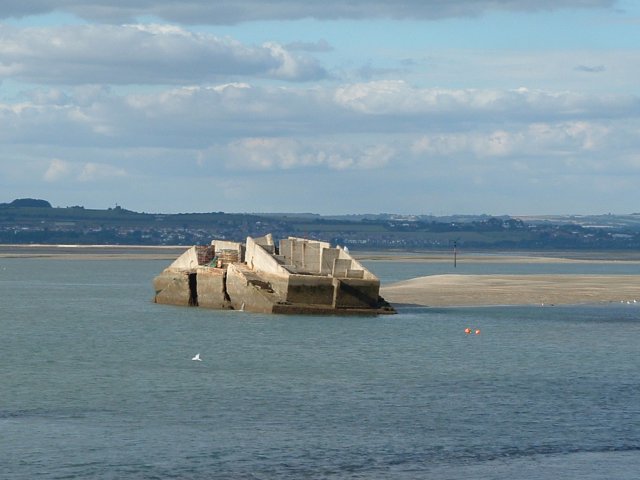
While doing the research on Operation "Starfish" in the last post, I also got distracted by the background to a huge concrete structure that has sat at the bottom of the (same) harbour for as long as I can remember..so thought I'd share..
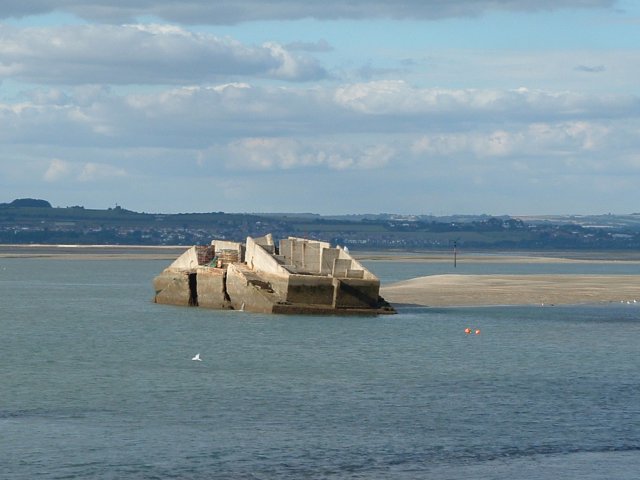
Putting this in context of "Starfish" - looking north - Farlington Marshes is left in the distance - the white line is the dyke around it..  Fort Purbrook is up on top of the hill..

This structure was built sometime between 1943 and 1944, and was intended for use as part of the Mulberry Harbour off the Normandy beaches post D-Day. Most people are aware that Mulberry was the code name for the artificial harbours (there were two) intended to assist the allies with offloading supplies and reinforcements direct from the beaches, what is lightly less well known is that each stage/part of Mulberry was formed of multiple parts..  along with scuttled ships, these concrete caissons were intended to bolster, reinforce, and in some cases replace the ships as required and provide the outer breakwater..

The caissons were code named "Phoenix", the block ships were code named "Gooseberry", but there were also a number of other elements to the design (booms etc.) - the first reference link below is very good on the overall design.

My research would seem to indicate that the Phoenix in Langstone Harbour (I've put it's position - the circle - on the "Starfish" map just for context) is what would have been classed as a type C (the smallest)

There were four Phoenix type C's built on Haying, sometime between '43 and '44 as mentioned, and I originally suspected that they would have been built in that inlet just to the left of the "Holiday Village" label in the map, but the actual build location I've marked with a star - the tide flows fast through the harbour entrance, and the beach is quite steep but photographic evidence [clicky] would indicate this was the construction site location - it's handy for Sinah Common, which as we already know had an anti aircraft battery.. 

The following picture was taken at Stokes Bay, which is just along the coast, but gives an idea of what a Phoenix beach construction site must have looked like at the time, albeit they made the bigger one's, type B's, at this site..

Returning to the particular Phoenix that started off this whole (enjoyable) rabbit hole I dived down, well unfortunately it developed a fault after it was launched so was towed to it's current position and just left - over the years it has broken it's back in two places but gives a good view of the internal separation/walls.

Once the caissons were built the usual method of hiding them from enemy aircraft attention was to sink them until they were needed - the Hayling Phoenix's were sunk off Pagham until required (x marks the spot)..the caissons had a water inlet, centrally controlled, in the bottom of each segment - open them and they took about 20 or 30 minutes to sink..  to refloat them, close the inlet and then suck the water out with pumps..

Unfortunately, before the other three were used, another was found to be faulty so only two of the Hayling constructions were eventually towed to Normandy and used.

Local records show that some 500 workers to construct them were billeted at St Mary’s hospital (which, apropos of  absolutely nothing, was the hospital I was born in! 😁), which is interesting as St Mary's Hospital is on Portsea Island so that would imply some kind of ferry service to take them to and from their work - I wonder if it used the same route as the ferry that still operates to this day, or whether it stopped further over, in Milton, at the Portsmouth end so as to be handier for the hospital site (which in turn prompts another idea for a military local history link!)
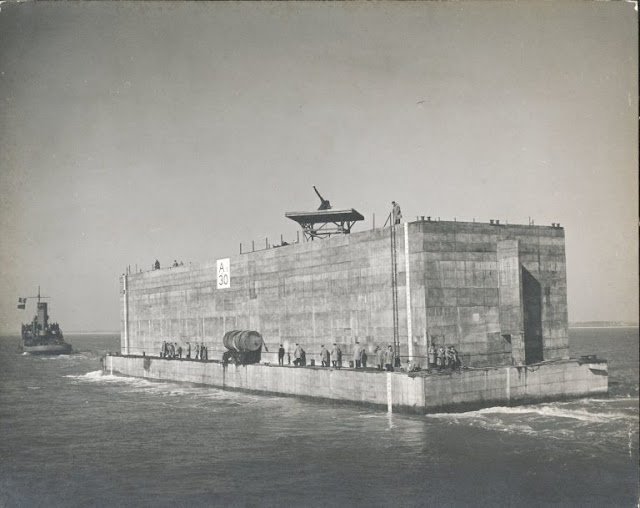
Type B being towed across the Channel - sailors give an idea of the size - note the temporary anti aircraft protection on top

Further reading:

~~~~~~~~~~~~~~~~~~~~~~~~~~~~~~~~~~~~~ 

 Laters, as the young people are want to say...