Showing posts with label ECW. Show all posts

Saturday, January 31

Attack on Brill - setup and game..

Time for another update..  and a game for once, a vaguely historical refight of an actual engagement in the English Civil War - the Attack on Brill - which was promoted by a post on Farcebook by the excellent Battlefields Trust

~~~~~~~~~~~~~~~~~~~~~~~~~~~~~~~~~~~~~

Historical background.. 

December 1642, and after their defeat at Turnham Green and their subsequent withdrawal to Oxford, the Royalists had established winter quarters for their army in the towns and strategic points around their new capital. 

Banbury, Reading and Abingdon were major garrisons but others, like Wallingford, Burford and Islip guarded important crossings of the Thames and its tributaries. Then to the east of Oxford there were a number of small garrisons in Buckinghamshire, there purely to retain their control of the county - one such garrison was established in the small hilltop village of Brill. 

Worth noting that the village was equidistant between Oxford and Aylesbury - roughly 15 miles from each but slightly closer to Oxford..

The village had been an important royal manor during the Middle Ages, but in the December of 1642 was home to two Royalist Lancashire foot regiments, under Lord Molyneux and Sir Gilbert Gerard, who proceeded to fortify it with banks and ditches around the church. 

The nearest Parliamentary garrison was at Aylesbury. There, Colonel Arthur Goodwin the Parliamentary Commander-in-Chief for Buckinghamshire, had three foot regiments (Bulstrode's, Holmstead's and Tyrell's) along with his own regiment of horse and Browne’s Regiment of Dragoons. 

Portrait of Arthur Goodwin in about 1639 by Anthony van Dyck

Goodwin had decided to eliminate the Royalist presence in Brill, and marched out of Aylesbury in late January with his horse, Homestead’s Regiment of Foot, and Colonel Browne’s Dragoons but he also had with him two pieces of ordnance (described as sakers [clicky] ie. slightly smaller than a 6pdr) in order to breach the defences. 

The refight..

Parliamentary entry point is bottom of table..


...with a church and village, surrounded by makeshift earthworks

Royalists deploy within the earthworks

OOB:

Royalist:

All regular foot, and at full strength (6 Strength Points or SP)

  • Charles Gerard's Regiment of Foot
  • John Belasyse's Regiment of Foot (standing in for Molyneaux's)
Parliament:

All units are regular and at full strength (6 SP)
  • Brooke's Regiment of Foot (for Homestead's)
  • Gramson's Horse (for Goodwin's)
  • Wardlowe's Dragoons (for Browne's)
Scenario specific rules:
  • Rules will be my SYW variant [clicky]
  • It seems likely that the sound of gunfire would clearly have been heard in Oxford which was only 12 miles away, so I am also assuming that there was a clear need to get this done quickly - my moves are quite short in terms of time so the scenario is limited to 15 turns (roughly two or three hours)
  • Artillery ammunition was not plentiful at the time [clicky], and as this was also a bit of a flying column, I'm assuming Goodwin didn't bring a lot with him - the guns are therefore limited to 10 shots between them (ie. 5 each)
  • I am going to assume* the earthworks were not substantial as the Royalists had only arrived in December, and Goodwin attacked in January - so they would be almost trenches with a raised parapet. Accordingly, each earthwork section is worth 3 SP's, once this is reduce to 0 by any artillery fire (only) that section is removed... 
* This is probably an unsafe assumption, but I have done it for playability reasons, as normally an assault on a fixed and defended position needs a clear 3 or 4 to 1 advantage (if I had been Goodwin, I would have brought both the other foot regiments with me, and probably any other units I could scrounge or lay my hands on as well. Shock and awe always works...😏) 

The refight:

Initial deployment was as follows..  Goodwin's sole foot regiment on the right flank - then cavalry in the middle, and the dragoons ready for a quick advance on his left. The sakers are deployed on his far right on a slight knoll..


In the village - following - the Royalists are limited in what they can do, so both regiments sit waiting while 'enjoying' the hectoring of the local monk.. 😁


I figured the real Goodwin wouldn't do anything before his sakers had done their work, so other than a general advance to just outside of musket range by his foot and horse, the only other major tactical move for my fictional Goodwin was to send his dragoons off to one flank - when the time came for an assault then an attack on two fronts could only help..  the following shows about move two., with the general advance by the horse and foot, and the flanking move by the dragoons..


..note the purple dice in front of the earthwork section in the following - the sakers are doing their stuff..


...and the plan worked surprisingly well - one of the trench sections has been blasted into nothingness (black pom poms - see following) and the sakers then switched what was left of their fire to the now unprotected Royalist foot regiments..

To forestall the inevitable, and because if they just sit there they're going to continue being shot at by the artillery, Belasyse's charge down the hill into Brooke's, but are repulsed bloodily and rout (see following - red dice). Meanwhile the Parliamentary dragoons are ready to climb the hill - the intention is to occupy the church, the cavalry also stand ready...


In the next turn Belasyse's recover their moral though, and halt shaken, only for Brooke's to then charge up the hill, banners flying (the mental image puts me in mind of Sir Bevil Grenville leading his Cornish regiments up that hill at Roundway 😊). Unlike the Cornishmen though, and against all the odds, Belasyse's stand and send the 'Butchers and Dyers' reeling down the hill in rout!

Regrettably though, it was all too late for the Royalists, the Parliamentary dragoons had now occupied the church and were peppering Gerard's with musket fire from their flank, and Goodwin's horse now charged up the hill causing Belasyse's to rout from the village and the hill. 

Then Gerard's also failed their morale and followed them, Gerard and Molyneaux cursing and trying to rally them as they went, and Goodwin advanced and took control of the village..


Just a small action in the greater picture of the war, but a much need propaganda fillip for Parliament I think..

Post Match Analysis:
  • what a fantastic little game - in the end we got nine full moves in, and I had no idea that the Parliamentarians would be so successful, but they did get good dice throws, the sakers were very effective, hitting 60-70% of the time 
  • still felt that it all rested on a knife edge though, so the scenario specific rules worked..
  • butchers bill was as you would expect - Parliament losing 6SP's, 50% casualties. The Royalists lost 3SP's, just less than 20% casualties (not counting the sakers in the overall total)
...and what actually happened??

Arriving before Brill on the 27th January, Goodwin had ordered Homestead’s foot regiment to assault the defences as the artillery opened a breach. Browne’s Dragoons were to stand-to until the breach was affected at which point they were to also launch their attack. Unfortunately, due to some confusion, the Parliamentary artillery did not concentrate its fire long enough to affect a breach and although Homestead’s men launched several charges, their firing was ineffective against the earthen defences. 

The fighting continued for two hours, but the Parliamentarians could make no impression on the defences. They were eventually forced to retreat due to the Royalist’s use of a smokescreen to drive away the attackers as detailed in a letter to Parliament: 

‘The Fight continued two houres, the Parliaments forces not giving way on one side in all that time; but at last the winde, and so the smoke being so in the face of them, which was made greater by wet straw which the enemy set on fire, they retreated, which the enemy perceiving made out after them in great triumph, pursuing them 4 miles with their horse...’  

(I wonder where that horse came from, reinforcements from Oxford I wonder?? Google tells me horses can trot at between 8 & 12 mph, and Brill was only 15 from Oxford - so given the battle/skirmish lasted a couple of hours that would have given the Royalists time to put a relief force together and also get there in time.. Theoretically.. 😏)

The Parliamentarians claimed that they lost between 10 and 17 dead including a captain, but the Royalists claimed (a probably highly exaggerated) 70 killed. 

Following the battle, the Royalist’s reinforced the garrison with cannon and sent tools to further improve the fortifications. 

Although Parliamentary forces moved up to Brill on a number of further occasions, the garrison was never attacked again and in April, needing troops to help relieve the besieged garrison at Reading, the King withdrew the garrison in order to reinforce the Oxford Army

Brill was not occupied again, except in passing, for the remainder of the war. 

More Reading:

~~~~~~~~~~~~~~~~~~~~~~~~~~~~~~~~~~~~~ 

 Laters, as the young people are want to say...

Saturday, July 27

"Firing into the Brown" #55 - Souastre foo-bar, Wesencraft and stuff..

"So Carnehan weeds out the pick of his men, and sets the two of the Army to show them drill and at the end of two weeks the men can manoeuvre about as well as Volunteers. So he marches with the Chief to a great big plain on the top of a mountain, and the Chiefs men rushes into a village and takes it; we three Martinis firing into the brown of the enemy".

Kipling "The Man Who Would Be King"

Time for another update..
~~~~~~~~~~~~~~~~~~~~~~~~~~~~~~~~~~~~~

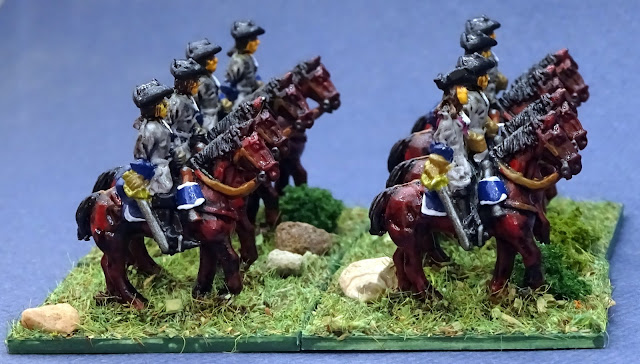
Another in the occasional "regiments of renown" series featuring the histories (such as they are in some cases, and notably in this one) of various regiments painted in haste at the beginning of a project but not documented here for posterity.. so we come to French cavalry regiment "Souastre" part of my War of the Spanish Succession collection..

Probably already known to the aficionados (which covers my reader for sure😏), but unknown to perhaps the majority, but in 1671, a royal order instructed that the French cavalry were to have buff leather coats, cloaks and good boots, and be "dressed in good grey cloth lined in the same colour" (except for the royal units, these were to "be dressed in dark blue..."). 

This order was followed well into the 18th century, but with the buff coat becoming a waistcoat by the time of the War of Spanish Succession. The vast majority of these "grey regiments" then adopted red as the facing colour (coat cuffs mostly) but a few regiments were distinctive as they used the livery of their colonel as the facing colour, and the colour for the saddle cloth and housings (ie. the cloth pistol covers on the saddle) and this regiment was chosen purely because of this, as I wanted a change from all the grey and red hordes, and they had the blue facings you see here..  

..and the foo-bar? Well this regiment never served in the War of the Spanish Succession - they were one of a few 'seven year wonder' regiments that Louis raised in 1691 for the Nine Years War (very much the appetiser for the later war), and the regiment was then disbanded at the end of the war (actually, a year later.. 1698) but was never reconstituted when the War of the Spanish Succession opened a mere three years later...  ah, well..  never mind...  😀

I know nothing about the service of the regiment during the war - orders of battle for the Nine Years War are very few and far between - but my assumption is that they would have been raised near the town of the same name in the Pas de Calais area (north east France - so think Calais/Channel ports) and therefore I'm guessing they would have served in the campaigns in Flanders - might have been at Steenkirk?? maybe??

I did manage to find this however, which provided a delightful rabbit hole to disappear down for a few hours...

Actual commission of company captain of the Souastre cavalry regiment for Jean-Guillaume Fruict, awarded at Versailles on 16 December 1691. Fruict had previously been a captain in Guines regiment; thanks to this promotion he became captain of the Souastre regiment.

So what do we know of Msr. Fruict? Not so much, just a few snippets... 

He was baptized February 23, 1653 in St-Étienne (Lille), so would have been about 38 or 39 when he got the commission, which would have put him in command of a company of troops counting somewhere between 40 and 60 men; three companies would then make a squadron, and most cavalry regiments would have had about 6 companies, so 2 squadrons so ~260-340 men in total. By 1698 when the regiment was disbanded he'd be late 40's and I would have thought that was getting old for such a demanding role, and it may account for their being no further mention of  him in any military sense..  he simply retired/disappeared..

He died at at the age of 64, on April 1, 1717. Sounds like an enterprising gentlemen as he married late, in 1711, to a lady called  Marie Joseph Butin, who was 26 years younger than him..  they had two daughters born in 1707 and 1709, so both were legitimised by the marriage!😁

I think the regiment was under the overall command of a Mestre de Camp (Colonel) Wallon (NB. not Walloon) and have found reference to him being the oldest Colonel in the army at the time the regiment was disbanded..  he was not without influence, as he was married to one of the daughters (name unknown) of the immensely rich and powerful Étienne Chérade, Comte de Montbron, but I know nothing more about him than that..

Regiment painted some time in 2007 (pre-Blog!) and comprising 15mm Dixon Miniatures..

Sources:

~~~~~~~~~~~~~~~~~~~~~~~~~~~~~~~~~~~~~~~~~~

..just finished reading (again) this Charles Wesencraft book I managed to get on eBay "With Pike and Musket: Wargaming the 16th and 17th Centuries" and decided to put up a review...

Book is 185 pages long plus 2 or 3 pages summarizing the rules described in the book.

The actual rules section of the book comprises approx. 50 pages, the rest of the book is about army organization (he uses a few sample armies of the period focusing purely on Elizabethan, Elizabethan Irish, English Civil War, and the New Model), and typical weapons of the period. The two chapters are interesting (I hadn't realized the importance of the halberd in the earlier par of the period) but pretty basic - no in depth analysis as you would expect in what is primarily a wargaming book - he does have a good and extensive bibliography for more detail on these aspects.

The rules are interesting - considering that they were written in the mid-70's, there are a number of concepts that are not unheard of in some of the more modern rules.

In summary:
  • Figures are single mounted
  • Movement is pretty normal and as you would expect
  • He deals with weather in some detail as given the armaments of the time it was important - matchlocks are particularly susceptible to wet… to track weather in the game he postulates a weather gauge. Throw a dice at the beginning of the game to decide the opening weather and then a dice throw each move will either move a counter up or down the gauge, or not - making the weather better or worse depending on where the starting position on the gauge is…
  • Movement is alternative - Mr Wesencraft explains in detail why he thinks it is the better approach and I don't disagree with him! Each move comprises:
    • Side A move
    • Both sides fire
    • Side B move
    • Both sides fire
  • Then we have a chapter on an element of gaming not touched on much at this time - Charles describes how each unit has an efficiency rating that effects how it will perform in the various actions it will take in the game (firing, melee, morale checks, etc.) The efficiency rating is diced for and kept secret from the enemy, and from that point is reduced as the game continues reflecting the decrease in efficiency of the unit. It can temporarily improve (eg. as a result of a staff officer joining the unit, being under cover etc.) but can also temporarily decrease (eg, by attack in flank or rear) or get permanently reduced as a result of casualties or running away from a melee… much food for thought in this chapter!
  • Then he explains the role of the staff officer (primarily efficiency improvement) and the standard bearer (also efficiency improvement - something for the enemy to try and capture as taking it away will result in an automatic deduction in efficiency!)
  • For infantry firing he uses a casualty table explaining why he doesn't throw a dice per man, or a dice per number of men - well explained… artillery strength is decided by number of crew (typically 3 crew men when full strength representing a battery of three guns) artillery throw one dice per crewman/gun - using the same table..
  • For melee he has a pre-melee reaction test for both sides - and when melee is enjoined he has a mechanism based on the efficiency of the unit, their weapon, and the number of figures, which then re-uses the firing table… very effective…
  • He finishes off with a section on how to work out which figures are removed as a result of a unit taking casualties, and a final chapter in the unit record sheet - which he then uses to maintain records for each of his units describing how they fought, what battle honours they won, etc. Really nice idea..
The rest of the book - 100+ pages - is general descriptions of battles in the period, but described in terms of his rules, figure scales, etc. Irrespective of their historical context, there are some excellent sources of scenario's here..

... on the whole I would say this was well worth the money, and at the time must have been quite cutting edge in terms of some of the concepts he describes. It was a good read and I would still wholeheartedly recommend it..

~~~~~~~~~~~~~~~~~~~~~~~~~~~~~~~~~~~~~~~~~~

Laters, as the young people are want to say...

Saturday, January 20

"Firing into the Brown" #37 - Dams, Solitaire and stuff..

"So Carnehan weeds out the pick of his men, and sets the two of the Army to show them drill and at the end of two weeks the men can manoeuvre about as well as Volunteers. So he marches with the Chief to a great big plain on the top of a mountain, and the Chiefs men rushes into a village and takes it; we three Martinis firing into the brown of the enemy".

Kipling "The Man Who Would Be King"

Time for another update..
~~~~~~~~~~~~~~~~~~~~~~~~~~~~~~~~~~~~~

Bit of a (delightful) rabbit hole this one..  while doing the research on the arches in the last post, I heard mention of the fact that the creek had dams at each end..  I had no idea, but when you think about it it makes sense if you want to use gunboats as an additional line of defence in what is a tidal creek..

Bit of orientation, following..  top of the page is North, the remains of the (only) dam left is ringed in red, the Lines are outlined yellow, with the separate moat in front, I've ringed the remains of the old road bridge (from the last post) in blue. My guess is that the western dam disappeared as part of the land reclamation for the Hilsea 'wall of death' (that big roundabout on the left).

This used to be one of my regular cycle routes to work, so I've looked at this feature for years, never knowing it was the remains of a dam..  this - following - is the one ringed red in the map..


An army report on the status of the Hilsea Lines made in 1853 mentioned that the creek was filled with weeds to the point where for 3 to 4 hours every day it could be walked across (!) so later in the decade, as part of upgrade works on the Hilsea Lines, the creek was widened and deepened to allow it to be used by gunboats.

Dams and flood gates were constructed at the ends of the creek to allow it to be kept it in water at all stages of the tide.


..the Lines are behind that line of tree's in the distance (following)..

Which opens me up to another delightful rabbit hole kicked off by this little ramble - what kind of gunboats were they?! 😏

~~~~~~~~~~~~~~~~~~~~~~~~~~~~~~~~~~~~~ 

Anyhoo..  enough local history (apologies, but it is my blog and I find it fascinating.. 😀) and time for some gaming..

Just after Christmas, with my Christmas present vouchers grasped in hot sweaty hand, I obtained the item left from Amazon (other online monolithic shopping experiences are available). This was based on positive feedback on a couple of board game/solitaire board game Farcebook groups I belong to..

Mike (Lambo) has a fair few published booklets/games, but given the subject matter this was a bit of a no brainer for me..  what do you get for your (very reasonable) amount of money?

An A4 size booklet, printed on good paper, and strongly bound (I have forced this open on some of the pages in order to play a game and there's no sign of the pages getting loose or giving up the ghost). 

There's 50 plus pages, comprising a dozen or so pages describing the (fairly simple) rules, and more specifically the AI for the programmed opponent, but the meat of the book is the 15 separate scenario's (battles) with the battle specific deployment rules and OOB's...

The following an example of how it looks - this is the second battle in the book and is a screenshot of the final move of one of my attempts to win the game (I've played twice and not one this one yet)...  


The rules are fairly simple, but there is enough meat in there to give you pause for thought and you do have to think about what you're doing. The AI for the automated opponent is good, and is quite detailed with responses for each troop type (only 4 types by the way; Musket/Pike/Cavalry/Cannon)

So far I've played four times, and I'm two all against the AI - each game lasts about 15 to 20 minutes, and the way I am playing it is to scan the maps and counters into my PC and then use GameMapr* as the playing medium - moving the counters around on the online map.

*I've had GameMapr for years, but can't find an online site where it can be downloaded, but I suspect you could use any graphics program to do the same thing ...

~~~~~~~~~~~~~~~~~~~~~~~~~~~~~~~~~~~~~ 

 Laters, as the young people are want to say...

Saturday, December 9

"Firing into the Brown" #32 - Thomas Ballard's Regiment of Foote completed, Dickens, beer and stuff..

"So Carnehan weeds out the pick of his men, and sets the two of the Army to show them drill and at the end of two weeks the men can manoeuvre about as well as Volunteers. So he marches with the Chief to a great big plain on the top of a mountain, and the Chiefs men rushes into a village and takes it; we three Martinis firing into the brown of the enemy".

Kipling "The Man Who Would Be King"

Time for another update..
~~~~~~~~~~~~~~~~~~~~~~~~~~~~~~~~~~~~~

Thomas Ballard's regiment have now been based and flagged..  job done..

Considering that they were the first little metal men to receive the tender ministrations of my paint brush since March the year before last, I'm reasonably happy with these..  the paint brushes hadn't fallen apart, and the paints were still vaguely liquid!

These were painted using my usual technique - black primer, damp brush all over with white, and then start blocking in colours...  rather than normal paint I use inks wherever possible (as they self shade when you have the   black primer/white dampbrush combo). I then apply washes over any normal paints to dirty them down - these guys are supposed to look like they are on campaign, not the parade ground. 

Washes, b.t.w, were venerable bottles of Games Workshop 'flesh wash', 'armour wash', and some newer ones from Vallejo in the form of Umber and Sepia 'Game Wash'.


So there you have them - Thomas Ballard's Regiment - as present at the Battle of Edgehill - painted December 2023 - 24 figures - mostly Peter Pig with a leavening of Steel Fist (officer/drummer/ensign and the kneeling musketeer)

~~~~~~~~~~~~~~~~~~~~~~~~~~~~~~~~~~~~~ 

That time of the year again, my regular reader will know that as Christmas approaches it is my want to read a Charles Dickens book, so it's Dickens time again! 

Here's the 'Christmas Dickens' timeline to date...

  • 2013 - "David Copperfield" (9/10)
  • 2014 - "Nicholas Nickleby" (exceptional)
  • 2015 - "Oliver Twist" (8/10)
  • 2016 - "The Old Curiosity Shop" (7/10)
  • 2017 - "A Tale of Two Cities" (7/10) and "A Christmas Carol" (9/10)
  • 2018 - "Great Expectations" (10/10)
  • 2019 - "Bleak House" (8/10)
  • 2020 - "Little Dorrit" (retired hurt - no score 😏)
  • 2021 - "Our Mutual Friend" (8/10)
  • 2022 - "Pickwick Papers" - brilliant... (9/10)
  • 2023 - "Dombey and Son" - stay tuned for a review...

My top four Dickens novels so far would be "David Copperfield", "Nicholas Nickleby", "Great Expectations" and last year's absolute joy, "Pickwick Papers" - "worst" (it's Dickens for goodness sake, how can there be a worse?), 'least enjoyed', was without a doubt "Little Dorrit" which was mawkish beyond extreme, but of which my opinion seems to be at odds with most other people - I may have to have another go at some point, as Dickens 'only' wrote 15 novels, and I've now read 11 (and a bit) of them...

This years Dickens, however, will be "Dombey and Son", of which I know nothing of the story, so a bit of a voyage of discovery...

~~~~~~~~~~~~~~~~~~~~~~~~~~~~~~~~~~~~~ 

Beer of the week:

..not had the opportunity to try this before but a couple of pints yesterday confirmed my initial view that this is a  lovely pint..  clean tasting, very fresh golden ale brewed with green East Kent Goldings hops as soon as they are picked... kind of a Beaujolais nouveau of the beer world..  I'll give this one a 7/10.. 😀🍻

~~~~~~~~~~~~~~~~~~~~~~~~~~~~~~~~~~~~~ 

Laters, as the young people are want to say...

Saturday, December 2

"Firing into the Brown" #31 - "You cowboy", Thomas Ballard's Regiment of Foote, and an anniversary...

"So Carnehan weeds out the pick of his men, and sets the two of the Army to show them drill and at the end of two weeks the men can manoeuvre about as well as Volunteers. So he marches with the Chief to a great big plain on the top of a mountain, and the Chiefs men rushes into a village and takes it; we three Martinis firing into the brown of the enemy".

Kipling "The Man Who Would Be King"

Time for another update..
~~~~~~~~~~~~~~~~~~~~~~~~~~~~~~~~~~~~~

Been a while, but little metal men have appeared in the manse..


Cowboys!🤠


...and a wagon.. 😀


Very much enjoyed the little set-to at Long Bute Farm [clicky], and promised that for the next set-to I'd try the 2nd Edition rules, but in order to do that I wanted some pukka cowboys rather than my ACW stand-in's...  I've gone 15mm thinking they would fit my existing Sudan/desert terrain as I have a feeling, I'd like to set these games somewhere on the Mexican border (and indeed one of these bags does indeed feature some Mexican bandoleros!)

Not painting all of them, just enough for four or five a-side..  a selection are already mounted on pennies, the wagon constructed, all of them undercoated and ready for the brush... 

~~~~~~~~~~~~~~~~~~~~~~~~~~~~~~~~~~~~~ 

From the freely available online
 Osprey Elite - "Soldiers
 of the English Civil War 1: Infantry"
 link in the ECW Project Blog
Couldn't help noticing the other day while playing the ECW game that the two sides of the project are currently slightly unbalanced as the Royalists have six regiments of foot completed, whilst the Parliamentarian army only has five..  time to remedy that!

Looking at the order of battle for Edgehill that I am using as my "starter for ten", I picked Thomas Ballard's Regiment, purely because I had only painted one other regiment in the brigade..

My main source for information on the battles, leaders, and regiments of the British Civil Wars is the BCW site, but I've noticed that it is currently unavailable so have had to revert to the last scanned copy of the site on the Wayback machine..  I hope the owner is OK, as the site is an absolute gold mine of information..  link in the ECW Project page has been updated to take you to the saved version of the website, by the way..

There's not a huge amount of information available about either Sir Thomas Ballard, or indeed his regiment, and that's mostly because the regiment (and him to an extent!) were a bit of a one hit wonder..

The old Sealed Knot website for the reenactment of the regiment was good for the history, though - link here:

Col Thomas Ballards - Ballards in the Civil War (archive.org)

So, to summarise the information there, it seems: 

  • Thomas Ballard was born in 1600, and was the 3rd (and only surviving) son of Henry Ballard.
  • The family lived in Southwell near Nottingham/Newark, and also owned property in Lincolnshire. That becomes important later..
  • He served under Lord Grandison in The Bishops War, and there is mention (but little documentary evidence) that he also served abroad in the 30 Years War.
  • I think it probable that he did serve though, as Parliament saw him experienced enough to appoint him to command and recruit a regiment (one of five) for service in Ireland, following the rebellion there in the spring of 1642. Only one was actually sent abroad, and the others (including Ballard's) were incorporated into the Parliament army at the start of the war.
  • Ballard's apparently were under strength and marched later than the other regiments, but by October the regiment was complete and had joined the Earl of Essex's army in the Worcester area. 
  • At this time Ballard was appointed Sergeant-Major General of Foot (similar I guess to Brigadier) and had command of four regiments - his own, Essex's foot, Lord Brooke's and Denzil Holles' totalling 3604 men excluding officers. Ballard's numbered 776 men and 33 officers with the men formed into 10 companies. 
  • At Edgehill. Ballard's brigade was in reserve, positioned on the left centre of the army, behind Charles Essex's brigade. 600 musketeers from the brigade were detached to the left flank to counter Royalist dragoons (200 of these were from Ballard's). Royalist cavalry charges on both flanks routed the Parliamentary horse and must have had a devastating effect on these musketeers as there was no no pike support. 
  • Rattled by both the defeat of their cavalry and pressure from the Royalist foot, the brigade in front of Ballard's broke and ran but despite this, Ballard's four regiments stood firm and engaged the opposing foot, helped by two regiments of Parliament cavalry that had been in reserve - this turned the course of the battle.
  • The battle ended in a stalemate, but the losses suffered by Thomas Ballard's Regiment were dreadful - the brigade as a whole is estimated to have lost approximately 40% of it's strength. but Ballard's lost nearly 45%; 776 men down to 439 - two company commanders had been lost and two companies formerly of 80 men were down to 19 and 15 each.
  • There are no further records of the regiment participating in any major actions as the reduced unit was relegated to a Garrison unit and in in Aug 1643 Thomas Ballard himself left to take up a command in the Midlands and the regiment was taken over by it's Lt-Col, Francis Martyn. From May 1644 to October 1645 the regiment formed the garrison of Aylesbury. A few of the officers seem to have been continued in pay until spring 1646. . 
  • Ballard himself fell from favour after the attack on Newark failed. Some accounts have it that he did not pursue the attack as fiercely as he might because he still had friends in Newark (told you that was pertinent.. 😁). It is believed that he subsequently left England (he apparently applied for a pass to do so from Parliament) and may have been buried in Rouen, France or emigrated to America (where there were several Ballard's amongst the early settlers despite it not being a common name) or even joined Henry Morgan in Jamaica (!).

Painted - not yet based - bear with..

From The Cromwell Association Online Directory of Parliamentarian Army Officers:

  • Thomas Ballard Colonel of a regiment of foot in the earl of Essex’s Army from or by 12 Aug. 1642. On 6 Jan. 1643 he was paid a month’s salary as colonel of a brigade from 9 Dec. 1642, and as colonel of a regiment and captain of a company from 24 Dec. Ballard was still colonel as late as 31 July 1643; however, he left in the summer to campaign instead in the Midlands and the regiment had passed to Francis Martyn by 25 Aug. 1643. References: TNA, SP28/1a/66, SP28/5/39, SP28/8/224, SP28/9/187.

~~~~~~~~~~~~~~~~~~~~~~~~~~~~~~~~~~~~~ 

...and the Anniversary?? Well the 27th November just gone, marked the 17th Anniversary of the first ever blog post here on the "Random Musings"..  where the hell did those years go???! 😱

Laters, as the young people are want to say...
Sunday, November 19

"Firing into the Brown" #29 - "Battle of Grimpen Mire" (OHW #24), and the Lines

"So Carnehan weeds out the pick of his men, and sets the two of the Army to show them drill and at the end of two weeks the men can manoeuvre about as well as Volunteers. So he marches with the Chief to a great big plain on the top of a mountain, and the Chiefs men rushes into a village and takes it; we three Martini's firing into the brown of the enemy".

Kipling "The Man Who Would Be King"

Time for another update.. and about bleeding time too..  eight months since the last one, foresooth!

~~~~~~~~~~~~~~~~~~~~~~~~~~~~~~~~~~~~~

I suppose it behoves me to at least apologise to my reader (you know who you are, Jim 😄) for my prolonged absence but what can I say - I was busy elsewhere, the wargame mojo left me for a while (well at least the desire to apply paint to little metal men, and set up tables for games anyway - reading in the subject however, was unaffected), it was my first summer as a retired person, so the boat, and Gertrude played a significant part in my absence - the weather (for the first part of it anyway) was glorious, and inconducive to sitting in a stuffy loft...

Clearly however, the mojo is now stirring..  😏

~~~~~~~~~~~~~~~~~~~~~~~~~~~~~~~~~~~~~ 

Based on scenario #24 in Neil Thomas's "One Hour Wargames" I thought it long overdue to get the English Civil War little metal men out for a run..  last game was February..

The scenario posits that one army is trying to clear enemy control from a major road that provides them with both supply and communication. The fly in the ointment though is that while they have superiority in force, their ability to use those forces is constrained by the fact that there is terrain either side of the road that is impassable/unavailable to them...  

West of the road is a dense wood that not only have they have not managed to reconnoitre, but of which they have intelligence it is hard going, and not passable. Meanwhile, East of the road is Grimpen Mire*, a supposedly bottomless marsh of sucking water and soft mud providing no footing or passage for any troops. There only routes north to south then, are via the road, or on either flank.

For this scenario, the Royalists (all regular quality troops) are the attacker and comprise four regiments of foot, one regiment of horse ("galloper") and a regiment of dragoons. Parliament (also all regular) comprises three regiments of foot, and  regiment of dragoons. Both sides were rolled for on the random tables in "One Hour Wargames", substituting "skirmishers" for dragoons

Parliament starts the game with all units on the table but is allowed to have one of them deployed in the woods - following shows the position at move one with the Royalist attackers just appearing at top..  

Parliament has deployed its dragoons in the wood (a logical choice I thought), but as the winning condition for the game is to have a unit within 6" of it at the end of 15 moves they have deployed all three regiments of foot to withstand any Royalist attempt to drive them off. 
 

The Royalists (following) are pushing all their foot down the road - column of march where necessary to move quickly. They gave sent their cavalry and dragoons down the east and west flanks. Parliament is turning their flank foot regiments to face the threat. Blue dice is the move counter so this is turn 3..


"Boom!" - following - and the muskets of both sides open fire as the Parliamentary dragoons and Sir Charles Gerard's Regiment of Foote exchange fire.. to the left John Belasyse's Regiment of Foote [blue flag] and Colonel Thomas Blagge's Regiment [St George flag] have taken advantage of the dragoons being otherwise occupied, to slip past..


It is all too much or the Parliamentary Dragoons (following picture) and after a couple of diabolical morale checks they re seen here routing from the field (bottom right) the Parliamentary commander desperately trying to rally them..  


It's about turn 9 from memory, and in the centre John Belasyse's Regiment (blue flag) have come to close quarter fighting with Colonel Charles Essex’s Regiment (yellow flag - musketry only - neither regiment could get the ascendancy to close to push of pike), no room on either flank for overlaps..  


..the Royalists are 'cab ranking' their foot regiments to maintain pressure in the event Belayse's break.


Here you go - following - we suddenly went back to 197'pffft... 😆

Crunch point of the battle - turn 11 - on the right Lord Wharton's regiment have formed stand of pike to receive horse but as is always the way the horse swerved and targeted Lord Mandeville's Regiment on the left where the Dragoons had dismounted and were providing flank support..  it was all too much for Mandeville's and they break and stream away past Wharton's..


Move 13 - following -  and I think it safe to say that the Royalists are in the ascendancy..  for Parliament Gerard's have finally broken but not before first having sent Belayse's off with a flea in their ear.. happily the Royalists already have a replacement to feed into the mincer in the form of Sir William Pennyman's Regiment, who finish them off 

Mandeville's (blue) continue to rout to the right/East accompanied by Gerrard's - all hopes for Parliament are now pinned on Lord Wharton's regiment (green flag) who stand like a rock - pikes ready to receive horse, but looking worriedly at Pennyman's - they have yellow dice so they're already shaken, but so are the Royalist horse - can they pull it off?? Can they last two turns??


Final move of the game - following - and no they couldn't...  they managed to see off the Royalist horse but the continued pressure from Pennyman's - with flank support provided again by the dismounted dragoons was in the end too much, and they break and rout ...


...pursued by Pennyman's (following)..  


Royalist mission accomplished - just in time!

Post match analysis..
  • Very close and enjoyable game even solo - and the scenario delivered exactly what it promised it would, a four foot table width is reduced to little less than 9" total available 'advancing room' for the attacker..  very clever..
  • I realised after I'd started the game that terrain placement is key to the game - with only one unit allowed in the woods, it was theoretically possible for the Parliamentary dragoons to just sit in the woods out of range of muskets, but within 6"of the road to meet the victory requirement..  such games'manship is of course is beyond contempt, below the salt, and unthinkable to any of my reader..
  • * thanks Sherlock.. 😀

~~~~~~~~~~~~~~~~~~~~~~~~~~~~~~~~~~~~~ 

Since the completion of the little local history project based on the Portsmouth canal [clicky] which I enjoyed immensely, the next local history investigation is the old Hilsea Lines [clicky] an 18th/19th-century fortification built between roughly 1858 and 1871 to protect the northern approach to Portsea Island/Portsmouth (not generally known that Portsmouth is built on an island, by the by) but more importantly to protect the key naval base...   the lines were rendered obsolete by advances in artillery technology even before they were completed, and never saw actual action, not even in WW2 where you might have expected a significant anti aircraft presence, but where I suspect the lines would have been too far away from the dockyard to provide meaningful cover..   bit of geography may help here:


Portsea island..  the Lines are highlighted, dockyard circled..

As always, the bogeyman causing the huge expenditure was fear of invasion by the French under Napoleon III - this amble concerns the central section - Bastion 3, specifically - see following - but over this winter I'll go and check the other sections as well, if Gertrude is willing..


Bastion 3 following.. these are the casemates - so this would be behind/south'ish of the gun line which would be firing from the other/north side, connected to these, internally, inside the mound..  


This is very descriptive; helps understanding of the construction and design.. 


Other direction to the first picture ..  so approximately 10 casemates in total in this bastion..


Artillery store entrance I think.. 


Stay tuned - this will be a slow'ish burner - I have details on the sallyport, but the other bastions I plan to visit over the winter..

~~~~~~~~~~~~~~~~~~~~~~~~~~~~~~~~~~~~~ 

 Laters, as the young people are want to say...  and hopefully not so long this time!