Showing posts with label Painting Total 2017. Show all posts

Monday, March 20

Charles Gerard's Regiment of Foote

My apologies for the delay - as these have been ready for some time.. been a mite busy painting bigger things [clicky] ๐Ÿ˜€

First of the units for the English Civil War project - these are Charles Gerard's Regiment of Foote
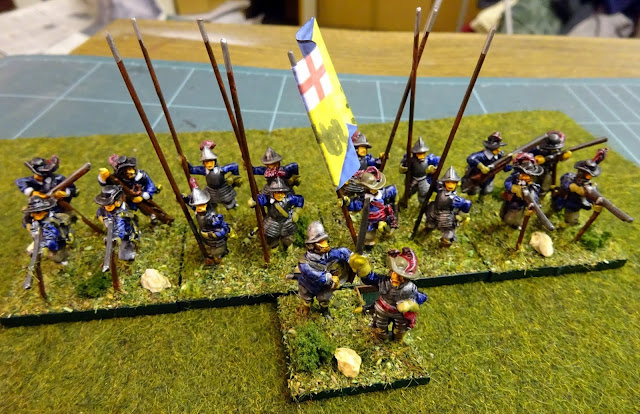

According to my research they were originally raised - probably in early 1642 - as part of the Earl of Derby’s forces in Lancashire, where they were present at the siege of Manchester in September, and at Edgehill (which is the the basis for this project) in October.

Deployed for receiving horse - hedgehog...

At Edgehill (where they numbered approximately 740) they were part of Charles Gerard's Brigade (along with Sir Lewis Dyve's and Sir Ralph Dutton's regiments) which were positioned on the front right of the Royalist deployment...

Picture courtesy Google Books

By all accounts they did sterling service anchoring the Royalist line at a time of most need


In November they were present at Turnham Green, before going into winter quarters as part of the Oxford garrison at the end of the year.


Tumbling Dice figures - 18 of them... 

On to Parliament next - one of Charles Essex's Brigade, I think (so Sir Charles Essex's regiment/Sir Henry Cholmley's regiment/Lord Mandeville's regiment or Lord Wharton's regiment)

More details here:

http://www.battleofedgehill.org/edgehill-battlefield-map/index.html
http://bcw-project.org/biography/charles-gerard
http://wiki.bcw-project.org/royalist/foot-regiments/col.-charles-gerard-oxford

Sunday, March 5

Arab dhow complete...

So just over a year after I first started the build [clicky] the Arab dhow is complete.. I suspect they don't take as long as that to build a real one... ๐Ÿ˜€

Quite pleased though..  I really couldn't justify spending the cash for a proper one and this was fun to make..


Masts are a bamboo barbecue skewer, and a plant pot support from some pot plant the current Mrs Steve the Wargamer got for Christmas, and which had now handily died..  sail is printer paper, drew the pencil lines on, then painted with Windsor and Newton Chestnut ink...


Hull and masts spray coated black, and then successive coats of mud brown in lighter and lighter shades..  the deck cargo came from one of my spares pots..

The intent with the crew (who are Peter Pig 15mm)is that the two bases will form one whole unit for the rules I use when they come storming ashore, commando-like, as a raiding party..


...so... somewhere in the Sudan, on the Nile just above the third cataract, an Arab dhow with it's crew of Dervish has nosed aground and sent a raiding party to the nearest village for supplies...


Tuesday, February 7

13th Indiana

The veritable painting frenzy that 2017 is thus far, continues with the arrival in the ranks of the Union Army of the 13th Indiana.. 
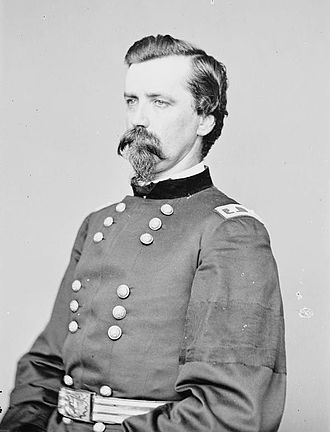
Robert "Sandy" Sanford Foster (courtesy Wikipedia)
The 13th Indiana Volunteer Infantry Regiment was organised at Indianapolis from volunteers in camp and was originally mustered for state service for one year, but was one of the first four regiments who extended that to three years. They were mustered into service on June 19, 1861.

Their commanding officer at Kernstown was Robert "Sandy" Sandford Foster (left) who was born in Vernon, Indiana in 1834; his pre-war career was as a tinner (or tin-smith).

Foster had enlisted as a private in the Indiana volunteers at the start of the war but was quickly promoted to captain in the 11th Indiana Infantry Regiment where he saw action at the Battle of Rich Mountain.

After these battles he was transferred to the 13th first as a major but shortly after was promoted to colonel (April 30, 1862) - from private to Colonel in a year, and still only 28 not bad for a tin-smith!


Foster went on to lead the regiment throughout Stonewall Jackson's Valley Campaign of 1862 until his regiment was transferred to southeast Virginia a few months after Kernstown (which is the focus for this wargame project).


The regiment went on to extensive action and was eventually mustered out on September 5, 1865. Apropos of nothing Foster was given a Brigade after the transfer to south east Virginia, but ended the war as a (brevetted) major general with a divisional command, interestingly he was also as a member of the commission which tried the Lincoln Conspirators. He retired from the army in September 1865 and lived to 1903.


During the war the the 13th Indiana Infantry lost 3 officers and 104 enlisted men killed and mortally wounded, and 2 officers and 146 enlisted men by disease. Total 255.


Figures as ever are by Newline, and their completion brings something of a halt to the project for the time being as I now have 1 regiment of horse, six regiments of foot, and one battery of artillery a side..  quite enough for a decent game on a six foot table..  I can see more of all types in the future but now I want to get the English Civil War project off the ground..!

Saturday, January 7

21st Virginia Infantry

Some paint has been sloshed - we are already guaranteed to have a better painting total than 2016! ๐Ÿ˜


Not sure what came over me but decided it was time I got the paint brushes out and before I know it these guys had been completed... let me introduce you to the 21st Virginia Infantry - another regiment of Stonewall Jackson's famed 'foot cavalry'...

The regiment was first organised in June, and mustered into Confederate service in July, 1861, at Fredericksburg, Virginia. As was usual at this time the regiment was formed from a number of separate (already existing) companies, as these tiny units concentrated they were simply grouped together and made into a regiment - in this case most of the men were recruited in the city of Richmond and the counties of Charlotte, Mecklenburg, Cumberland, and Buckingham. The regimental Colonel was William Gilham [clicky] (of the Virginia Military Institute), and the regiment eventually comprised ten companies, totalling about 850 rank and file.


After participating in Lee's Cheat Mountain and Jackson's Valley campaigns, the unit was assigned to J.R. Jones's and W.Terry's Brigade, Army of Northern Virginia. At Kernstown they were in the Brigade of Colonel Jesse S. Burks..

This regiment reported 60 casualties at First Kernstown and in May, 1862, totalled about 600 effectives (so 25% losses in less than 10 months!).


Colonel Gilham and Major Scott Shipp left the regiment on January 9, 1862 (so before Kernstown) to resume their duties at the Virginia Military Institute (though Shipp was to return to command the regiment until the surrender at Appomattox). At Kernstown, the regiment was led by their Lieutenant Colonel, John M. Patton (who was an ancestor of George S. Patton), after the battle the regiment elected him colonel
John M Patton Jr.

The regiment went on to serve at Gaines' Mill, Cedar Mountain, Second Manassas, the Bristoe campaign and the Mine Run operations (of November 26 to December 2 1863) before fighting in the Wildnerness campaign (where their brigade's losses here were very severe), Spotsylvania Court House, the crossing of the Monocacy River, Cedar Creek, and finally the defence of Petersburg.

It lost 37 killed and 85 wounded at Cedar Mountain, had 3 killed and 9 wounded at Second Manassas, and reported 4 killed and 40 wounded at Chancellorsville. Of the 236 engaged at Gettysburg about twenty percent were disabled


"When it was evident that they were to surrender at Appomattox Court House on April 9, the flag of the 21st Regiment was torn into pieces and distributed among the regiment's survivors.Only 6 officers and 50 men surrendered at Appomattox"


Figures are by Newline (20mm)

Onward and upwards, the figures destined to be the 13th Indiana are primed and on the painting sticks..