Showing posts with label Painting Total 2013. Show all posts

Wednesday, December 18

Zvezda 1/100 (15mm) Matilda Mk 1 Infantry Tank (A11) - a review..

Picture courtesy: http://tinyurl.com/n684nzz
Tank, Infantry, Mk I, Matilda I (A11) to give it it's full designation was of that peculiar breed known in the British army post WWI  as an infantry tank ie. it substituted speed for armour, and was intended to support the infantry in assault, whereas the cruisers fulfilled the old cavalry role..

The Matilda Mk I shares its name with the better known Mk II but in reality the tanks were completely different and shared no components or parts at all.

Designed by Carden at Vickers-Armstrongs in 1935 (you can see the similarity to the Carden designed Bren carrier in the running gear I think??) the army requirement was for something cheap that used standard components to also allow for easier maintenance..  which is exactly what they got...in reality however, the design was hopelessly outdated

So what do you get when you open the box? Very little - the kit is so simple they don't even provide an instruction sheet... 

There are just 6 parts on that sprue..


Which when cut off and clicked together give the following snappy little armoured perambulator...


So what was the tank actually like? Mixed bag, mostly bad, I'd say...

Hull and turret were well protected against the current crop of anti-tank weapons (Armour thickness: Maximum 60mm Minimum 10mm - NB. Panzer II max 13mm), but the tracks and running gear were completely exposed.

Armament was either the .303 Vickers MG or in some cases the larger .5 inch, so no anti-tank capability - this was real WWI thinking...

Maximum speed was 8mph (NB. Panzer II 25mph), but cross country no better than 5-6 mph - in fact there are reports that the infantry could move faster and often had to wait for the tanks to catch up.

 In addition to these other disadvantages, there were also crew issues; besides operating the machine gun the commander also had to direct the driver and operate the wireless (which was in the hull due to lack of room in the turret)...  in addition to the commander there was just one other crew (driver)

Nice detailing on the rear casing..
The first order for Mk 1 Matilda was placed in April 1937 (for 60), the tank remained in production until August 1940 at total of 140 were produced - most of them were left behind after Dunkirk. Remaining tanks in the UK were used for training only.

Last of all some pictures of the completed items....  with figures for scale - they are tiny!


References:
http://www.tanks-encyclopedia.com/ww2/gb/Matilda-MkI.php

Thursday, December 12

Zvezda 1/100 (15mm) Matador Truck - a review..

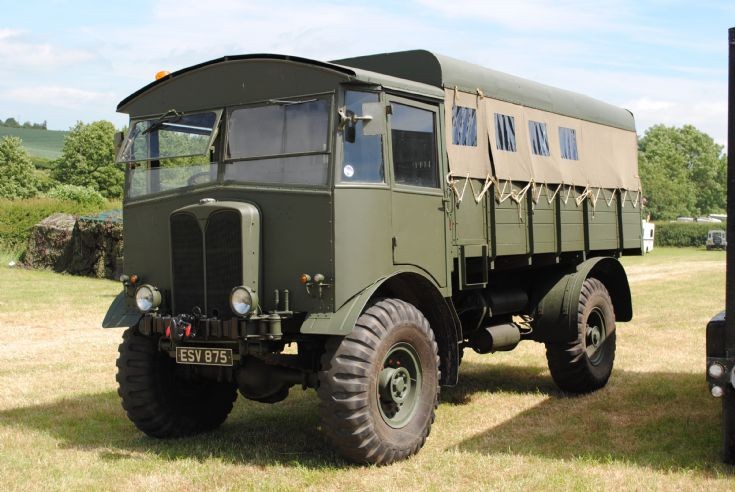
http://military-vehicle-photos.com.s3.amazonaws.com/10821.jpg
The Matador was built as an artillery tractor by Associated Equipment Company (who are probably most famous for being the builder of those iconic London red buses), for use by British and Commonwealth troops during WWII, so they are not strictly valid for the use to which I am about to put them, but they'll do..

This was a big old beast - 10 ton - and to fulfil the gun towing requirement was fully 4 x 4. AEC built nearly 9000 of them in total, the majority going to the army but a few went to the RAF. It also had a few interesting variations - in the desert they used them with a 6Pdr anti-tank gun on the back in a portee role (this was called "Deacon"), some of them were also converted to use as command posts (I have one of these see following)
AEC Matador converted to armoured command vehicle - designated "Dorchester" (after the hotel!)
- this one is Minifgs 10mm, and in my WWII North Africa collection
So what do we get in the Zvezda box when we open it - something very similar to follows - in fact exactly like this...  


Two sprues, instructions, and a couple of cards with detail for Zvezda's own WWII rules...  once the parts are taken off the sprues (I use a scalpel) you end up with the following:


Very clever - no glue is needed - the fit is absolutely superb...  there's some very clever pieces of design int his kit - a couple of little cross members that provide support to both floor, side panels and roof in particular...  the cab is a triumph - five panels plus roof to give that unique shape...


So when it goes together it looks like this - fit is very good - if I was anal I might want to fill those gaps but happily I'm not...

 
Last of all, a couple of pictures of the completed model with some 15mm infantry for scale comparison


Tuesday, December 10

British Army Rifle Platoon 1940..

I've been busy since I got back from Warfare, and almost all those purchases have now been painted...

As previously mentioned the idea is that they will form a small composite force for skirmish gaming using the "Rate of Fire" rules, so at an organisational I have decided the Rifle Platoon is a good starting point. Somewhat serendipitously the figures I bought at Warfare just about make up the numbers required...

Completed items colour coded green...

Rifle Platoon (3 of these make a company)

Platoon Headquarters
  • 1 x .38 cal Pistol 
  • 1 x 2" light mortar 
  • 2 x .303 cal Rifle (Assistant MTR Gunner) 
  • 1 x .55 cal AT Rifle (39-42), or 1 x PIAT (42-45) 
  • 2 x .303 cal Rifle (Assistant ATR/PIAT Gunner)
Platoon HQ - 2" light mortar and commander

Platoon HQ - 2" light mortar and commander

Platoon HQ - 2" light mortar - deployed/prone position (left) and moving (right)

Platoon HQ - 2" light mortar - deployed/prone position

3 x Rifle Squads
  • 1 .45 cal SMG (40-41), or 1 x 9mm SMG (41-45) 
  • 1 x 7.7mm LMG 
  • 2 x .303 cal Rifle (Assistant LMG Gunners) 
  • 6 x .303 cal Rifle 
This is the first & second squads - third still to complete...

1st & 2nd Rifle Squads - Riflemen

1st & 2nd Rifle Squads - Riflemen close up

1st & 2nd Rifle Squad
1st Rifle Squad - Bren team moving
1st Rifle Squad - Bren team prone/deployed
Still to do:
  • HQ Section needs a anti-tank team (at this stage of the war an anti-tank rifle)
  • 1st and 2nd Section need an SMG figure (probably with a Thompson a la Frank in Dad's Army! )
  • 2nd Rifle Section Bren Team
  • 3rd Rifle Section (complete)
 Source: http://www-solar.mcs.st-and.ac.uk/~aaron/WW2ORG/uk.html

Thursday, July 25

43rd Regiment of Foot

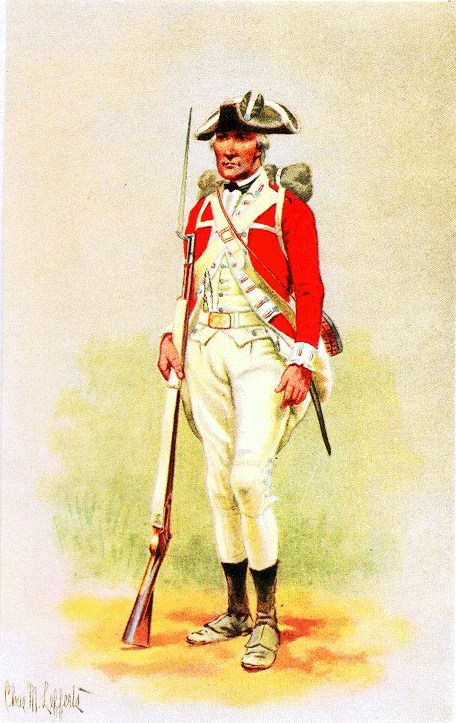
SOURCE: Uniforms of the Armies in the
War of the American Revolution, 1775-1783.
Lt. Charles M. Lefferts. Limited Edition
of 500. New York York Historical Society.
New York, NY. 1926.[Clicky]
After what seems like ages, I've finally  hit the painting table again..

The 43rd (Monmouthshire) Regiment of Foot was raised as Thomas Fowke's Regiment of Foot in 1741 though it was actually numbered the 54th Foot until 1748, when it finally became the 43rd.

During the War of Independence (or American Revolution for my colonial readers ) they were one of the first regiments to set foot in America, arriving in Boston in 1774 before the beginning of the Revolution. They were joined by the 52nd Foot at Boston and the two regiments fought side by side at Lexington (albeit the Grenadier and Light Infantry companies of the 43rd only), and then at Bunker Hill.

The 43rd went on to serve throughout the war (one of a few tat did) and on April 30 1781, along with two other regiments, they were sent to Virginia to reinforce Cornwallis

They landed at Brandon on the James River on May 26, I'm not sure if they were involved in the skirmish at Spencer's Ordinary [clicky] in late June (Queens Rangers and Hessians only I think), but they fought at Green Spring  [clicky] at the beginning of July. On August 6th, the British army  (including the 43rd) landed at Yorktown and Cornwallis started fortifying it and Gloucester Point just across the York River.


The actual siege formally got started on September 28 and during it the 43rd was part of the British force’s left wing, in the 2nd Brigade (Lt. Col. Thomas Dundas of the 80th Foot), along with the 76th & 80th Foot - the regiment was commanded by Major George Hewitt. They were mainly deployed in Redoubts 9 and 10 so would have been present in the attack on the night of October 14 when the Franco-American forces attacked. At least one of the regiments officers, Captain Duncan Cameron, was commended in orders by Lord Cornwallis for "distinguishing himself at the American redoubt" (that would have been Redoubt 10  which was attacked by an American force, Redoubt 9 being attacked by the French)


During the siege the regiment sustained casualties of ten killed, 18 wounded and 12 missing. The strength of the regiment at the capitulation on October 19 was 94 rank-and-file, with an additional 168 men sick and wounded. Following the surrender, the Battalion Companies were interned until May, 1783, and were part of the final embarkation for England on November 22. They lost their colours (both Kings and Regimental) at Yorktown.

These figures (25mm Minifigs) are some of the last of those that Lofty C [clicky] left me, and were already partially painted, so it was more a matter of finishing the rest of the paint job and matching to existing scheme.. checking through my records these are the first I've added to the AWI project since November 2011...


John was a "parade ground uniform" painter (something these old school/classic sculpts almost force upon you) so these guys are painted pretty much as the illustration top left.. In reality I suspect the gaiters wouldn't have been full length (but they look good), and during this campaign they would have cut their coats down shorter because of the heat, probably would have had larger, circular, hats, and would have looked a lot more lived in than I have represented them.... but hey, this more than any of my projects is an "old school style" one, a homage, the look is derived from Mollo and Mcgregor [clicky] but more from the style of these old Minifigs sculpts...  No flags for this unit...  they lost them at Yorktown!

Thursday, April 4

39th Illinois Volunteer Infantry

Another regiment leaves the painting table...! 


The 39th Illinois Volunteer Infantry (nicknamed "Yates' Phalanx") was organized at Chicago, and mustered into service on October 11, 1861, for a three year term.

The organization of the Regiment was started by Thomas Ogden Osborn (August 11, 1832 – March 27, 1904), a lawyer in civilian life, as soon as the news of the firing on Fort Sumter reached Chicago.

Recruitment was from the following counties:

Company A - Will and Cook Counties
Company B - McLean County
Company C - Livingston and Cook Counties
Company D - Ogle and DeWitt Counties
Company E - Will and Cook Counties
Company F - Cook and Lake Counties
Company G - Cook and Will Counties
Company H - Cook County
Company I - DeWitt and Boone Counties
Company K - LaSalle, McLean, and Cook Counties


Unfortunately the state filled its quota before the regiment completed preparations so they then tried to get the regiment accepted as part of the muster of Missouri (also without success).

The regiment had assumed the name of the Governor of Illinois (the aforesaid Yates), who as a result was keen to see them accepted into service. He wrote to the President and Secretary of War.

Osborne (seated left) and his staff - piccie
courtesy Wikipedia
The Regiment was accepted on the day following the Union defeat at First Bull Run, but Austin Light, of Chicago, was appointed Colonel with Osborne as Lieutenant Colonel (which must have been a disappointment to Osborne??) According to the sources I've seen though Light was well liked...

They left Camp Mather, Chicago, on the morning of October 13, 1861, and reported to Brigadier General Curtis, at Camp Benton, St. Louis, Missouri.

On October 29, the Regiment received orders to proceed to Williamsport, Maryland, where it was fully armed and equipped.

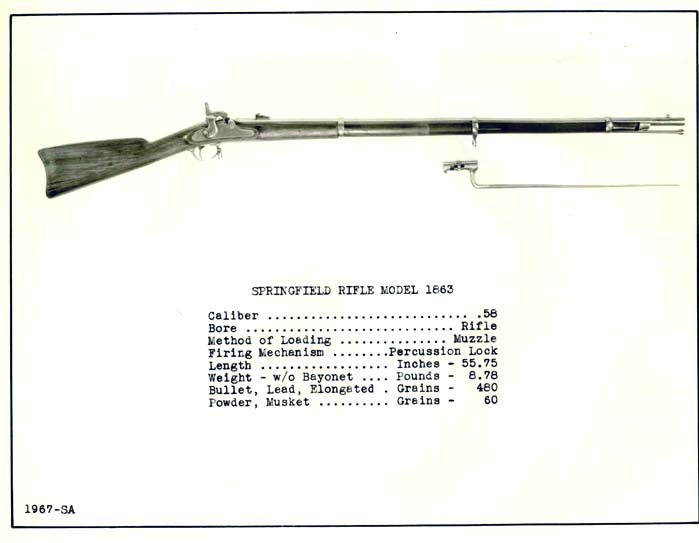
Colonel Austin Light was dismissed on November 25 (he was a regular army officer and my sources seem to indicate this was because of technical reasons going back some years rather than any fault), and Osborne finally became the regiment’s colonel in December 1861. In the same month the regiment was armed with Springfield rifled muskets..

On January 3, 1862, Confederates "under the command of "Stonewall" Jackson, attacked Companies D, I and K, in the command of Major Mann, near Bath, Virginia, and, after a brisk little fight, were repulsed; then, with two pieces of artillery, and a liberal display of strategy and courage, the enemy was held in check for nearly twenty-four hours". Company G, was also attacked at Great Cacapon Bridge, while Osborn, with the rest of the Regiment was attacked at Alpine Station. The Regiment finally retreated by fording the Potomac, having lost most of their baggage....
Cumberland was then threatened, and the Thirty-ninth was ordered to make a forced march of forty miles over poor roads, this was accomplished in just eighteen hours.


From Cumberland the Regiment was ordered to New Creek, Virginia, and assigned to the First Brigade of General Lander's Division. It was then ordered to Martinsburg, to protect workmen repairing the Baltimore and Ohio Railroad.

The Regiment then took part in the battle of Kernstown where they fought in the Second Brigade (this is the first unit I've painted in that brigade) commanded by Colonel Jeremiah C. Sullivan, but were little involved owing to their position on the extreme left.

The regiment went on to serve throughout the war - but never in any of the big battles - they seem to have been a well respected, veteran regiment, who happily, fought in very few of the major bloodbaths...

  • the siege of Fort Wagner
  • Jan. 1, 1864, returning to the front in Virginia the regiment was located on the extreme left of Gen. Butler's command in May, when the entire force under Butler was attacked and driven back. The regiment was at one time completely surrounded by the enemy, but succeeded in cutting it way out after great loss. Its entire loss in that engagement, including killed, wounded and missing, reached nearly 200. 
  • on Aug. 16 the brigade to which the 39th was attached was ordered to charge the works of the enemy at Deep run, during the performance of which the enemy's lines were broken and a large number of prisoners captured. In this battle the regiment lost 104 men in killed, wounded and missing. 
  • In the latter part of August it was ordered to the trenches in front of Petersburg, a few days later the regiment took part in a charge upon the enemy's works near Darlington road, 7 miles from Richmond, and out of about 250 men who went into that charge, 60 fell, struck by the enemy.
  • it crossed to the left of the Army of the Potomac and on April 2 (1865) took part in the charge upon Fort Gregg, the key to the works about Petersburg and Richmond, the 39th was the first regiment to gain the ditch, and the first to plant its flag upon the structure. Out of 9 of the color-guard 7 were shot down, and out of 150 members who went into that fight 16 were shot dead and 45 severely wounded, many of whom died from their wounds. 
  • After this affair the regiment took the advance of the Army of the James in the pursuit of Gen. Lee, and were present at Appomattox Court House on April 9, 1865,
The regiment was mustered out on December 6, 1865.


Figures are 20mm by Newline Designs - these guys take me over my painting total for the whole of last year so clearly I'm on a roll given it's only April...  the next unit will mark a return to 25mm tricorne's - American War of Independence time...

Apologies for the yellowing of the pictures, had to use my new camera which is slightly more sensitive to available light than my trusty old one (battery flat)...  must invest in a light box.... 

Thursday, March 14

33rd Virginia Infantry

Pushing on while the painting mojo is strong.... 

First though - that post I did on Old School has gone 'positively viral' (as the young people say) 800+ views so far, against my more usual levels of a tenth of that....  blimey....  still this post should manage to return us to more usual levels! 

For a change of flavour (and a change is as good as a rest) this time I decided to make the next unit one for the American Civil war project, so let me introduce you to the 33rd Virginia Volunteer Infantry.

The 33rd was organized in the lower Shenandoah Valley during the months of April, May, June and July of 1861 but was mustered into service on 17 April 1861, it was one of five infantry regiments that made up the "Stonewall" Brigade in the Army of Northern Virginia and comprised ten company's. The regiment was assigned to Colonel Arthur C. Cummings, a prominent lawyer
from Abingdon, Virginia who was a veteran of the Mexican War.


Cummings came from Washington County, Virginia and was the son of James and Mary Cummings; born October 1, 1822. He was licensed to practice law in 1846.In May, 1846, he raised, and was elected captain of, two different volunteer companies whose services were offered to the President of the United States for the war just beginning (Mexican American war); but the offer was declined (full quota of volunteers had been received) Undeterred he obtained a commission as captain of Co. K, 11th Regiment of U. S. Infantry and reached Vera Cruz with his company, July 1, 1847. 
Cummings was dangerously wounded in an engagement with a large guerrilla force at Paso Ovejas, near the National Bridge leading to the City of Mexico; and, on August 15, 1847, he was made brevet major for gallant conduct in that engagement. He continued to serve with great credit till the War ended. He was mustered out of the service, August 19, 1848.


On his return home, he resumed the practice of law but was commissioned colonel of the Fifth Regiment of Artillery, in the State's Militia, on October 22, 1849. In May, 1861, he was commissioned colonel of Virginia Volunteers, and was ordered to report to Jackson at Harper's Ferry, where he was assigned command of the 2nd (later 10th) Regiment.


In June, 1861, by order of General Jackson, he organized the 3rd Regiment, followed by the 33rd which he was then assigned the command of. He commanded this regiment at the first battle of Manassas, and until the reorganization, in 1862 where for reasons unknown (some say he'd had a disagreement with Jackson) he refused reelection as Colonel and went on to a career in politics. He passed away on the 19th of March, 1905
(Source: The Military History of the Virginia Military Institute from 1839-1861, by: Jennings C. Wise, Publ: 1915. Transcribed by: Helen Coughlin) 

The ten company's (comprising 60 to 100 men each) were as follows:

CompanyNameCounty FormedFirst Captain
"A"Potomac Guards (mustered June 17th)Hampshire County, WVP.T. Grace
"B"Independent GreysShenandoah CountyEmanuel Crabill
"C"Page Greys (mustered June 19th)WoodstockJohn Gatewood
"D"Mountain Rangers ( made up men from the small farms and cabins in the hills around Winchester; mustered July 26th))WinchesterFrederick W. M. Holliday
"E"Emerald Guard [clicky](made up mostly of Irish Emigrants; mustered June 1)New MarketMarion N. Sibert
"F"Mount Jackson Rifles (reported by a local newspaper, "...is made up of many of our best citizens and represents a large amount of wealth"; mustered June 15)Mount Jackson areaGeorge W. Allen
"G"Tom's Brook Guard Company (had so many members of the Crabill family in the company, it was oftentimes known as the "Crabill Company"; mustered July 8th)Mount Jackson areaGeorge Crabill
"H"Shenandoah RiflemenPage CountyWilliam D. Riffeter
"I"Rockingham Confederates (mustered June 22nd)Rockingham CountyJohn R. Jones
"K"Hardy GreysHardy County, WVAbram Spengler

By all accounts the 33rd saw hard fighting throughout the war - under Jackson, they fought at First Manassas, Kernstown*, Port Republic, Malvern Hill, Cedar Mountain, Second Manassas, Sharpsburg, Fredericksburg and Chancellorsville. After Jackson's death they fought with the rest of the brigade at Gettysburg, Mine Run, the Wilderness Campaign and Spotsylvania, where the majority of the Brigade was overrun and captured.


Those that weren't captured were re-organised and went on to see action at Monocacy, Cedar Creek, Fisher's Hill, Petersburg, Saylor's Creek and finally Appomattox, where only 14 men were left to surrender!
The 33rd Virginia remained in the Stonewall Brigade in Thomas J. Jackson's Second Corps until the restructuring of the Army of Northern Virginia after his death in the spring of 1863. It was then put under Richard Ewell's command until the spring of 1864, when it dissolved at the Battle of Spotsylvania Court House.

* The 33rd played a large role in holding a stone wall against overwhelming numbers, until being ordered to retire as their ammunition became expended. The regiment suffered 23 killed, 12 wounded and 18 captured out of  275 effectives at the start of the battle) See here [clicky] for a first hand account from Cummings himself...

Figures are 20mm from the inestimable Newline Designs [clicky] - flag is my own design, basic flag found on the web and then doctored...

Thursday, February 28

Regiment de Ligonday

Took me a little longer to get round to these guys, but herewith another unit ready to join the forces of Louis XIV at Blenheim. As per the recent Allied cavalry, when choosing which unit to paint I decided to focus on completing a brigade, though in this case it's a big brigade and I'm some way off, either way welcome a squadron of the Regiment de Ligonday.


The regiment doesn't even feature in Grant, but was 2 squadrons strong at Blenheim numbering about 100 men in total - the following section of the Order of Battle is from Wikipedia, and is what I normally use as my reference..... I now have one squadron from each of the regiments in the brigade (I must have a group photo at some time!)

Marechal de Camp, the Duc d'Humeries Merode-Westerloo's Brigade (Spain)
Comte de Merode-Westerloo
  • Regimiento de Gaetano (two squadrons, 214 men)
  • Regimiento de Acosta (two squadrons, 200 men)
  • Regimiento de Heider (two squadrons, 200 men)
la Valliere's Brigade
Marquis de la Valliere
  • Régiment de Bourgogne (three squadrons, 360 men)
  • Regiment de la Valliere (two squadrons, 136 men)
  • Regiment de Noailles (two squadrons, 200 men)
  • Regiment de Beringhen (three squadrons, 783 men)
Silly's Brigade
Marquis de Silly
  • Regiment de Orleans (three squadrons, 165 men)
  • Regiment de Montreval (two squadrons, 110 men)
  • Regiment de St. Pouanges (two squadrons, 100 men)
  • Regiment de Ligonday (two squadrons, 100 men)

The Franco Bavarian horse ; more horseflesh than a cheap supermarket beef burger!

With no uniform source, the thoroughly knowledgeable chaps over at the Early Linear Warfare Yahoo group agreed that my suggested colour scheme of grey with red cuffs was sound - it seemed a no-brainer given that at least 80% of the French cavalry was similarly accoutred!

So what of Ligonday??  Not much information - but some really interesting original sources gave me the following..... and his name has various spellings; I've seen Lizondez/Ligondes/Ligonday

I like the grey second from the left...  quite pleased with that...

I know his full name was the Chevalier (Sir) Michael de Ligonday (I'll stick with that though I think this is an Anglicized version of his actual French name Ligondès), that he was a Knight of Malta, and a member of the House of Auvergne (the same family as the noted French general the Vicomte de Turenne).

From the Histoire des chevaliers hospitaliers de Saint-Jean de Jérusalem ..., Volume 7 - year 1689

"Michel de Ligondès le 22 juillet: d'azur semé de mollettes d'or, au lion rampant de même. Combraille"

..which is the reference to when he was knighted (22nd July 1689), then his coat of arms, and that he came from Combraille (about as central as you can get on a map of France)


He was captured after Blenheim and sent as prisoner to Britain.

While here it would appear he married the widow of the 5th Viscount Killmorey, Frances (maiden name Fowler); this was her third marriage as she'd also previously been married to Theophilus Earl of Huntington (who died 1701)

"thirdly the Chevalier de Ligonday Colonel or Horse one of the French Prifoners taken with Count Tallard at the Battle of Hockstet (Blenheim)....

I found a reference on-line to an extract from "A brief historical relation of state affairs, from September 1678 to April 1714" as follows:

Gaspard du Ligondes
"April 1706 The following 7 French prisoners of war are come hither from Nottingham, having obtained her majesties leave to goe for France on their parole of honour, to return in 6 months, the chevallier de Ligonday, marquesse de St. Second, marqaesse de Marivaux, marquesse de la Masselir, marquesse de Armigny, marquis de Valsene, and the count de Tallard"

..the marriage was sometime before July 1706 so occurred while he was on parole - there is also the following interesting statement:

"This marriage was regarded by the Government and the Queen as a grave "affront done to her authority." see The Complete Peerage vol. 6 p. 660"


He was the second son of Gaspard du Ligondes
(1633-1709) and according to the only web site I've found that has information on him he was:
  • commisioned as a cornet in the cavalry regiment Mestre de Camp in 1690
  • lieutenant in 1691, 
  • captain in 1692, 
  • major of the regiment Ligondès in 1701
  • colonel of the same regiment in 1703
  • he was given the regiment by his father on May 10, 1704, "after several brilliant actions". 
Ligonday died in 1717, and Frances died December 27th 1723 (while taking the waters at Bath)  so they were married just 11 years before he died - but despite her being 42 when they married, they had two children Jean & Marie Antoinette, but from what I can tell only Antoinette survived.

Figures are 15mm and from Freikorps [clicky](they are actually sold under their Seven years war range but at this scale the later period is hardly noticeable) - simple paint job..  I went with azure blue saddle cloths and pistol covers in homage to the Ligonday coat of arms which has an azure blue background..