Showing posts with label WSS. Show all posts

Monday, December 29

"Firing into the Brown" #97 - Flags, barracks and stuff

"So Carnehan weeds out the pick of his men, and sets the two of the Army to show them drill and at the end of two weeks the men can manoeuvre about as well as Volunteers. So he marches with the Chief to a great big plain on the top of a mountain, and the Chiefs men rushes into a village and takes it; we three Martinis firing into the brown of the enemy".

Kipling "The Man Who Would Be King"

Time for another update..

~~~~~~~~~~~~~~~~~~~~~~~~~~~~~~~~~~~~~

The excellent David Morfitt (he of Not by Appointment fame) mentioned in a comment that the standard carried by the Foot Guards in my recent regiments of renown spot [clicky] was a little "meh" as the young people say (David was more polite than that, merely indicating it was a little 'vanilla' 😁).. 

More importantly though, he also mentioned that he had done a version of it himself some time before, albeit the version he had was for the earlier William'ite period, but having seen it I planned to use it anyway because it was gorgeous, but bugger me if he didn't then go and produce the 1703 Queen Anne version...

No time to hang around - a presenting of the Colours needed to be arranged, and I'm pleased to report, this is now done...

So from this - the old one..


To this:


,,,and the regiment is hugely proud of their new standard...

Cheers David! πŸ‘πŸ˜Š  

~~~~~~~~~~~~~~~~~~~~~~~~~~~~~~~~~~~~~ 


..not surprisingly, there was a huge barracks complex down in Portsmouth to house the men required to man those walls, bastions, ravelins and redoubts.. Victoria Barracks was demolished in the 1960's but the other end of the parade ground you see in the picture, ie. behind the photographer, was another barracks that still exists, and now houses the City Museum... this bears further investigation, might be time for a visit? 

~~~~~~~~~~~~~~~~~~~~~~~~~~~~~~~~~~~~~ 

Laters, as the young people are want to say...

Saturday, November 29

"Firing into the Brown" #93 - Foot Guards, Bastion No. 1 and stuff

"So Carnehan weeds out the pick of his men, and sets the two of the Army to show them drill and at the end of two weeks the men can manoeuvre about as well as Volunteers. So he marches with the Chief to a great big plain on the top of a mountain, and the Chiefs men rushes into a village and takes it; we three Martinis firing into the brown of the enemy".

Kipling "The Man Who Would Be King"

Time for another update..  apologies for the intermission dear reader - too busy elsewhere, and not enough to blog on...
~~~~~~~~~~~~~~~~~~~~~~~~~~~~~~~~~~~~~


Look at those battle honours.. including all the big
four in the War of the Spanish Succession..
Another in the occasional "regiments of renown" series featuring the histories of various regiments painted in haste at the beginning of a project but which were not documented here for posterity.. so we come to British infantry regiment "1st Foot Guards" - the creme de la creme of the British infantry..

They were first raised in 1656 in Bruges as a bodyguard for Charles II whilst in exile. Initially under the command of the Earl of Rochester, on his death (1658) the command then passed to the regiments original founder, who was Thomas, Lord Wentworth 

Initially known as the 'Royal Regiment of Guards' it comprised 400 of the King's most loyal supporters - they were all officers in the earlier Royalist army of Charles I and who had gone into exile at the end of the war.

Following the Restoration (and in the interim, service at the Battle of the Dunes - where they were badly handled), they returned to England in 1660. In 1665 they were amalgamated with 'John Russell's Regiment of Guards' to form the 1st Regiment of Foot Guards - they remain the most senior regiment of the British Army to this day.

There is no point in repeating the excellent Kronoskaf regimental history of their service in the War of the Spanish Succession (see link below), but my reader will know that I am endlessly fascinated by the characters and personalities, so by way of providing some rabbit holes to disappear down, the Colonel-commanders during the War of the Spanish Succession were:

  • from 16 March 1689: Henry Sidney, Earl of Romney - described by Jonathan Swift (he of Gulliver's Travels fame) as 'an idle, drunken, ignorant rake, without sense or honour' - but given Sidney's politics, and that Swift was notably anti-Whig, other views may definitely differ! 😁 He died of smallpox at his house in London on 8 April 1704..

    Painting attributed to John Baptist Medina

  • from 24 April 1704: John Churchill, Duke of Marlborough - arguably (not arguably in my eyes) Britain's greatest general...  he lost the Colonelcy after his fall from grace with (Queen) Anne - "I am sorry for your own sake the reasons have become so public which makes it necessary for me to let you know you have rendered it impracticable for you to continue yet longer in my service".

    Painting attributed to Michael Dahl

  • from 1 January 1712: James Butler, 2nd Duke of Ormond - boo hiss 😏- a noted Tory, and the tool the British government tasked with getting the British army out of the war - the British government gave him secret orders to take no active part in supporting their allies under Prince Eugene. Happily - he was also a Jacobite as well as a Tory, and when George I (who was neither Jacobite or Tory!) came to power a mere two years later, he was stripped of  his posts as Captain-General, and as colonel of the regiment - both of which positions were given back to Marlborough.. yay!😁

    "A fine soldier, as a statesman ‘he often followed the advice of those who had a smaller share of sense than himself (and)... was as irresolute and timorous in affairs as he was brave in person’" Painting by Sir Godfrey Kneller (LΓΌbeck 1646 - London 1723)

Important men one and all, but the regiments battle field commander would have been the Lieutenant Colonel, and from what I can tell - this would have been these men throughout the period of interest:

  • Lieutenant-Colonel Henry Withers - he was Lieutenant-Colonel when the regiment was first sent to Flanders in 1701  - just the one battalion, of the four (!) the regiment comprised at that time. Withers was made Brigadier-General in March 1702, and Major General in 1704 shortly after Marlborough was made Colonel of the regiment. He eventually died at a good old age.. his grave stone says..

    "Henry Withers Lieutenant General descended from a military stock and bred in arms in Britain, Dunkirk and Tangier; thro' the whole course of the two last wars of England with France. He served in Ireland, in the Low Countries and in Germany, was present at every battle and at every siege and distinguished in all by an activity, a valour and zeal which nature gave and honour improved. A love of glory and his country animated and raised him above that spirit which the trade of war inspires; a desire of acquiring riches and honouse by the miseries of manking. His temper was humane, his benevolence universal, and among all those ancient virtues, which he preserved in practice, and in credit, none was more remarkable than his hospitality. He dyed at the age of LXXVIII years, on the XI of November MDCCXXIX. To whom his monument is erected by his companion in the wars, and his friend thro. life, Henry Desney".

    Not a bad epitaph at all.. 😊
  • At the Schellenberg, Kronoskaf shows them under the command of Lieutenant-Colonel Primrose (perhaps Captain? Maybe promoted as a result of his efforts?), who was wounded in the assault while leading the grenadier company, which had been detached to make up a composite force of grenadiers from multiple regiments. He recovered from his wounds, made Colonel, and was later given command of the 24th Foot - he ended up a Major General
  • Lieutenant-Colonel Philip Dorner assumed temporary command but was subsequently killed at Blenheim where the regiment was part of Fergusson's Brigade (that attacked the village of Blenheim).
  • Lieutenant-Colonel Charles Gorsuch then assumed command - he died in December 1708 at the Siege of Ghent after commanding them for five campaigns. When reinforcements for the Guards in the form of an extra Battalion was sent, Marlborough specifically asked that they not be sent with any officer senior to Gorsuch, so that Gorsuch would remain in overall command, he was that well regarded.
  • Lieutenant Colonel Cholmondeley is mentioned as being in command in 1711, but in the interim the most active battlefield command seems to have been by Withers (above)..

These are Minifig's and painted and based by me some time pre-2006 from the batch of unpainted figures that DG passed me when he decided not to proceed with the project. Probably one of the first regiments I painted..  flag is from the old Warflag site

Further reading:

~~~~~~~~~~~~~~~~~~~~~~~~~~~~~~~~~~~~~ 

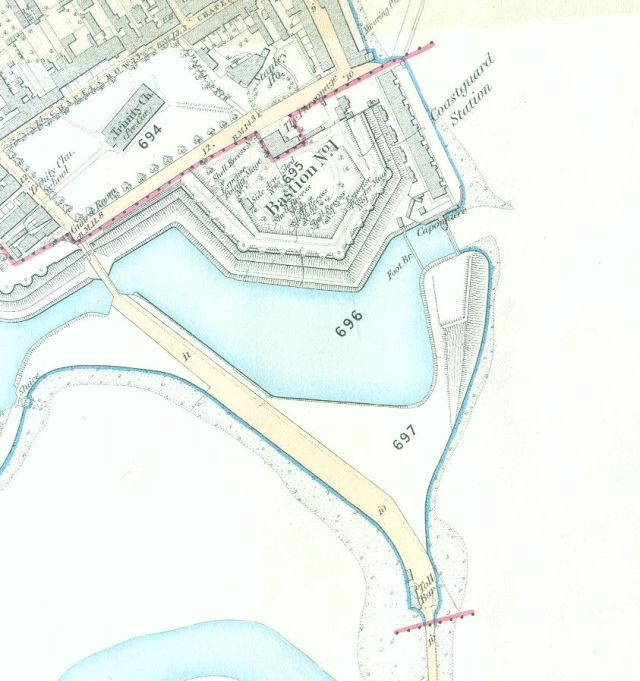
Time to get my Dora the Explorer hat on - I was reading some stuff [clicky] on the Interweb the other day and mention of this one caught my eye..

Bastion No.1 from an 1890 WD Plan

Bastion No. 1 is in Gosport (just the other side of the harbour from Portsmouth), and over the years I must have crossed that moat via the modern footbridge any number of times without seeing the greater significance..  I sense a little winter project coming on - the Gosport Lines! 😏

Other reading sources:

Trinity Bastion - Gosports History

~~~~~~~~~~~~~~~~~~~~~~~~~~~~~~~~~~~~~ 

 Laters, as the young people are want to say...

Saturday, August 30

"Firing into the Brown" #89 - fort speak, Nassau Friesland and stuff..

"So Carnehan weeds out the pick of his men, and sets the two of the Army to show them drill and at the end of two weeks the men can manoeuvre about as well as Volunteers. So he marches with the Chief to a great big plain on the top of a mountain, and the Chiefs men rushes into a village and takes it; we three Martinis firing into the brown of the enemy".

Kipling "The Man Who Would Be King"

Time for another update..

~~~~~~~~~~~~~~~~~~~~~~~~~~~~~~~~~~~~~

An English/Fort, Fort/English translation... a starter for 10 anyway.. some of them you'll know - some not - I've picked up some crackers over the last few work parties! πŸ˜€

Caponier centre covering the ditch, Carnot Wall to the right, then scarp, then glacis, then parapet far right - read on for clarity! 
  • bastion - the angular structure - usually on a corner - sticking out from a curtain (see later) wall, may have a postern for access to a Carnot Wall
  • curtain wall - the outer wall of a fortified structure  - can also be known as a rampart
  • parapet - top part of a defensive wall that provides cover for the defenders - can be crenelated (see later) - can also be known as battlement
  • banquette - raised step at the bottom of the parapet for the defenders to stand on when firing over the parapet - a firing step..
  • merlon - the solid part of a crenelated parapet ie. the bit between two embrasures/spaces
  • moats and ditches - we know that one 😏
  • Casemates or Casement - a bomb-proof chamber in a fort - used to mount guns in
  • sally-port/postern  - a small, secure gate in the curtain wall used for making surprise attacks or sallying out from a fortification. 
  • chemin de ronde - the walkway allowing defenders to patrol the tops of ramparts, protected from the outside by the battlements/parapet.
  • Carnot Wall - loop-holed wall built along the ditch to allow the defenders to fire directly into the ditch
  • Caponier - type of defensive structure - covered or not - loopholed, and placed to allow the defender to fire along the ditch - can be accessed via a Gallery, may have a postern for access to a Carnot Wall or Bastion
  • Crenelation - regular spaces (known as embrasures) in a parapet through which the defenders can shoot while remaining in partial cover
  • Gallery - a long enclosed passageway, or corridor - can be used as defensive position and as a means to move around the fort without being exposed to fire.
  • Glacis - a sloped earthen bank that protects the forts vertical walls from cannon fire
  • Loophole - we know that one 😏
  • Place of Arms - protected area, usually near a sally port, in which small groups of men can be assembled when leaving or returning to the fort. 
  • Redoubt - any small fort with its own defences which is located near a larger fort. 
  • Scarp - the steep, inner slope of a ditch located just below the rampart of a fort. The opposite side of the ditch from the scarp is called the counter scarp.
  • Tenaille -  an advanced defensive-work, in front of the main defences of a fortress  - used to protect the main entrances to a fort from cannon fire and direct assault.
  • Faussebraye - a shot trap - similar in function to a tenaille but a part of the curtain wall rather than separate 
  • Terreplein - the level space on the top of the ramparts on which cannons were placed. 
Chemin de ronde indeed, Rodney! 😁
~~~~~~~~~~~~~~~~~~~~~~~~~~~~~~~~~~~~~

Source: Pike and Lace Wars site..

Another in the occasional "regiments of renown" series featuring the histories of various regiments painted in haste at the beginning of a project but which were not documented here for posterity.. so we come to Dutch cavalry regiment "Nassau Friesland" (NB. Friesland, sometimes Friedland, was one of 8 Dutch provinces at the time so the regimental name refers to both where it was raised, and the Colonel's name in this instance)

Raised in 1668 the regiment was also known as "Oranje-Friesland" after 1702 - presumably from their honorary Colonels title of that time.. 

Sapherson shows two Colonel's for the period we're interested in, from 1673 it was Prince Hendrik Casimir van Nassau Friesland, and from 1696, his son, Johan Willem Friso van Oranje Nassau - both these guys were the Stadtholder (the title of a provincial governor and military commander, acting as a deputy to a monarch) of Friesland..

Johan Willem is an interesting character, he was one of the (main?) claimants to the throne on the death of William III as a result of being his first cousin, in fact he was titled Prince of Orange, but he was hideously young - he was only 9 when he was given the Colonelcy of the regiment  so it was clearly not an active role at the beginning..  he was only 15 when William died, and the outbreak of the war stopped any further action on his part to follow up the claim which was opposed by Prussia (and of course Louis)...  John Willem died at 24 as a result of drowning on a ferry crossing..  a short but active life as he made General before he died.  He commanded the Dutch infantry at the Battle of Oudenarde, the Siege of Lille, and the Battle of Malplaquet. 

After Johan Willem Friso drowned on 14 July 1711, his wife Marie Louise van Hessen-Kassel became regent until their son, who became Willem IV, came of age. 

Interestingly - all the current regents of Europe can trace their lineage back to him..  😏      


I can find little or no record of the regiments activities in the war - the similarly named infantry regiment (and indeed their Colonel) was most active, but these guys not quite so.. 

  • they are listed as 2 squadrons strong in 1702 in the Allied camp in Nijmegen prior to the campaign in the Low Countries that year (and the same in 1705 and 1712)
  • they are listed as "Oranje-Friesland" and 2 squadrons strong at Ramillies where they were on the left wing under Brigadier Grovestine (sometimes Grovesteyn) and 3 other Dutch cavalry regiments
  • they were at the siege of Mons in 1709 (again 2 squadrons) where their Colonel (John Willem - Price of Orange) was in overall command of the Allies
  • in 1712 they were under the command of a Colonel Cavendish when they were part of what would have been called a chevauchee in medieval times - Prince Eugene sent a large raiding force into France in order to pillage, "raise contributions" (😏), and bring back prisoners (for both information and ransom) - the raid was a success "[they] made great booty everywhere and burned down several villages. Afterwards, he went to the dioceses of Verdun, Toul and Messins where he also raised contributions. After his incursion, Grovesteyn [who lead the force] returned to Trarbach with 300 hostages and a lot of cattle"

"John William Friso (1687-1711, Prince of Orange. At half-length, slightly to the right, lookong at viewer. In armor. After an original by Lancelot Volders. Part of the collection of portrait miniatures of the Rijksmuseum Amsterdam".

These are Dixon's and painted and based by me some time pre-2006, and as I usually say probably one of the first regiments I painted - I have a curious antipathy towards flags for my cavalry units - so there isn't one, despite the luxuriousness of the example above.. 😏

References:

~~~~~~~~~~~~~~~~~~~~~~~~~~~~~~~~~~~~~ 

 Laters, as the young people are want to say...

Saturday, March 22

"Firing into the Brown" #74 - Beeston's, Bourbonnais and stuff...

"So Carnehan weeds out the pick of his men, and sets the two of the Army to show them drill and at the end of two weeks the men can manoeuvre about as well as Volunteers. So he marches with the Chief to a great big plain on the top of a mountain, and the Chiefs men rushes into a village and takes it; we three Martinis firing into the brown of the enemy".

Kipling "The Man Who Would Be King"

Time for another update..
~~~~~~~~~~~~~~~~~~~~~~~~~~~~~~~~~~~~~


Another in the occasional "regiments of renown" series featuring the histories of various regiments painted in haste at the beginning of a project but which were not documented here for posterity.. so we come to French infantry regiment "Bourbonnais", part of my War of the Spanish Succession collection.. 

There is a very (very) good potted history of this regiment on the Kronoskaf WSS site (link below) so there's little point in me repeating the good work completed there, but by way of a framework to hang some 'rabbit holes' on (😏), the regiment was first created in 1584 from the old Bandes* de Montferrat. On 6 March 1597, it became part of the regular French Army and apart from a 10 year period at the start of the 1600's (when Louis XIII instigated a massive reorganisation of the French army) has been a permanent regiment of the French Army to this day.

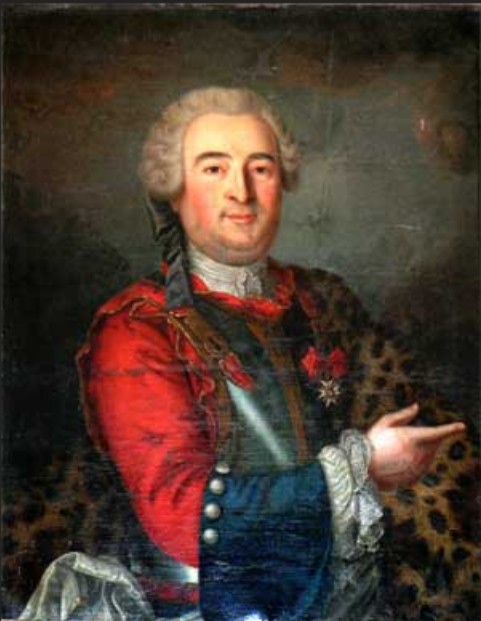
Louis de Brichanteau, Marquis de
Nangis (painter unknown)

The regiment is included in those six regiments who, by their ancestry and lineage and therefore ranking, were considered to be the "Petit Vieux" (the 'little olds') giving them the privilege of not being disbanded at the end of any war, and making them second only to those four regiments in Les Vieux Corps (Navarre, Picardie, Piedmont and Champagne). 

By the time of the War of the Spanish Succession, the regiment counted three battalions, but at Blenheim the regiment was two battalions strong, numbering about a 1000 men, and were in Nangis' brigade (who was also their Colonel), entrenched in and around the central village of Oberglau with fourteen (!) other regiments under the overall command of Lieutenant General Jean-Jules-Armand Colbert, Marquis de Blainville (who was to die during the battle). 

By all accounts they fought stubbornly and resisted Allied attacks under Prince Holstein-Beck, which at the end of the battle allowed the remnants of Tallard's Corps to retire in an orderly fashion - they then retreated in column per battalion and formed the rearguard of the defeated army.

During the War of the Spanish Succession, the regiment was commanded by:

  • from 15 January 1700 by Louis de Brichanteau, Marquis de Nangis - he lived to a ripe old age and their are some fascinating snippets about him on this blog [clicky] - he shared a mistress (not at the same time! 😁) with a colonel of regiment Navarre we have already met.. "...Nangis, who was more plausibly reported to have been the lover of the duchesse de Bourgogne (hence of a woman in line to become queen of France), served heroically in his youth, though he would live to become a lackluster (sic) marshal of France. In his prime, however, his amorous exploits were rivaled (sic) only by his exploits on the field of battle...." (from Ladurie & Fitou, "Saint Simon and the Court of Louis XIV")
  • from 1 January 1709 till 1 July 1727: Louis-Antoine de Gramont, Comte de Lesparre - I reckon he was about 20 when he got the Colonelcy and I would think that his might well have been due to the influence of  his much better known father (pictured following) who by that time was a Marshal of France (and was wounded at Malplaquet in 1709) ..  Louis-Antoine (the younger) got his colonelcy the same year..  he was to later die at Fontenoy

Undated portrait of Antoine de Gramont (the elder)

*The Bandes (there were many) by the way were the first permanent, paid, infantry units in the service of France, and were modelled on the organisation of the Swiss units (mercenaries in French pay). You may remember (who would? 😏) that when I did the unit history for Navarre, they also originated from one of the old Bandes.


These are Dixon's and painted and based my me some time pre-2006 - the flag is from the old Warflag.com site which is still - regrettably - down...

Other reading:

~~~~~~~~~~~~~~~~~~~~~~~~~~~~~~~~~~~~~

A little rabbit hole presented itself.. 

I was having another look at that 1860 map of the Portsmouth fortifications and happened to notice this in the top corner..  Beeston's Bastion...  now Steve the Wargame is of an ancient enough age that the secondary school he went to, whilst not private in any way, still had a house system, and my school had four houses of which the sorting hat put me in Beeston's (where we then had the privilege of wearing a yellow button badge on our blazer lapels).

The houses (of which there were four) were named after notable bastions in the old city defences, so there was Beeston's, then Guy's, King's and I think Pembroke's (not so sure on this last one but I do remember that the other three houses wore red, green and blue badges) but either way I've often wondered who or what said Beeston was.. this seemed like an opportunity to find out!

My reading would indicate that by all accounts the Beeston's were big cheeses in Portsmouth back in the day (and we're talking Queen Elizabeth the First era). Under a grant from the Corporation in 1574, Thomas Beeston became proprietor of the Sea Mills (a flour mill based on a tidal creek or basin between Portsmouth and the Dockyard), he also constructed a new carriage bridge near it connecting the two locations, he was Mayor in 1591, and in future years both his son and grandson filled the same office, other later descendants were Burgesses of the town.

In 1709, the land the mill was standing on was taken under an Act of Parliament to improve the fortifications, Thomas Beeston (the family had a habit of naming the oldest son Thomas, so he was either the third or fourth generation of the first one.. 😏) was still the proprietor, and sold the mill and the Mill pond. 

It was later renamed King's Mill, by the way, and it produced flour for the Victualling Commissioners of the Royal Navy - you can see it on the map just north of the bastion, it in turn was protected by it's own bastion - the Mill Dam Bastion. Which in itself represents another little rabbit hole, as Milldam Barracks was built on the reconfigured Mill Pond - and the building still exists...πŸ€”

~~~~~~~~~~~~~~~~~~~~~~~~~~~~~~~~~~~~~ 

 Laters, as the young people are want to say...

Saturday, January 18

Battle of Grande Battaglia

So as promised in the last post... I was suddenly hit with the need over Christmas for a big game..  I'm really loving the skirmish format with a small table and a dozen units/figures a side, but as a spectacle I guess it's not quite the ticket..  😁

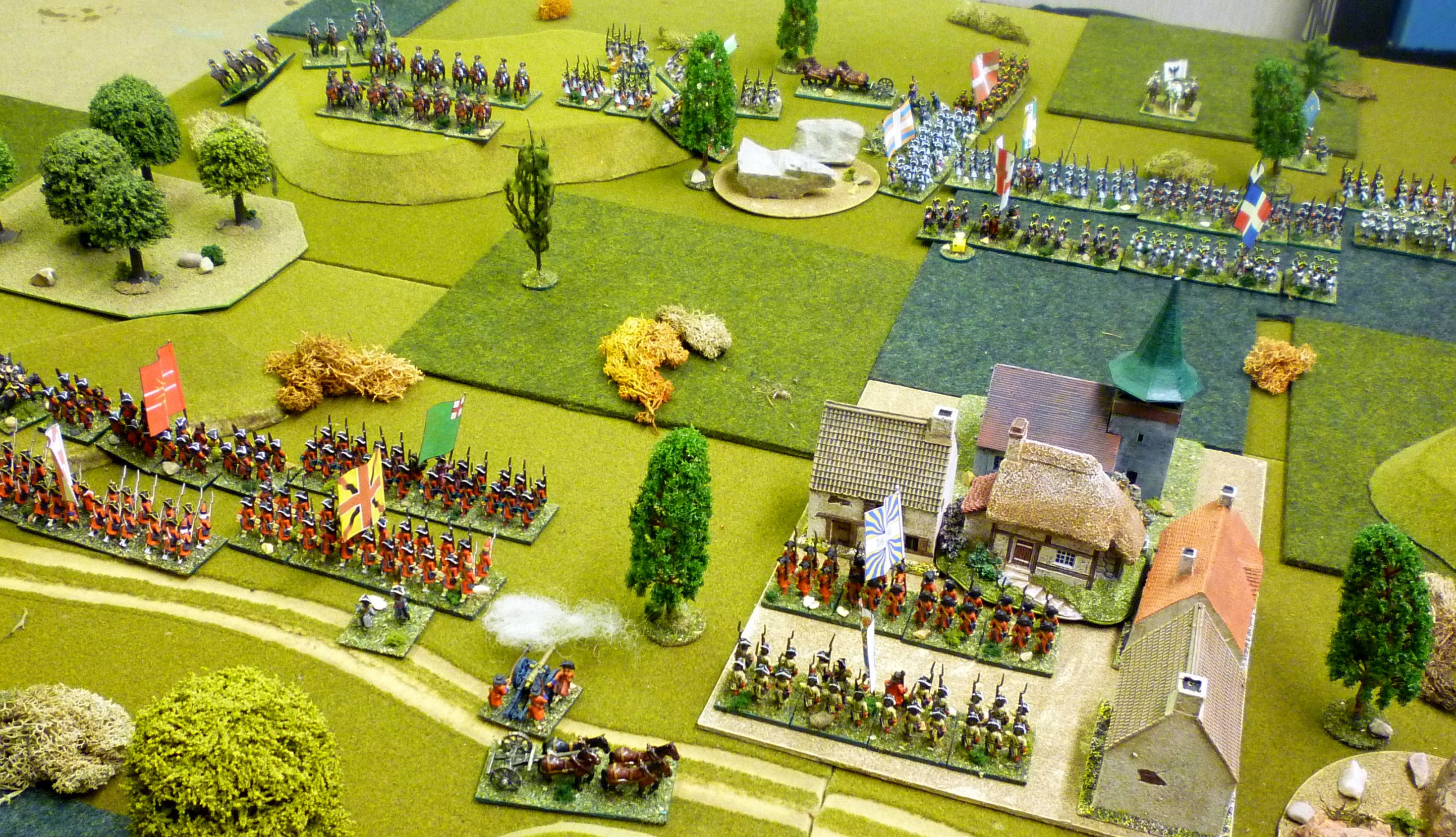
Having just rebased and reflagged Navarre though, it seemed opportune to get some more of the  Marlburian troops on the table, and so was born 'The Battle of Grande Battaglia'. Narrative via the captions on the pictures..

Start of game - all is quiet as the Allies contemplate the village of Grande Battaglia in front of them - supposedly named after a battle centuries before - are the Allies going to make a 'Blenheim mistake' as per the French at the battle of that name? πŸ˜€


End Move 1 - general advance by both sides.. I purposely loaded the table with both units and terrain so as to provide the maximum amount of friction for the opposing sides (and me)


End Move 2 - general advance by both sides continues.. one of the Allied artillery pieces has at last opened fire..  the other is limbered to try and find a better vantage point


End Move 3 - Allied right flank..  the horse have clashed!


End Move 3 - Allied left flank..  as you can see..  the French are having issues getting manoeuvring room..  that wood (top left) in particular was to provide an irritant for both sides..


End Move 4 - the Allies have occupied the village with two battalions..  to the right, in the far distance one of the French cavalry regiments has routed.. worryingly, the French cavalry has now managed to deploy two abreast..  they'll get overlap bonuses in any ensuing melee


End Move 4 - this time looking across the battlefield..  routing cavalry bottom right..  in the centre that front rank Allied cavalry regiment is shaken - they've been bounced back by the tactically superior French...  the advancing French infantry look fearsome!


End Move 5 - Allied right flank - boom! The Bavarian cuirassiers have given their lighter opponents a right good hiding.. the Danish (blue flag white cross) have also routed but as a result of poor morale checks following hits from the French artillery..


End Move 6 - looking across the table from the Allied right flank...  at the village (centre) the French infantry have come to close musketry as they desperately try to close to bayonet..  


End Move 6 - Allied left flank, and it's all beginning to go pear shaped for the Allies - the French infantry in their centre threw at least a half a dozen 11's (on 2D6) for their firing and Allied regiment after regiment has taken hits and is shaken - note the number of yellow dice - or routing..


End Move 6 - Allied right flank, and the only good news is that the last remaining Allied cavalry has now seen off the French cavalry..  the French infantry is streaming up so as to close off the threat to that flank that they pose..


End Move 7 - Allied left flank, have they managed to stabilise the situation?? Things are not good in the village - at least one of the two Allied regiments providing the garrison have been sent packing (bottom centre)..


End Move 7 - Allied right flank, and those dastardly cuirassiers have managed to regroup - top right - can they do the damage again!? The fight for the village is going hammer and tongs..  at least once the Allied infantry is driven in and the French come over the wall, only to be expelled in the next phase..


End Move 8 - Allied left flank, and unfortunately it's all fallen apart again - poor morale throws all round (lots of red dice indicating rout) - the Allies are bringing up cavalry (in column) to try and plug the gap


End Move 9 - Allied right flank, and the cuirassiers have finally managed to close with a shaken Allied cavalry regiment - uh oh... the Allied infantry are taking the fight to the French but look at that infantry battalion threatening the flank of the cavalry..


End Move 9 - Allied right flank, success at last! Against all the odds the cuirassier attack failed, and they have broken and run.. it's fairly clear though that the Allies are running out of steam..  and men..


End Move 10 - Allied left flank, it's all over bar the shouting..  French cavalry are poised to exploit the breakthrough and two thirds of the British cavalry are routing..


End Move 10 - Allied centre and right, more stable, but still fragile - some of those battalions are very low on strength but the remaining British cavalry, top right, are about to swing round the back of the hill and into the French rear


End Move 10 - all done and dusted - French win..  both Allied flanks have collapsed and the centre is not far from doing the same, though they do still hold the village..  the Allied commander orders his brigades to disengage and fall back on prepared rear positions..

Post Match Analysis:
  • Fun game, but the lack of space to deploy and manoeuvre in definitely caused some interesting tactical decisions to be made.
  • On the whole I would say that the French "turned up" for the battle but the Allies were a little, err..  absent minded.. in other words, the French were definitely the masters of the dice for this game.. 😏
  • From a starting strength of 90 each, the French ended the game with 41 strength points - of their units left on the table 1 was shaken. This compares with the Allies who ended up with 33 strength points but of the units left on the table 3 were routing, and 1 was shaken. Clear points decision I think...

~~~~~~~~~~~~~~~~~~~~~~~~~~~~~~~~~~~~~ 

 Laters, as the young people are want to say...

Saturday, January 11

"Firing into the Brown" #71 - Olivia, Johnnie, Grande Battaglia and stuff...

"So Carnehan weeds out the pick of his men, and sets the two of the Army to show them drill and at the end of two weeks the men can manoeuvre about as well as Volunteers. So he marches with the Chief to a great big plain on the top of a mountain, and the Chiefs men rushes into a village and takes it; we three Martinis firing into the brown of the enemy".

Kipling "The Man Who Would Be King"

Time for another update... first of the year, so Happy New Year to my reader...  not a very cheerful update either if I'm honest, but that's the way life sometimes is... 😏

~~~~~~~~~~~~~~~~~~~~~~~~~~~~~~~~~~~~~

Back in '75 or '76 a pubescent, slightly oily and spotty Steve the Wargamer did "Romeo and Juliet" for his English O Levels and our most excellent teacher (and he really was excellent) dragged us all in to the school hall one day where the television on the big wheelie stand lived (all schools at the time must have had them😏) and showed us Zeffirelli's film of the play..

I was at an all-boys school (they existed in the dark ages) but was completely, utterly and totally blown away by Olivia Hussey...

😍

She would have been about the same age, or a year older, than me when the film was made, and she was incandescently beautiful, and I had a crush on her for some considerable time..πŸ˜€

...it was those eyes...  honest... 

So it was that with great sadness I heard of her death over this Christmas period..  so sad...  but so good to have left such a film in your body of work. I must seek it out and watch it again...

~~~~~~~~~~~~~~~~~~~~~~~~~~~~~~~~~~~~~ 

...and if that wasn't bad enough, a mere few days later I then heard that Johnnie Walker had also died...  


...bugger! 😐

I suspect Johnnie is not as well-known as Olivia outside of the UK, but in the UK, he was a behemoth of the rock radio world...  a true out and out rock DJ, he was outspoken in his support of songs, bands and genres of music when they weren't universally approved of or accepted by the powers that be, but equally dismissive of music and bands that he saw as trite...

The guy was on the radio for 58 years, started on the pirate ships (Caroline) was sacked by the BBC (or was it a mutual parting of the ways??) for his on-air comments about the Bay City Rollers, went to the US on the FM radio circuit for a while before coming back eventually to the BBC and presenting the "Sounds of the 70's" and the "Rock Show" both of which I have listened to for years and years...

...another legend passes...  Ave..

~~~~~~~~~~~~~~~~~~~~~~~~~~~~~~~~~~~~~

...we have however, on a slightly more cheerful note, kicked off a big game...

Set in the War of the Spanish Succession this one features 10 battalions of foot, 6 regiments of horse, and two batteries of heavy guns a side, as the Maritime Powers and the Franco Bavarians fight for control of the (aptly named 😏) village of Grande Battaglia..

Big old game so I'll save the report to a separate post, but to wet the appetite here's the initial setup and table..


Allied, or Maritime Powers, to the left..


...and the Franco Bavarian's (booooo.. hissss πŸ˜€) to the right..


~~~~~~~~~~~~~~~~~~~~~~~~~~~~~~~~~~~~~

 Laters, as the young people are want to say...