Showing posts with label Gosport Lines. Show all posts

Saturday, June 6

"Firing into the Brown" #102 - D-Day, Gosport Advanced Lines photo'd by the Luftwaffe (!) and stuff...

"So Carnehan weeds out the pick of his men, and sets the two of the Army to show them drill and at the end of two weeks the men can manoeuvre about as well as Volunteers. So he marches with the Chief to a great big plain on the top of a mountain, and the Chiefs men rushes into a village and takes it; we three Martinis firing into the brown of the enemy".

Kipling "The Man Who Would Be King"

Time for another (long over due) update..

~~~~~~~~~~~~~~~~~~~~~~~~~~~~~~~~~~~~~

It ill behoves me on todays very special date not to make mention of what will be the 82nd Anniversary of Operation Neptune, or what is better known as D-Day

Commandos of HQ 4th Special Service Brigade, coming ashore from LCI(S) landing craft on Nan Red beach, Juno area, at St Aubin-sur-Mer, 6 June 1944. Image: IWM (B 5218)

Time to remember all those brave men and women who went ashore, aided those going ashore, flew over to protect, and landed from above on that day.. what a generation...

~~~~~~~~~~~~~~~~~~~~~~~~~~~~~~~~~~~~~

Something popped up on a  Farcebook feed today, and as is the way of maps and aerial pictures got my interest levels up far higher than any average normal persons would have been..  😁

So you may remember my visits to Bastion #1 [clicky] and a couple of years ago to Battery #2 [clicky] at Stokes Bay, and that certainly after the visit to Bastion #1 I expressed an interest in tracing some of the Gosport Lines. That should be Lines plural of course, as the original lines, or fortifications, that Bastion #1 was part of, were then superseded by the Advanced Lines ('advanced' because they were further out from what they were built to protect due to advances in the artillery technology of the time) Battery #2 could be considered part of the advanced lines..

So what was it that popped up on Farcebook?? This.. 

...which comes comes courtesy of the Luftwaffe (😐) and was taken in September 1943 apparently. It is one, a stupendously clear and informative picture, and two, shows in crystal clarity the five major forts that formed the western facing Gosport Advanced Lines, way before the population and building density ramped up to current levels..

This is them today.. I've labelled them for clarity.. note the effects of 80 odd years of humans breeding and building! 😁

West at top - Solent on the left..

The forts run north to south (with Battery #2 being furthest south).. Forts Elson, Grange, and Rowner are all situated within MoD establishments so are only open to the public rarely*. Gomer was demolished in 1964 and a housing estate was built on it. 

This next one is again courtesy of the Luftwaffe and taken in September '42 - it was a lovely day, clearly.. Forts Gomer (bottom), Grange and Rowner are clear, and what I think is a tree lined road running behind them..


Finally, this picture dates from just after WW2 - note the runways between Grange and Rowner, I suspect we'll come back to them at some point.. 😏


*Fingers crossed there may be an opportunity to visit Forts Grange and Rowner with the Palmerston Forts Society in August..

~~~~~~~~~~~~~~~~~~~~~~~~~~~~~~~~~~~~~ 

Laters, as the young people are want to say... and the Remuda game will appear at some time!

Monday, January 12

I have been to... Gosport No. 1 Bastion

"Bastion(ˈbΓ¦stΙͺΙ™n IPA Pronunciation Guide) [noun]
1. a projecting work in a fortification designed to permit fire to the flanks along the face of the wall
2. any fortified place
3. a thing or person regarded as upholding or defending an attitude, principle, etc the last bastion of opposition.

Collins English Dictionary

Time for another update..  and he's been a explorin' 😁

~~~~~~~~~~~~~~~~~~~~~~~~~~~~~~~~~~~~~

...and so starts a little project to amble around and discover what's left of the Lines protecting the town that's on the other side of the Harbour from Portsmouth - Gosport..  it stands to reason that these would have existed in abundance, and not inconsiderable strength, as this side of the Harbour housed the Royal Navy's victualling yards, and also their main arsenal.

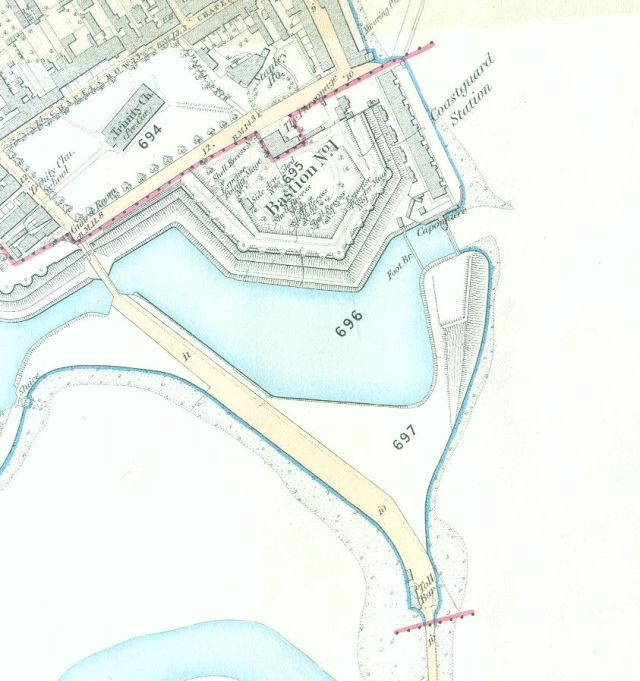
But we love a map - so let's start with one...  Bastion No. 1 (sometimes known as Trinity Bastion - named after the Church just north of it) is circled, North is top of page, so this Bastion was the one closest to the Harbour entrance while still remaining within the boundaries of the Harbour. 


The other side of the body of water labelled Haslar Creek in the map, is where Fort Blockhouse is now sited, and this would have dominated the actual entrance, so my assumption is that Bastion No. 1 was intended for defence in depth - if anything managed to get through the entrance, this was what the Bastion was there to oppose..

So when was it first built? Most of the fortifications in both the Portsmouth and Gosport Lines originate with de Gomme (we've met him already [clicky]) and that's the case for this Bastion as well. Building probably started some time around 1678, as one part of the aforementioned Gosport Lines, and at the beginning was probably no more than a "rampart 10-11 ft. high without a parapet and a moat, partly wet and partly dry, 30 ft. wide and 11 ft. deep" (source below). It's probable, the Lines as de Gomme designed them, were never actually completed (they certainly weren't when Charles II visited in 1683) - but work to complete them continued after the deaths of both de Gomme and Charles.


Second development phase kicks off in 1748, with a major redesign of the de Gomme fortifications by one John Peter Desmaretz - a master engineer, he was Architect to the Ordnance Board (he'd also served with Marlborough at one time). The work continued for 50 odd years and Bastion No. 1 was part of the last work completed, and wasn't finished until the turn of the century (1802/3'ish). 

It "..mounted 14 guns in brick lined emplacements firing over the parapet. Expense magazines were built into the earth of the rampart behind the terreplein. A caponier to protect the sluice connecting the moat to Portsmouth Harbour was added ... Behind this caponier a section of the rampart and wall was used as a school of musketry".

The guns would originally have been 18 and 24pdr smoothbores (I suspect the 18's would have been replaced during the life of the Bastion, and by the end they would all have been 24's) of the type typical for Royal Navy warships of the day, but mounted on wooden or iron traversing carriages something like the following interpretation from one of the boards on the site - note the anchor pivot at the back

 Something is not quite right with the picture based on where the actual pivots are in relation to the retaining wall/rampart in the bastion.. 😁

I suspect it was more like this example - with the pivot at the front...


OK - enough rambling - on with the pictures..

The bastion is on two levels - 'ground' pictures following..
  • "Expense Magazine" on the left - used for preparing cartridges, filled with gunpowder - there are two of these in the bastion - one at each end...  double brick lined with an air space between to keep out damp, and a raised wooden floor
  • "Ready use" magazine on the right - a smaller structure, which would have held about 100 rounds of mixed type (case/cannister/round) - there are four of these spread evenly along, and construction was the same as the Expense Magazines

Second Expense Magazine at the eastern end of the bastion

Inside the first expense magazine - the wooden floor is gone but the supports can still be seen.. note also the rare examples of Royal Artillery Mk 1 deck chairs... 😁

The following shows a good view of the ground level of the bastion - looking west - a further two ready-use magazines can be seen on the left.. the gun platform is above..  note the ramp at the far end to allow movement of men/munitions and guns from ground to the gun ramp - or as it is known in the parlance (fort speak), the "terreplein" 😏


There is a second ramp at the other/eastern end, but it is not part of the current bastion grounds and is pretty overgrown and separated by a fence - you can just trace the ramp by looking at the fence line..


Climbing up the ramp to the terreplein gives you the following view.. this is the rampart that faces roughly west'ish - Trinity Church on the left to allow you to orientate yourself to the map at the beginning..


Detail - following - on one of the emplacements. See what I mean about the pin/swivel? I suspect that the carriage swung round that pin, from the front - and from the remains of the stones at the back, through an arc of about 90 degrees


The pins/swivels are in remarkable condition given they're over 200 years old


Another nice view of the terreplein, this time from the eastern end - so these guns would be facing south towards Haslar Creek


....then a scramble up on to the top - following shows the moat and front face looking roughly north west.. originally there would have been a berm at the bottom, all the way along, which was used by sentries guarding the moat


..the northwest end of the bastion is not currently accessible - the Haslar Gate would have been down there where the road is in the following. It marks the western edge of the Bastion - none of the plans show any emplacements on top of this - it was purely defensive..  the berm would have been where that rough path at the bottom is... 


...and this - following - is the retaining wall behind it..  the Haslar Gate would have been where that house is


At the eastern end of the Bastion are some later additions that are not strictly part of  it other than the fact that they are connected physically.. this is it following.. note the gates for access..


It was built about 1853 and was used as a musketry school, but it's primary purpose was to defend the sluice gate that would have been about where the modern bridge is...  that sluice maintained the water levels in the moat.


This - following - is a view of it from the mentioned bridge.. ramparts for the bastion to the left - the defensive positions for the sluice are the loopholes, which are in a caponier (of which only this one remains - there would originally have been another, the other side of the bridge)..


...and here's the view of the inside of the caponier..


Last of all, I thought this - following - was good. It depicts the Bastion in, I think looking at the ships, the early 19th Century, maybe even after it was first completed.. note the retaining wall, the Vicarage (the grey building by the flag pole), and the top of the Haslar Gate (the brown square with white corners) providing access to the bridge


...and a couple of the excellent interpretation boards on site..


The death knell for the Bastion would have been the same as for the Portsmouth fortifications - the 1859 Defence Review. The Review had advised the building of replacement 'Advanced Lines' for Gosport - further out from the town due to advances in gunnery/artillery technology. Basically the same reason they started the Hilsea Lines - everything was moving further out from the thing they were defending..

It's likely the guns were removed as early as 1858, but what saved the Bastion was it's connection to Trinity Church - the Vicarage formed a major part of the rear of the Bastion (and still does - it's a very handsome building), but although it was sequestered by the Army, when the Bastion fell out of use, the Vicarage was returned to the church and the Bastion became it's private garden..

Further Reading:

Both of these are good..

~~~~~~~~~~~~~~~~~~~~~~~~~~~~~~~~~~~~~ 

 Laters, as the young people are want to say...

Saturday, November 29

"Firing into the Brown" #93 - Foot Guards, Bastion No. 1 and stuff

"So Carnehan weeds out the pick of his men, and sets the two of the Army to show them drill and at the end of two weeks the men can manoeuvre about as well as Volunteers. So he marches with the Chief to a great big plain on the top of a mountain, and the Chiefs men rushes into a village and takes it; we three Martinis firing into the brown of the enemy".

Kipling "The Man Who Would Be King"

Time for another update..  apologies for the intermission dear reader - too busy elsewhere, and not enough to blog on...
~~~~~~~~~~~~~~~~~~~~~~~~~~~~~~~~~~~~~


Look at those battle honours.. including all the big
four in the War of the Spanish Succession..
Another in the occasional "regiments of renown" series featuring the histories of various regiments painted in haste at the beginning of a project but which were not documented here for posterity.. so we come to British infantry regiment "1st Foot Guards" - the creme de la creme of the British infantry..

They were first raised in 1656 in Bruges as a bodyguard for Charles II whilst in exile. Initially under the command of the Earl of Rochester, on his death (1658) the command then passed to the regiments original founder, who was Thomas, Lord Wentworth 

Initially known as the 'Royal Regiment of Guards' it comprised 400 of the King's most loyal supporters - they were all officers in the earlier Royalist army of Charles I and who had gone into exile at the end of the war.

Following the Restoration (and in the interim, service at the Battle of the Dunes - where they were badly handled), they returned to England in 1660. In 1665 they were amalgamated with 'John Russell's Regiment of Guards' to form the 1st Regiment of Foot Guards - they remain the most senior regiment of the British Army to this day.

There is no point in repeating the excellent Kronoskaf regimental history of their service in the War of the Spanish Succession (see link below), but my reader will know that I am endlessly fascinated by the characters and personalities, so by way of providing some rabbit holes to disappear down, the Colonel-commanders during the War of the Spanish Succession were:

  • from 16 March 1689: Henry Sidney, Earl of Romney - described by Jonathan Swift (he of Gulliver's Travels fame) as 'an idle, drunken, ignorant rake, without sense or honour' - but given Sidney's politics, and that Swift was notably anti-Whig, other views may definitely differ! 😁 He died of smallpox at his house in London on 8 April 1704..

    Painting attributed to John Baptist Medina

  • from 24 April 1704: John Churchill, Duke of Marlborough - arguably (not arguably in my eyes) Britain's greatest general...  he lost the Colonelcy after his fall from grace with (Queen) Anne - "I am sorry for your own sake the reasons have become so public which makes it necessary for me to let you know you have rendered it impracticable for you to continue yet longer in my service".

    Painting attributed to Michael Dahl

  • from 1 January 1712: James Butler, 2nd Duke of Ormond - boo hiss 😏- a noted Tory, and the tool the British government tasked with getting the British army out of the war - the British government gave him secret orders to take no active part in supporting their allies under Prince Eugene. Happily - he was also a Jacobite as well as a Tory, and when George I (who was neither Jacobite or Tory!) came to power a mere two years later, he was stripped of  his posts as Captain-General, and as colonel of the regiment - both of which positions were given back to Marlborough.. yay!😁

    "A fine soldier, as a statesman ‘he often followed the advice of those who had a smaller share of sense than himself (and)... was as irresolute and timorous in affairs as he was brave in person’" Painting by Sir Godfrey Kneller (LΓΌbeck 1646 - London 1723)

Important men one and all, but the regiments battle field commander would have been the Lieutenant Colonel, and from what I can tell - this would have been these men throughout the period of interest:

  • Lieutenant-Colonel Henry Withers - he was Lieutenant-Colonel when the regiment was first sent to Flanders in 1701  - just the one battalion, of the four (!) the regiment comprised at that time. Withers was made Brigadier-General in March 1702, and Major General in 1704 shortly after Marlborough was made Colonel of the regiment. He eventually died at a good old age.. his grave stone says..

    "Henry Withers Lieutenant General descended from a military stock and bred in arms in Britain, Dunkirk and Tangier; thro' the whole course of the two last wars of England with France. He served in Ireland, in the Low Countries and in Germany, was present at every battle and at every siege and distinguished in all by an activity, a valour and zeal which nature gave and honour improved. A love of glory and his country animated and raised him above that spirit which the trade of war inspires; a desire of acquiring riches and honouse by the miseries of manking. His temper was humane, his benevolence universal, and among all those ancient virtues, which he preserved in practice, and in credit, none was more remarkable than his hospitality. He dyed at the age of LXXVIII years, on the XI of November MDCCXXIX. To whom his monument is erected by his companion in the wars, and his friend thro. life, Henry Desney".

    Not a bad epitaph at all.. 😊
  • At the Schellenberg, Kronoskaf shows them under the command of Lieutenant-Colonel Primrose (perhaps Captain? Maybe promoted as a result of his efforts?), who was wounded in the assault while leading the grenadier company, which had been detached to make up a composite force of grenadiers from multiple regiments. He recovered from his wounds, made Colonel, and was later given command of the 24th Foot - he ended up a Major General
  • Lieutenant-Colonel Philip Dorner assumed temporary command but was subsequently killed at Blenheim where the regiment was part of Fergusson's Brigade (that attacked the village of Blenheim).
  • Lieutenant-Colonel Charles Gorsuch then assumed command - he died in December 1708 at the Siege of Ghent after commanding them for five campaigns. When reinforcements for the Guards in the form of an extra Battalion was sent, Marlborough specifically asked that they not be sent with any officer senior to Gorsuch, so that Gorsuch would remain in overall command, he was that well regarded.
  • Lieutenant Colonel Cholmondeley is mentioned as being in command in 1711, but in the interim the most active battlefield command seems to have been by Withers (above)..

These are Minifig's and painted and based by me some time pre-2006 from the batch of unpainted figures that DG passed me when he decided not to proceed with the project. Probably one of the first regiments I painted..  flag is from the old Warflag site

Further reading:

~~~~~~~~~~~~~~~~~~~~~~~~~~~~~~~~~~~~~ 

Time to get my Dora the Explorer hat on - I was reading some stuff [clicky] on the Interweb the other day and mention of this one caught my eye..

Bastion No.1 from an 1890 WD Plan

Bastion No. 1 is in Gosport (just the other side of the harbour from Portsmouth), and over the years I must have crossed that moat via the modern footbridge any number of times without seeing the greater significance..  I sense a little winter project coming on - the Gosport Lines! 😏

Other reading sources:

Trinity Bastion - Gosports History

~~~~~~~~~~~~~~~~~~~~~~~~~~~~~~~~~~~~~ 

 Laters, as the young people are want to say...

Saturday, November 30

I have been to.... Battery #2 Stokes Bay
Hugely entertaining* and interesting afternoon out this week visiting another one of the local mesh of defences built to defend Portsmouth and the Home Fleet at the tail end of the 19th Century - and known collectively as Palmerston Forts (or Folly's if you are of a cynical bent). This time it was to Stokes Bay No. 2 Battery..

*(said no one in the world ever.. apart from a wargamer..😏)
Battery #2 in about 1890 - I've coloured the moat to make it more obvious..

This Battery was the largest of five (!) batteries built along the Stokes Bay Lines in Gosport (at what I think todays equivalent would have been about £12.5M which seems good value), positioned to dominate Spithead, the (Portsmouth) harbour entrance and the eastern Solent but also to provide enfilade and covering fire for other positions in the lines. What remains today is an architectural onion - so many layers you don't think you could ever unpick them all!

Here's what it was built to cover - Portsmouth to the left (east), Spithead and the eastern Solent in front

Either way, here's my amateur attempt (and some of the others I visited with, who are fellow members of the Palmerston Forts Society [clicky], are unbelievably knowledgeable on this stuff) to try and explain what I saw, and how it fits.

South/sea facing side - those emplacements had 68 pdrs smooth bores first, then 64pdr rifled muzzle loaders, then 7" Rifled Muzzle Loaders.. there's also two layers on show - the darker and lighter concrete marks the transition in the late 1890's

The Battery went operational in about 1862, it had taken four years to build. It was originally designed to mount 15 guns (the majority of which were 8" smooth bore muzzle loaders, but there were also a couple of 68pdrs) mostly in casemates very similar to those featured earlier in the Blog in the Hilsea Lines, and also like Hilsea it was protected by a moat that went all the way round it

All that remains of the original moat - this is on the west side running north/south

The casemates were arranged in four ranges (and the map at the top should help you to orientate): 

  • Left/Front Face with 2 guns on the rampart firing out to sea (guessing they were the 68pdrs). 
  • Right/West Face with 6 guns  in casemates covering Browndown (another part of the lines) to the west. 
  • Right/North West Flank with 2 guns firing north-west to provide enfilade fire for Fort Gomer (another part of the lines). 
  • Left/East Flank with 3 guns in casemates firing to the east and 2 further guns in open positions covering the beach in advance of the moat. 
The rear of the battery is open (it was positioned in such a way that the other battery's and forts could cover it, in the same way it did for the others) and when it was built there was no permanent accommodation  (the crews would have had rest area's, but no permanent barracks).  

Looking down from the ramparts at the back of the west facing casemates - note they are two sizes..  the bigger one's had the guns (and greenhouses πŸ˜€) in, the smaller between them would have been some kind of rest area for the crews.. note also how the casemate to the left has been half built over as a result of later developments of the battery

In the 1880s the smooth bore armament was upgraded, with two 64pdr Rifled Muzzle Loading guns mounted on the front face and 7" Rifled Breech Loading (RBL) guns elsewhere. 

In 1892, following a consultation, the two 64pdr's were replaced with 7" Rifled Muzzle Loading (RML) guns mounted on those fascinating Moncrieff disappearing carriages within the concrete emplacements on top of the battery. Within the battery there were two shell stores/magazines containing 930 7" RBL and 180 7" RML shells (plus barrels of powder and separate charges)

Number 2 Battery’s armament was again reviewed (and upgraded) in 1899 (fourth upgrade in effect - but this was 37 years after the battery went live so not surprising) along with significant changes to the structure. The 7" Rifled Muzzle Loading guns mounted on the Moncrieff disappearing carriages were replaced with state of the art 6-inch mark VII guns, new magazines were constructed for each gun, together with an additional reserve cartridge store between them. The old casemates were converted into crew shelters, stores and a married quarters. Some of the old gun casemates were used to install five cone mounted (think upside down funnel with the gun mounted on the spout) maxim machine guns for local defence. 

The West facing casemates - largely covered as part of the 1899 upgrade/changes - the Museum has plans to get an additional grant to uncover the front face..

Unfortunately the construction changes made for this upgrade were far reaching in terms of ongoing damage to the structure as well - the new bits were basically all concrete, and just slapped on top of the old, and which resulted in the huge numbers of chimneys/vents/lifts left to leak for a 150+ years until the current leaseholders (the Historic Diving Society Museum) managed to obtain a Lottery grant to reverse/stop the damage. Think this work is now largely done, and the Museum will re-open next summer..

New (left) and old (right) - with an air gap to allow wet/damp/growth..πŸ˜•

The battery was finally disarmed in the early 1900's following the findings of the 1905 Owen Committee who had reviewed all the the defences in the Stokes Bay area and come to the conclusion that the only enemy they would face would already have been badly damaged by outer defences. In the opinion of the Navy this damage would have been bad enough to discourage any further attack so the forts/battery's were superfluous..

The story is not yet over though as in the 1930's the local council purchased the Battery (they still own it), the old parade was used as a caravan park (and greenhouse store 😏) and the casemates for storage but in 1982 the Battery was used as the councils ‘nuclear bunker’ albeit only for 4 or so years..

A leftover from the cold war - this was/is the radiation air filter for the nuclear bunker..

OK some further photo's which I'll try and group according to context..  these are the two 6-inch mark VII gun emplacements


Base for the gun mount would have bolted to those.. not  lot of difference between this and the next picture but this was the east of the two emplacements..

West emplacement...

Expense magazine perhaps?


I'm a sucker for a casemate - so the following show exteriors and interiors..

Expense magazine (for TV storage who knew 😏) interior of one of the west facing casemates.. 162 years that wood surround has lasted - they could have made it a straight edge but they chose to put in a compound curve of both bricks and wooden lintel..  bless 'em..

Gun opening, same casemate, behind the blanket - note air vent above the opening.. there's soil the other side currently..

Fully renovated opening on the east side - going to guess this would have been one of the casemates used for the Maxim's - note also the angled edges in the grass which have been put in to show the angle of cover the original gun would have provided - very clever idea who ever had it!

Time now to move inside the Battery - the following is the (now) main entrance to the battery which is in the middle of the east facing casemates. Unlike the west facing casemates, these are enclosed..

Casemate gallery, gun openings to the right - note curved blast proof ceilings

The museum is storing it's exhibits in here, but the gun opening can just be seen - along with an expense store

"Recess, storage for the use of..."

Despite the face that the battery was no longer in use it does look like that at some point soldiers were barracked there as there are still some existing "autograph's" from the time - some of these are dated 1939/1944  and seem to be infantry regiments (rather than anti-aircraft as you might expect)..


Going to guess this might have been a magazine for the guns in the east casemate - it sits at the end of the gallery..


Then last of all down into the bowels of the battery to what would have been those new magazines for the MkVII 7" guns..

"Serving hatches" for the magazine - shells would have come through here, to be put on the mechanical hoists up to the guns on top of the battery

That's a vent - but this is the hall where shells would have been loaded on to the hoists..

Inside one of the magazines - light sconce on the wall would have had a lamp in it, with a glass screen either side..  issuing hatch for shells to the left..

Two more lamp sconces, stairs go up to the west casemate

Close up of a lamp sconce - there are loads of these all over the building, but still those Victorian builders put in the fancy airbricks

Battery insignia - Alpha battery..


Fantastic day out - very much recommended for a visit..  

~~~~~~~~~~~~~~~~~~~~~~~~~~~~~~~~~~~~~ 

 Laters, as the young people are want to say...