Showing posts with label Painting Total 2010. Show all posts

Saturday, January 1

Painting totals 2010...

Out with the old - and in with the new....

Hope you all had pleasant New years Eve festivities - suffice to say mine were every bit as dreadful as I was expecting....

So for the record - and to keep them safe - here were my painting totals for 2010... time to start gearing up for 2011!

3/1/10 - 8th Ohio - ACW - 20 figures - Newline Designs, 20mm @ 20 pts.
9/1/10 - 4th Virginia - ACW - 20 figures - Newline Designs, 20mm @ 20 pts.
20/1/10 - Carpenter's Battery - ACW - 13 figures/6 horses/limber/guns - Newline Designs, 20mm @ 25 pts.
9/2/10 - Ohio Light Artillery - ACW - 13 figures/6 horses/limber/guns - Newline Designs, 20mm @ 25 pts.
17/3/10 - Brigadier officers - ACW - 4 figures - Newline Designs, 20mm @ 5 pts.
14/4/10 - 5th Virginia - ACW - 20 figures - Newline Designs, 20mm @ 20 pts.
4/5/10 - 67th Ohio - ACW - 20 figures - Newline Designs, 20mm @ 20 pts.
18/5/10 - Regiment de Foix - WSS - 24 figures - Minifigs/assorted, 15mm @ 24 points
6/6/10 - Regiment de Saintonge - WSS - 24 figures - Black Hat, 15mm @ 24 points
15/7/10 - 7th Virginia and 1st Michigan (dismounted) - ACW - 16 figures - Newline Designs, 20mm @ 16 points
20/9/10 - 7th Virginia and 1st Michigan (horse-holders) - ACW - 8 horses, 2 standing figures - Newline Designs, 20mm @ 18 points
27/9/10 - 1st Michigan (mounted) - ACW - 8 horses & riders - Newline Designs, 20mm @ 16 points
9/10/10 - 7th Virginia (mounted) - ACW - 8 horses & riders - Newline Designs, 20mm @ 16 points
14/11/10 - 5th NY Volunteer Infantry (Duryee's Zouaves) - ACW - 20 figures - Newline Designs, 20mm @ 20 pts.

Total for 2010: 268 points

Friday, November 12

Duryée's Zouaves

I approached these figures with a considerable amount of trepidation for a number of reasons.. first the figures (by Newline designs) are very very nice and deserve a certain amount of skilled paint brush'ery, but two, one of the main drivers for my interest in the American Civil War was to be able to have a couple of zouave regiments present! So much responsibility to rest on such tiny metal shoulders

Either way can I present you with the first of the two zouave regiments (one Confederate and one Union) to join my American Civil War project; these are the Union 5th New York Volunteer Infantry, better known as "Duryée's Zouaves" after their first colonel, Colonel Abram Duryée.

The regiment was formed on April 12th, 1861, by a group of military enthusiasts in Manhattan, was formally accepted by the state on April 23rd. It deployed to Fort Schuyler at Throgs Neck, New York Harbour to organise, and was mustered into the United States army to serve for two years on May 9th. It must have been a sight to see; "the majority of the soldiers were educated and above average height".

Colonel Abram Duryée was appointed as the commander of the regiment (that's him to the left - an interesting man, he came from a family of soldiers, made general in the Union army, as did his son, and after the war he became New York City Police Commissioner!).

On the 23rd May it embarked for Fortress Monroe, camped for a few days near Hampton Bridge, then moved to Camp Butler, Newport News, and was attached to Brig Gen Ebenezer W. Peirce's brigade.

The troops of the 5th led the force at the battle of Big Bethel (June 10, 1861; the 5th New York Zouaves attempted to turn the Confederate left flank, but were repulsed) and lost 5 killed, 16 wounded and 2 missing.

In July they would be transferred to US Major General John A Dix’s division. Garrisoned in Baltimore, they would serve in the city’s defences through March 1862 when they were transferred to Brigadier General George Sykes’ Second Division of US Major General Fitz John Porter’s V Corps – Army of the Potomac - with which it fought in the battles of the campaign on the Peninsula. McClellan said that "the Fifth is the best disciplined and soldierly regiment in the Army." During this period Duryée had been promoted to general rank, so Governeur Kemble Warren (now that's a name..) took over command of the regiment.

At the Battle of Hanover Courthouse on May 27th the regiment played only a minor role. However, they had a more major role in the Seven Days Battles (June 25th –July 1st, 1862; a series of battles that prevented the Union army capturing Richmond - 'Bobby' Lee forced McClellan back to the James River)

As McClellan moved his base to the James River on June 27, 1862, the regiment fought against the Confederate soldiers under Gregg’s South Carolina brigade. In a counter-attack, the regiment defeated the initial Rebel attack.

In August 1862, the regiment came under the command of General John Pope. At the Second Battle of Manassas (also known as the Second Battle of Bull Run), the 5th New York Volunteer Infantry regiment was forced to withstand the advancing forces of General James Longstreet. After the hard fighting of the Seven Days battles, the regiment numbered around 560 men – 60 of which were new recruits.

Pope seriously underestimated the size of the Confederate advance and ordered the regiment to support Hazlett’s Battery. The stage was set for their bravest and most tragic moment.....

Longstreet’s soldiers easily outnumbered the small regiment, and the Texas Brigade (a battle hardened group that included the 1st, 4th and 5th Texas regiments, the 18th Georgia and the Hampton South Carolina Legion - four or five regiments to one!) quickly inflicted over 330 casualties on the regiment. One hundred and twenty of the zouaves were killed within eight minutes (!), the greatest single battle attrition of all Federal volunteer infantry regiments in the entire Civil War. The entire colour guard was killed, except for one man. The only officer to survive the battle was Captain Cleveland Winslow (who went on to command the regiment - though it would seem the men didn't particularly like him as he was a bit of a martinet).

"Forced to retreat towards Henry House Hill, nearly a mile to their rear, the few remaining Zouaves gathered around the regimental flag, which Warren had ordered jabbed into the ground. As Hennessy described in his authoritative narrative on Second Manassas, 'Warren sat immobile on his horse, looking back as if paralysed, while a handful of his men, formed in files of four, blackened with dust and smoke, stood under the colours as silent as statues, gazing vacantly….A murmur of surprise and horror passed through the ranks of our Regulars at the fate of this brave regiment.' With only sixty of its men filing under the regimental flag on Henry Hill, five hundred lay scattered - dead, wounded or missing - on the stubble field one mile to the west. The scene of slaughter was not missed by the charging Confederates, with one of Hood’s men stating the scene was 'a ghastly, horrifying spectacle.'"


Later, at the Battle of Antietam on September 17th, not surprisingly, what was left of the regiment was held in reserve.

Three months later they fought at Fredericksburg, and on December 15 helped cover the Federal retreat from the town.

Following several months in winter quarters, Winslow (who was now colonel) led the Zouaves in their final campaign culminating in the Union defeat at Chancellorsville (the Confederate victory was tempered somewhat by the mortal wounding of "Stonewall" Jackson to friendly fire, a loss that Lee likened to "losing my right arm.").

"The officers and men of the Fifth New York behaved as they have always done," brigade commander Patrick O'Rorke reported; "I can give them no higher praise."

On May 14, 1863, the regiment, commanded by Winslow, was honourably discharged and mustered out of service. Its three years' men (the newer recruits still with time to serve) were transferred to the 146th New York Volunteer Infantry.

During its service the regiment lost by death, killed in action, 4 officers, 126 enlisted men; of wounds received in action, 2 officers, 47 enlisted men; of disease and other causes, 37 enlisted men; total, 6 officers, 210 enlisted men; aggregate, 216.

Figures are Newline Designs, 20mm, and painted largely with inks - Winsor & Newton calligraphy ink (blues and blacks), and Daler Rowney FW acrylic ink for the red (nicer shade than the Winsor & Newton equivalent)..

======================================

At some point in time this week I noticed that the number of visitors to the site snuck past the 100,000 mark - only one word for it, "blimey"... oh, and all of you need to get out more! 

Saturday, October 9

7th Virginia finished!

As promised - the 7th Virginia are now finished in all modes - mounted, dismounted, and horse holders... a lot of painting to represent one regiment!

So with further ado - here they are (and as usual - clicking on any picture reveals a pleasingly larger view):

They are a little more irregular than their Union counterparts, I tried to vary the horse colours, and also the grey used in the uniforms, so as to give the impression that they weren't quite as "regimental". I also remembered the plain metal sword scabbards this time... 😏

My reading would indicate that cavalry on cavalry engagements in the American Civil war, Brandy Station aside, were very rare...

..the way that I will try to encourage this on the tabletop is something that Bluebear Jeff alluded to in a post a long time ago - very closed in terrain; there were no open spaces, as there was in Europe, to encourage sweeping cavalry charges...

...and just as a reminder, here they are in dismounted mode - horse-holders to the rear..

Figures are Newline Designs (of course!), 20mm and painted in my usual style - acrylics and inks on a black undercoat (with a white damp-brush for contrast)

Monday, September 27

1st Michigan finished!

Pleased to report that the 1st Michigan are now totally complete.. click on any of the following for a pleasingly enlarged view....

That's in all their table-top guises, dismounted [click here - and also for unit history], with their horse-holders [click here] for when in dismounted mode, and now also in this, their mounted mode...

I could rave for hours about how much I like these figures, but I think the best thing about them is that even my "painting savagery" doesn't spoil the lines...

Purposeful I like to think...

I especially like the grey on the end - he worked out quite well in this batch...

Figures are 20mm Newline Designs - painting was done in my usual style (rushed and botched... ) - black spray undercoat, dampbrush all over in white, and then predominantly a succession of inks/washes.

For the horses I used an old bottle of Citadel "Chestnut", the darker one is Vallejo "Smoke" - I didn't use anything for the grey - just a slightly heavier damp brush with the white than the others.... I then washed them all over with a very thin black wash... I went back to do mains/tails/bottoms of the legs/harness in plain black...

Coat tunics are Winsor and Newton Calligraphy ink "Dark Blue" - I like the way it highlights & shades all in one coat when painted on top of the white... I used their "Black" for the previous step... I like these inks so much I may try some of the browns for horse colours... only "downside" is that the inks are water soluble, but I like it, as it means a simple wet paintbrush easily fixes mistakes...! The inks are then fixed at the end with a matt fixative spray..

Dismounted mode - extended skirmish line with horse-holders behind....

The next eight are already under-coated and waiting to be turned in the Confederate 7th Virginia...

Tuesday, September 21

Horse holders...

Wow - clearly the trip to the Colours show was more affecting than I thought.. I had an almost overwhelming urge to pick up a paint brush when I got back... these guys were already under-coated so they were the unlucky candidates and drew the short straw!

These will provide the markers for my cavalry regiments when they dismount... these are the horse-holders for the Confederate 7th Virginia Cavalry [click here].


The following are the horse-holders for the Union 1st Michigan Volunteer Cavalry [click here]


..actually I think it's more to do with DG's visit and the sheer pleasure of pushing some lead around!

Figures are 20mm and Newline (I will try some other manufacturers at some point in time, but at the moment I'm wholly enjoying painting these little guys!)

This time I tried a new technique with these horses.. my favourite horses are bays - usually I use a paint to get the reddish brown colour (Vallejo Maron). This time I decided to save time - black undercoat, damp brush white, generous coat of some (very old) chestnut coloured Citadel ink, once that is dry over-brush with a generous coating of (very) dilute black ink, with a final darker black ink for mane and tail and the bottoms of the legs - done! No more than 10 minutes for all four, but I think they look OK... a little dark, but in the flesh they're good.

Next step - and already started - is the mounted versions of the regiments. First off the chocks will be the 1st Michigan.

Monday, July 19

1st Michigan Volunteer Cavalry

The 1st Michigan Cavalry was organized at Detroit, Michigan, between August 21 and September 6, 1861.

Thornton F. Brodhead (1822-1862) - that's him top left - studied law at Harvard, and practiced in Detroit, Michigan. 

He served through the Mexican was as an officer in the 15th infantry, and was twice brevetted for bravery. Resuming the practice of his profession after the war, he was elected to the state senate, and in 1852 appointed postmaster of Detroit. 

At the beginning of the civil war he raised the 1st Michigan cavalry regiment, in August, 1861, and the regiment left the State on September 29, with 1,144 officers and men. 

It went into winter quarters at Frederick, Md., but in February, 1862, moved into Virginia, joining Banks's troops in their advance up the Shenandoah Valley. While there it was attached to Williams's Division, and took a large share of the cavalry fighting in that campaign.

This was their flag..

Brodhead died of wounds received at the second battle of Bull Run while leading a charge; the regiment went on to serve at Gettysburg (where they took part in a charge that Custer – yes, him - pronounced unequalled for brilliancy and gallantry in "the annals of warfare") and until the end of the war..

It was later a part of the famed Michigan Brigade (also known as the Wolverine Brigade), commanded for a time by Brigadier General George Armstrong Custer. The brigade was created on December 12, 1862, at Washington, D.C.. It originally consisted of the 5th, 6th and 7th Michigan Cavalry regiments under the command of General Joseph T. Copeland. During the early part of the 1863 Gettysburg Campaign, the 1st Michigan Cavalry and Battery M, 2nd United States Artillery were added to the brigade in central Maryland as part of a major reorganization of the Army of the Potomac's Cavalry Corps.

The regiment was mustered out of service on September 12, 1865. Over the span of its existence, the regiment carried a total of 2705 men on its muster rolls. The regiment suffered 14 officers and 150 enlisted men killed in action or mortally wounded, and 6 officers and 244 enlisted men who died of disease, for a total of 414 fatalities.

Further references:

http://www.civilwararchive.com/Unreghst/unmicav.htm#1st

Figures are Newline and 20mm ad this represents the regiment in dismounted mode - the picture of them in line with the base width between, will be how I represent them in "extended line" for the Regimental Fire and Fury rules..

Thursday, July 15

7th Virginia cavalry...

Just to let you know that all wargaming activity in Steve the Wargamers life hasn't completely halted in the face of perfect sunny days, and force four breezes and that while, with weather like this, sailing is taking a bit of a lead (especially as I've only just got the boat back from an extended repair, and am absolutely gagging to get out on it as much as possible!), some painting is being done in the odd remaining minutes left over from said activity, sleeping, and working... 

So - no hanging about - this and the next post will detail the first cavalry to join the ACW collection. In both cases, as mentioned before, these represent regiments present at Kernstown. As usual, please feel free to click on any of the pictures for a gratifyingly bigger view...

The following are the Confederate cavalry, and represent the 7th Virginia in dismounted mode - the horse holders are already on the painting table and after that will be the mounted version..

I'm behoven to Wikipedia for a lot of the following - the entry for the regiment is very good, but happily there are also a number of other websites dedicated to the regiment as I think it is fair to say that the 7th Virginia Cavalry were one of the elite regiments of the Confederate States army..

The regiment was also known as Ashby's Cavalry (after a later colonel - read on for a little more about him) and was raised in the spring of 1861 by Colonel Angus W. McDonald, Sr.

The regiment was comprised primarily from men from the counties of the upper Shenandoah Valley as well as from the counties of Fauquier and Loudoun. Two companies contained men from the border counties of Maryland.

The regiment was initially assigned to guarding the upper Potomac and was attached to the command of Thomas "Stonewall" Jackson in the Valley.

On July 23, 1861, Brigadier General Joseph E. Johnston appointed Turner Ashby lieutenant colonel of the 7th Virginia Cavalry (his nickname was the "Black Knight of the Confederacy" due to his striking dark hair and beard - that's him to the left - Wikipedia has an entry here that is a good read, and there is also some good info here).

Due to the fact that McDonald was ill, Ashby had effective control of half of the regiment which he operated separately. When McDonald retired in February 1862 as a result of his continued ill health, Ashby assumed command of the entire regiment on March 12th.

In the spring of 1862 the regiment took part in Jackson's Valley Campaign, where Ashby's reconnaissance and screening skills were factors in the success of Jackson's campaign. At the First Battle of Kernstown, however, he "mucked up" and Jackson ended up attacking a retreating Union column that Ashby had estimated to be four regiments of infantry, about the size of Jackson's force. It turned out to be an entire division of 9,000 men (!), and Jackson was forced to retreat. Ashby was eventually killed on June 6th, he was only 33...

The regiment was reorganized at the end of the campaign as it had swelled to 29 (!) companies; the original 10 companies remained, with the excess forming the 12th and 17th Virginia. Together with these two regiments, the 7th would become the nucleus of the famed Laurel Brigade.

They served to end of the war, but managed to get home after Appamatox and disbanded rather than having to hand in their parole.

As ever these figures are Newline 20mm and a joy to paint... they are depicted in a very uniform/tidy way - in all likelihood the regiment would probably have been considerably scruffier than this... I have also seen documentation to show a quite bewildering array of armament in the regiment - all sorts or rifles, carbines, muskets, shotguns & pistols. These guys are all shown with the Spencer breech loading carbine - beautifully sculpted by the way!

If anyone has a good source for decent yellow acrylic paint by the way - please let me know - I have several types/versions, but none of them are satisfactory...

Next post will feature the 1st Michigan, a Union cavalry regiment

Tuesday, May 18

Regiment de Foix

As promised, I recently decided that I needed to add to my war of the Spanish Succession forces as somehow I had managed to get out of balance, and the French were lagging behind their opponents by a couple of regiments...


So - the first of the two regiments is the Regiment de Foix, who were formed in 1684 as part of the huge expansion in the French army requested by Louis XIV in that year. Altogether 62 battalions of foot joined the army (31 regiments) that year, and all in all 133 battalions were raised between 1684 and 1701!

The regiment de Foix comprised two battalions when it was established on the 14th September.. my usual sources seem to be at odds as to what the uniform was for this regiment but I've gone with the description as per Grant.. white coats & leggings, blue waistcoat, red cuffs and collar. Grant also seems to agree with the Osprey book on the armies of Louis XIV - a slightly later period but presumably mostly unchanged...


I'm assuming the regiment was raised in and around the town of Foix, which is about 30 miles west of Carcassonne and about the same distance south of Toulouse - it lies in the foothills of the Pyrenees..

At the time of Blenheim, the regiment was commanded by Joseph de Mesmes the Marquis De Ravignan. According to truly excellent book entitled "Histoire de l'Ordre Royal et Militaire de Saint-Louis, Volume 2" (which is available free and online here [click here]), Ravignan (who received said order in 1737) had an interesting and exciting life... the book is in French so the following is courtesy of an online translator and what I can make out (as the French is old style)!


He started his military career in the Musketeers, before leaving a few years later to join a regiment of Dragoons in which regiment he served at Steenkirk (1692), and the bombardment of Charleroi (1693).

Promotion followed with service in the French Guards, and in 1696 he was given the colonelcy of the Regiment de Foix.

The regiment was at both Munderkingen (13 July 1703) and the battle of Hochstad (20th September 1703) - both French victories, and Ravingen performed well enough that he was promoted Brigadier.

He further proved himself in the sieges of Lille and Tournai where Bouflers singled him out specifically to command a number of sorties.. a brilliant attack on entrenched troops at the Chapel of Magdelaine is specifically mentioned and got him a promotion to Maréchal de camp (Field Marshal).

For his exploits he was also made second in command of the defence of Tournai, but when it fell he rejoined the army in time for Maplaquet.

Afterwards he led a contingent of Grenadiers, Dragoons and infantry against a more heavily escorted Allied convoy, which he managed to burn, destroying a huge amount of powder, and then returned to Ypres with 20 prisoners.

He was captured in the fall of Ypres and served the rest of the war as a prisoner of the allies.


After the war and his release, Ravignan went on to serve in Italy in the capacity as Lieutenant Général during the war of 1734, at the end of which he was given the Grand Croix in the Order of Saint Louis.

He was also employed in the war of Austrian Succession. He eventually became sick & died in Straubing, after fifty-three years of service.

Only one word for that - wow!!

These figures are a right bunch of odds and sods - all 15mm of course - mostly Minifigs, but there's one British infantryman in there, and four (I think) Essex figures with those hideous tiny bases. The officers are also a hodgepodge - the standard bearer & drummer are Dixon I think, the enthusiastic gentlemen giving the Allies the benefit of his pistols is Peter Pig...

Monday, May 3

67th Ohio Volunteer Infantry..

I'm indebted the following excellent sites
http://www.ohiocivilwar.com/cw67.html [click here] and http://www.ohiocivilwar.com/67oh.html [click here] for a lot of the following... credit where credit's due and all that!

Unidentified Comrade 67th OVI<br />Courtesy of and Copyright © L.M. Strayer CollectionThe next regiment in my ACW project represents the 67th Ohio Volunteer Infantry...

The Regiment was organized by consolidating the parts of two other regiments, the 45th and 67th, and originally was under the command of a Colonel Otto Burstenbinder (now that my friends is a name and a half - all you fellow wargamers commanding armies in various Germanic imaginations may well want to borrow it!) but was soon succeeded by Colonel Alvin C. Voris.

National Colors 67th OVI"The regiment left Columbus, Ohio, for the field January 19, 1862, going into Western Virginia, under General Lander. With the exception of a march to Bloomrey Gap, the greater portion of the month of February was spent at Paw Paw Tunnel. On the 5th of March the regiment moved to Winchester, General Shields commanding the division, where skirmishing was frequent, on the picket-line, with Ashby's cavalry.

On the afternoon of March 22nd the regiment reported to General Banks in Winchester, and soon engaged the enemy, driving them till past nightfall, as far south as Kearnstown (sic). The regiment lay on their arms all night, and on the next morning were the first to engage the enemy. After the infantry fighting had been fairly opened the Sixty-Seventh was ordered to re-enforce General Tyler's brigade; to do which it was necessary to pass over an open field for three-fourths of a mile, exposed to the enemy's fire. The regiment executed the movement on the double-quick, and came into action in splendid order. The regiment lost in this action fifteen killed and thirty-two wounded".

After Kernstown they were then transferred to the army of the James (Union armies were named after the rivers that the army mostly served near) under McClellan, and shared in the Peninsula campaign, but in the December it was transferred to North Carolina where in the following April it took part in the assault on Fort Wagner with heavy loss.

After much more service, the regiment and was present at the final surrender and continued in service until December 12, 1865, when it was mustered out.

Colonel Alvin Coe Voris

Colonel Alvin Coe Voris enlisted as a 2nd Lieutenant in Company H, 29th Ohio Infantry on October 2, 1861. He was promoted to Lieutenant Colonel of the 67th Ohio Infantry on October 3, 1861. He was wounded July 18, 1863 during the assault on Fort Wagner. He was promoted to Brevet Brigadier General on December 8, 1864, then to Colonel on September 1, 1865, and then to Brevet Major General on November 15, 1865. He mustered out with his regiment on December 7, 1865 at City Point, Virginia - a survivor!


===============================================


Would love to have been at the following - must have been some cracking stories to hear!


===============================================

All figures are Newline Designs, in 20mm... I have no idea where the dog came from, but having found it, it was crying out to be used so I decided to make him the totally a-historical regimental mascot, "Rufus" (don't ask - my spuds named him!)

Tuesday, February 9

Battery L 1st Ohio Light Artillery..

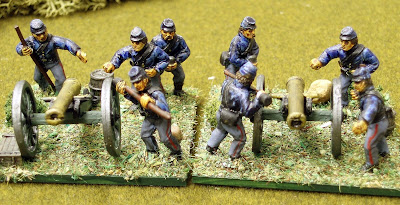
Just to let you know I haven't been completely idle in this fairly long interval between posts, can I now introduce you to the first Union artillery element, namely Battery L, 1st Ohio Light Artillery.. the poster by the way, is an authentic, actual, recruiting poster for the battery! Click on it, or any of the other pictures in the post, for a much larger view...

Like the other American Civil war units I've so far painted and researched, there is a pleasing quantity of information available for this unit, including a unit of re-enactors solely representing this battery!

The regiment came into being in 1860 under the Ohio Militia laws, and was commanded by Colonel James Barnett. It consisted of twelve batteries in total, and after doing their initial service in West Virginia the regiment was enlisted for three years service on September 3, 1861.

Each Battery in the regiment went on to have a separate history, as the regiment was split up amongst the various Union armies.

Batteries A, B, C, D, E, F, G, and M were with the Army of the Cumberland under Buell, where they served at Shiloh, and took part in the battles of Stone River, Perryville, Chickamauga and Mission Ridge. They also served during Sherman's Atlanta campaign, and with Thomas in the battles about Franklin and Nashville.

Batteries H and L (of which we have particular and most interest) were with the Army of the Potomac and fought all through the first battles (including Kernstown).

Batteries I and K fought both east and west, as they were transferred with Hooker's Corps to the west in 1863.

Battery L were commanded by a certain 44 year old Captain Lucius N. Robinson until he resigned on November 11th, 1862 (8 months after Kernstown and just two or three weeks before Fredericksburg), on account of physical disability. If you look on the poster you can see he was originally a Lieutenant.

He was superseded by Captain Frank C. Gibbs (a mere 26 - war is young mans occupation!) who commanded the battery until the end of the war. The battery comprised six 12pdr Napoleon's....
The following is excellent and is repeated verbatim - from this site http://www.civilwararchive.com/Unreghst/unohart1.htm

"From Dyer's Compendium

Deployments:

Organized at Portsmouth, Ohio, and mustered in at Camp Dennison, Ohio, October 8, 1861, to January 20, 1862.
Moved to Patterson's Creek, Va., January 20-27, 1862.
Attached to Landers' Division, Army of the Potomac, to March, 1862.
Artillery, Shields' 2nd Division, Banks' 5th Army Corps and Dept. of the Shenandoah to May, 1862.
Artillery, Shields' Division, Dept. of the Rappahannock, to June, 1862.
Alexandria, Va., Military District of Washington, D.C., to September, 1862.
Artillery, 3rd Division, 5th Army Corps, Army of the Potomac, to October, 1862.
Artillery, 2nd Division, 5th Army Corps, to May, 1863.
Artillery Brigade, 5th Army Corps, to April, 1864.
Camp Barry, Defences of Washington, D.C.. 22nd Army Corps, to May, 1864.
2nd Brigade, Hardin's Division, 22nd Army Corps, to July, 1864.
Artillery, 1st Division, 19th Army Corps, Middle Military Division, to August, 1864.
Reserve Division, Dept. of West Virginia, to September, 1864.
Artillery Brigade, Dept. of West Virginia, to January, 1865. 1st Separate Brigade. 3rd Division, West Virginia, to April, 1865.
Artillery, 2nd Division, Dept. of West Virginia, to July, 1865.

SERVICE.

Advance on Winchester, Va., March 7-15, 1862.
Reconnoissance to Strasburg March 19-20.
Battle of Winchester [a.k.a Kernstown] March 23. [At Kernstown they were part of the Artillery Corps under Lt. Colonel Daum, in Brigadier General James Shields First Division of V Corps, Army of the Potomac]
Occupation of Mt. Jackson April 17.
March to Fredericksburg May 12-21, and return to Front Royal May 25-30.
Moved to Alexandria June 29, and duty in the Defences of Washington till September. Movement to Falmouth, Va., October-November.
Battle of Fredericksburg December 12-15.
At Falmouth till April. 1863.
Chancellorsville Campaign April 27-May 6.
Battle of Chancellorsville May 1-5.
Gettysburg (Pa.) Campaign June 11-July 24.
Battle of Gettysburg July 1-3.
Duty on line of the Rappahannock and Rapidan till October.
Bristoe Campaign October 9-22.
Advance to line of the Rappahannock November 7-8.
Rappahannock Station November 7.
Mine Run Campaign November 26-December 2.
Duty at Camp Barry and at Forts Sumner and Kearney, Defences of Washington, till July, 1864.
Repulse of Early's attack on Washington July 11-12.
Expedition to Snicker's Gap July 14-23.
Sheridan's Shenandoah Valley Campaign.
Berryville September 3.
Battle of Opequan, Winchester, September 19.
Fisher's Hill September 22.
Battle of Cedar Creek October 19.
Duty at Winchester till December 28, and at New Creek till June 30, 1865.
Ordered to Columbus, Ohio, June 30.
Mustered out July 4, 1865.

Battery lost during service 1 Officer and 7 Enlisted men killed and mortally wounded and 1 Officer and 15 Enlisted men by disease. Total 24."

Very pleased with these guys as the uniforms came up particularly well... hell... I even managed to get the stripe on the side of the trousers!

Figures are Newline Designs, and are 20mm. For this limber I tried the alternative basing method I mentioned in my last post, and rather than have the limber as one long base I split it into three - two pairs of horses, and then the horse and limber.. I think it works well and I may still go back and re-base the Confederate limber at some time.

The artillery is based so as to be able to remove the guns from the base - it was a bit of a close fit with these guys as I also painted up some barrels and a crate to add interest!