Monday, May 25

Goose winged!

Apologies for the interruption to blog service folks - I promise you there's lots going on - it's just that there's not enough time to blog about them which in the grand scheme of things is probably the right way to go about life... do it and then blog!! So for your viewing pleasure the first of a few quick fire posts....

So - it's along weekend in the UK and most of it to date spent on the water - Saturday was a big race day at my local sailing club and I'd volunteered to man one of the rescue boats... bottom line I got to spend the day blasting all over the harbour in a nice comfortable rib, with a huge (for me) 40 horsepower outboard on the back, and better yet a nice little flag that meant the harbour master didn't mind me breaking the speed limit! Good day, though all the racing was delayed which meant we had a bit of a mud walk when we got back in...

Sunday though was a far more gentler experience as my littlest person and I took to the water in Papillon for the day... the outboard may be a tenth of the size, but it was an absolutely cracking day - we got the whole four hours of available tide, loads of sunshine, and although it was a little light at the beginning the wind soon filled in for some truly memorable sailing that had both me and little'un whooping... ace day... all capped off by a goose wing run from the bottom to the top of the harbour - and that has to be the most mellow experience known to man!

A little of what it was about.....


Distance: 8.5 miles (32 miles year to date)
Wind: None to Moderate (Nothing to force 3 perhaps gusting 4)

==========================================================

Next some book reviews....

This was a little bit of an impulse buy, but one that definitely worked out well...

As the author himself says, Napoleonic naval fiction is an absolute mine field for a new writer... and I guess you'd have to admire any writer who decided to launch a new series in this genre given the undoubted competition both past and present.

"Under Enemy Colours" is Russell's first novel, and I think he does an absolute blinding job... his writing is definitely in the style of Patrick O'Brian, but not quite so full on. I came to think of him as being the nautical equivalent of Alan Mallinson - Russell undoubtedly knows his stuff, and is not afraid to share it, but not in a heavy handed way....

The story is cracker - a half French lieutenant, Charles Hayden, currently unemployed and with little chance of finding a ship is offered a job by the first secretary of the admiralty to sign on as first lieutenant in a frigate commanded by an alleged tyrannical coward (quite a mix!).

He is given the task of reporting back with a view to removing the man from command which couldn't be done without evidence as the man is not without considerable "interest" or political clout...

The story about how Hayden finally manages to do this is accompanied by nice chunks of cutting out expeditions, broadsides, and all sorts of naval derring do, climaxing in mutiny and a full court martial... fantastic book, happily there's going to be another and I can't wait for it!

Steve the Wargamer gives this one 9 out of 10.

==========================================================

This one was recommended by Keith on his blog (click here) it is very unusual to find any books giving a good balanced account of the Italian Army in WWII so this immediately piqued my interest...

"Iron Hulls, Iron Hearts" (the motto of the Italian tank men) by Ian T. Walker is about the Italian Armoured Divisions in WWII from their inception to the surrender of the Axis forces in Tunisia. The vast majority of the book therefore covers the desert battles, from the disastrous battles of Operation Compass right up to Kasserine Pass...

Walker is very good at showing what the root causes are of the Allied (and German it has to be said) contempt for the Italian Army - what no-one was taking into account however was the huge material shortages that Italy faced at the start of the war and which inevitably led to huge shortages in material and equipment...

Despite this the Italian armoured divisions ("Ariete" & "Littorio" and later "Centauro") proved to be an integral and critical part of the forces available to Rommel - if they hadn't been there then Rommel may as well have packed his bags and gone home.

Again - this is an excellent read - the history is very familiar, what Walker does is show the effect the Italians had in each engagement on the bigger picture - what we see is that despite often failing to meet objectives due to poor equipment and limited resources, the Italians often batted over their weight, and often caused Allied forces to be sucked in that made Axis attacks on the flanks and in other parts of the battlefield significantly easier....

A brilliant book, and I'd say a must have for any wargamer with an interest in the North African theatre of WWII. Steve the Wargamer gives this one a well deserved eight out of ten.

...whew - and that's it for now - told you I'd not been idle...

Thursday, May 14

Heidebrecht Regiment based....

Just to finish off the last post, as promised some pictures of the regiment now that they're based and "flagged"...

Speaking of flags, I owe huge amounts of thanks to Dan Schorr (again!) on the Early Linear Warfare [click here] Yahoo group, and Yves Roumegoux & Ian Sumner on the Warflag [click here] Yahoo group, for details on the regimental standard.

In summary, details on the flag the regiment would have carried when they were under the command of Heidebrecht are not available, what details we have are from a French source that describes the flags taken by Louis's forces at the battle of Denain in 1712. This is much later than the period I'm specifically interested in, in fact it's even after Seckendorf had moved on, but as has been pointed out it's unlikely it would have changed much. At the time in question the regiments colonel was a man called Cavenach, or Kavenach...
First off, Dan sent me a black and white version of the flag which I was able to 'colour in' (no crayons were damaged in this process!) using information in the file - as follows..
Just as I'd finished this, Yves sent me the following - source is the Bibliotech Nationale de France - Cabinet des Estampes. The information is from a study by Jean Belaubre in 1970. Two flags are shown the one with the stripes (that I had done) is a company flag (the study indicates that the regiment would originally have carried one per company but this was reduced drastically as the war carried on). The plain one has exactly the same design and is a Liebfahne, or Colonel's colour.. interesting flags as the front and back of the flag do not have the same design. Best yet however, it has further information on it w.r.t the service of the regiment...
My French is rusty, but the pertinent parts of the Belaubre plate are as follows:

In January 1701, Georges Frederic, Margrave of Brandenburg Ansbach, raised 4000 men paid for by the Republic [Holland?] “all to be well equipped for service on the Rhine, or in the last campaigns in Hungary”. It consisted of two regiments of infantry: SECKENDORF (named 1708 Castel) and EBERSTADT (named 1703 Heydebrek, 1705 Seckendorf, 1711 Kavenach or Cavenach) and one of Dragoons: SCHMETTAU. Each infantry regiment comprised 1 battalion of 10 companies. Each company had it’s own flag but these were limited in the end to 3 per battalion.
Cavenach was badly engaged at the battle of Denain on July 21st 1712 and had almost 300 prisoners taken as well as these two standards taken by the French.

Ian & Yves also sent me an excerpt from another book titled "Bemalungsangaben fuer die Zeit des Spanischen Erbfolgekrieges" which was written in the 1960's by Goldberg and Wagner. Yves says the source for this is the same one Belaubre used. It was published in Hannover by Siegbert Wagner.
As you can see I decided to go with the Liebfahne for this regiment...! As per the last post, all figures 15mm and by Minifigs..

==========================================


On the sailing front, just a small trip last weekend - the wind was up and in the interests of ensuring that at least some of the family still wished to come out next time I decided to curtail the adventure!

Distance: 3 miles (23.5 miles year to date)
Wind: Moderate (force 3 gusting 4)

Tuesday, May 12

Heidebrecht Regiment....

Something of a milestone today as according to Blogger this is my 250th post!

Anyway - here is yet another demonstration, if any were needed, that Steve's painting funk may be coming to a close... another War of the Spanish Succession unit, but this time some infantry... just an advanced view - they need to be based.

An unusual regiment this time - not in terms of uniform which is pretty standard for the period, but in terms of nationality. This is the Heidebrecht Regiment (named as was usually the case after their colonel) who come from the Margraviate (click here)of Ansbach (click here) a very small country, and part of the Franconian Circle (click here) - that's their heraldic emblem up to the left.. Ansbach troops (like the Swiss) served in the pay of Holland.

There's little other information about Heidebrecht the man I'm afraid... in fact nothing at all other than the fact he was a major general. I do know that the regiment was present at Blenheim where they served in the 1st Line of the Allied Centre in the Prince of Holstein-Beck's Brigade, under Lieutenant General Horn.


Grant (click here)
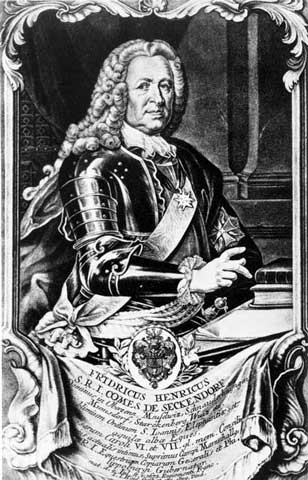
indicates that the regiment passed to a gentlemen named Friedrich Heinrich, Count von Seckendorf in 1705 (so the year after Blenheim - that's him to the right), and there's a lot more about him as he seems to have been a politician as well as a soldier.. Undoubtedly brave, Seckendorf seems on the face of it to be a particularly difficult man to like - he also had a long and eventful life!

In 1693 he served in the allied army commanded by William III & became a cornet in a Gotha cavalry regiment in Austrian pay. Leaving the cavalry he became an infantry officer in the service of Venice, and ended up in Ansbach in 1698 when his regiment was transferred to imperial army.

In 1699 as lieutenant-colonel of dragoons his Ansbach regiment was taken into the Dutch service. During the War of the Spanish Succession, Seckendorf led Ansbach's regiment and, at the head of a regiment of dragoons captured 16 standards at Blenheim. Promoted to Oberst (colonel), he was also present at Ramillies, Oudenaarde (where he distinguished himself) and the siege of Lille (where he was severely wounded).

Disappointed not to be promoted further by either Holland or Austria, he entered the Polish-Saxon army as a major-general and fought as a volunteer at the siege of Tournai and the battle of Malplaquet.

After our period he continued to serve in a diplomatic capacity in the peace negotiations, before ...

  • in 1713 suppressing an insurrection in Poland
  • in 1715, as a lieutenant-general, commanding the Saxon contingent at the siege of Stralsund, defended by Charles XII of Sweden.
  • in 1717 in the service of the emperor, and with the rank of lieutenant field marshal, he was present at the siege of Belgrade with Prince Eugene.
  • in 1718 and 1719 he fought in Italy, where in 1719 he was made a count of the empire.
  • in 1726, at the request of Prince Eugene he was made the Austrian representative at the court of Prussia. He remained at Berlin, with short intervals, up to 1735, and for the greater part of this time exercised a strong influence over Frederick William II. He was deeply involved in the family quarrels which embittered the lives of Frederick William, his queen and the crown prince (Frederick the Great), & which culminated in the prince's condemnation to death by court martial.
  • in the same year he was also appointed general of cavalry of the army of the Holy Roman Empire, and served with such distinction as was to be gained in a war of positions in the Rhine campaigns of the War of the Polish Succession (1734-35)
  • in 1737 the emperor Charles VI, made Seckendorf commander-in-chief in Hungary, at the same time promoting him field marshal. The new commander began well, but failed at the end, and his numerous enemies at Vienna brought about his recall, trial and imprisonment.
  • He remained in jail until 1740 (when he was 67 years old), and was then reinstated by order of Maria Theresa, but being denied his arrears of pay he gave up all his Austrian and Imperial offices and accepted the rank of field marshal in the Bavarian service from the emperor Charles VII, elector of Bavaria.
  • His last campaigns were those of 1743 and 1744 in the Austrian War of Succession where after the death of Charles VII and the election of Maria Theresa's husband to the imperial crown, he became reconciled with the Austrian court.
  • He largely retired in 1745, and after the death of his wife in 1757 his health broke (not surprising at the age of 84!). This wasn't the end of his eventful life however, as in December 1758 he fell into the hands of a Prussian hussar party and was held prisoner for five months by his old enemy Frederick the Great (who had little love for him either as his former court enemy, or as his unsatisfactory ally in the first Silesian war).
  • He died at Meuselwitz on the 23rd of November 1763 aged 90....


    As I say - undoubtedly brave but an almost universally disliked man! The historian Carlyle (in his book "Frederick the Great", vol. ii.) described him as a cold, passionless intriguer, taciturn, almost stolid, and absolutely unscrupulous in the furtherance of Austrian political aims. Frederick the Great wrote that "He was sordidly scheming; his manners were crude and rustic; lying had become so much second nature to him that he had lost the use of the truth. He was a usurer who sometimes appeared in the guise of a soldier, and sometimes in that of a diplomat". With a description like that I feel sure he would have been right at home amongst the vile Stagonians...!

    Having said that, it was the death of his wife that caused his health to break and he was quite obviously devoted to her... obviously brave... better to say that he was a complex character I think.

    Figures are by Minifigs in 15mm. As recommended/suggested by Flanderkin Serjeant (click here) this unit was the first time I had used mostly inks rather than paints to complete the regiment. Worked well, and I especially like the effect I got with the deep blue ink over black primer with a quite drybrush with white..

    Inks were FW (Daler Rowney) for the red:
    ..and the Dark Blue Windsor and Rowney Calligraphy (as opposed to normal) ink - I've always been a fan of the black, the dark blue is going to be as popular. I may get the scarlet in this range as well as it was marginally easier to use than the FW which was a little thicker...
    In fact the only paints I used on these were white, grey, metallics for the muskets and lace, and a tadge of pink for the officers sash... overall impression is one of speed, inks are quicker to paint with than paints... much more useable...

    I'll post some more pictures once the unit is based...
  • Wednesday, May 6

    Regiment de St. Pouanges

    With a resounding "crash!" Steve drives through the painting funk (see previous post) and - at last - sits down to paint this latest unit to join the ranks of His Majesty King Louis XIV...


    I've always enjoyed painting horses, so if there was any way to get me out of the current painting funk a cavalry unit would be the one to do it... so it was, that after a pleasant early morning sail on a fairly sunny bank holiday Monday* I sat myself down to apply paint to metal..

    These guys are the result, and I'm quite happy with them... Some of the saddle cloths have a slightly shaky edging but nothing that detracts from their undoubted air of superiority. These guys very definitely have their chins in the air!

    They represent the Regiment de St. Pouanges, who were just one of the 100 odd regiments of horse that Louis had in his armies at one time or the other, and I have been able to find out very little about them at all (though it was interesting to look!). They aren't even mentioned in Grant (and come to that neither are the next regiment on my list) so distinctly anonymous..

    What I do know however, is that they are listed as being present at Blenheim, where they were two squadrons strong (so about 100 men), and were brigaded with three other cavalry regiments; the Regiment de Orleans, the Regiment de Montreval (click here) and the Regiment de Ligonday in the Marquis de Silly's brigade of Marechal de Camp, the Duc d'Humeries's division. I have some deep diving to do to figure out if they were present at any of the other major/minor battles of the period...

    Figures are 15mm from Roundway and have been sat in my painting box for quite a while as in the metal they didn't seem to be too good, having painted them though I think they look considerably better. They were quite "flashy" though and required a fair amount of cleaning... & the tricorn is ridiculous - way too small! I now only have Ligonday to do to complete the whole of the brigade...

    =============================================

    * ..and the sailing? Lovely! A couple of fantastic trips out recently..

    ...as previously mentioned in the post on Marlborough's runners I did have the day off a week or so ago for my first solo trip - the fishing road was wielded in anger (caught nothing but I did get to reacquaint myself with rag worms - blechhh!). Most importantly a lot of confidence was built up; I can handle the boat on my own, and especially under sail... bodes well for a longer trip later in the summer. Even better though, I also caught my first brief sight of one of the colony of seals in the harbour - there's only 15 or so, but amazing to see one...

    Distance: 6 miles
    Wind: light (force 1 or 2)

    The trip referred to above, however, was on bank holiday Monday. Not good tides as the high was at 8 in the morning, and at best I can only sail from two to three hours either side of that before the mud takes over from the water! Either way I dragged littl'est person from her pit at 7 for company, and we were motoring for the main channel by 8... very light winds at that time of the morning, but with a full flask of tea, and some good chat with my youngest and the time just flew by. Ace day....

    Distance: 6 miles (20.5 miles year to date)
    Wind: v. light (force 1 just 2 at times)

    Friday, May 1

    .more books...

    There's no getting away from it, Steve the Wargamer is currently in the middle of a "painting funk" - a brush hasn't been raised in anger (except for a couple of occasions) for most of the year, so far...

    I'm not too worried about it as I know that these things come and go, and I know I'll be painting again soon. The best of the joy however, comes from knowing that the wargame hobby is truly a broad church; if I don't fancy painting, what does it matter, there's still reading, research, blogs, the latest wargames magazines, and a host of other facets of the hobby to keep me occupied until the painting urge comes upon me again...

    So it is that I've been doing a fair amount of reading lately... the latest book I've just finished is the one pictured above left. It's only just been released in paperback and is the latest in the "Simon Fonthill" series by John Wilcox. I've only ever read one of his other books, which I think was set in the Zulu War and that was ages ago. I seem to remember that I didn't think much of it, so to a certain extent, the spending of hard earned birthday book vouchers on this one was a bit of a leap of faith (justified by the subject matter more than anything). As it turns out, I was pleased I did...!

    The main protagonist is of course Simon Fonthill, an army captain who (we learn) was court-martialled in one of the earlier books, but having been cleared subsequently decided to leave the army anyway. He was accompanied in this departure from the army by his trusty side kick "352" Jenkins (so called because as a Welshman, he was one of a number with the same name in his regiment, and so was referred to by the last three numbers of his serial number).

    Mr. Wilcox does not believe in his hero's hanging around idle, so having been conspicuous by their presence in the Zulu War, the Afghanistan Campaign, and the Boer War, we now find him and 352 at his home in Wales for a spot of leave. This doesn't last for long however, as the rumblings of discontent begin to be heard from Egypt as Arabi Pasha begins the militarisation of Egypt in an attempt to overthrow Turkish rule.

    Summoned to Whitehall by Lieutenant General Sir Garnet Wolseley, he is asked to go to Egypt in an unofficial capacity as an intelligence gatherer. Having worked for him before Wolseley asks him to be his unofficial eyes and ears in Egypt to report back to him the state of readiness of the Egyptian army...

    ..and so it starts....

    Pretty soon Fonthill is caught up in the fighting in Alexandria, the bombardment by the British Navy under Admiral Seymour (Wilcox gives a good view of his character!) and the subsequent landings by the Royal Marines to safeguard people and property.

    Before he can even draw breath however, he is then sent in to the desert on a number of missions for Wolseley information gathering in preparation for a full blown invasion...

    Throw in a lost love now married to the man who caused the court martial, a particularly nasty baddy who works for Thomas Cook the travel agent, a trusty Egyptian helper and this story fairly rips along before culminating in the actual battle of Tel El Kebir...

    Suffice to say I'd finished it in a couple of days and was wishing I hadn't... characterisation is good, the people in the book are believable, and Wilcox is very good on historical facts and background which for a wargamer is key...

    I knew a fair amount about the campaign anyway (I recommend the Featherstone book in the Campaign series on the Tel el Kebir (click here) campaign) but a well written novel helps to feed the imagination on what it must have felt like to be present... this it delivers in spades...

    Steve the Wargamer gives this one an 8 out of 10

    PS. I notice that the next book is now out in hardback and features the Siege of Khartoum (click here); has to be a must have..