Saturday, March 9

"Firing into the Brown" #42 - Ingoldsby's, Dues and stuff..

"So Carnehan weeds out the pick of his men, and sets the two of the Army to show them drill and at the end of two weeks the men can manoeuvre about as well as Volunteers. So he marches with the Chief to a great big plain on the top of a mountain, and the Chiefs men rushes into a village and takes it; we three Martinis firing into the brown of the enemy".

Kipling "The Man Who Would Be King"

Time for another update..
~~~~~~~~~~~~~~~~~~~~~~~~~~~~~~~~~~~~~

Joseph Sabin - portrait attributed to Edward Byng
Another of those 'regiments of renown' that I missed the unit histories for - this time we get a two'fer, as the regiment in question serves in two separate projects, and therefore exists in two separate instances in my collection of little metal men..  Ingoldsby's (from my Marlburian project), later became The Royal Welch Fusiliers, and then the 23rd Foot (in my American War of Independence project)

Raised in Wales and in the adjacent counties on 17 March 1689 by Henry Lord Herbert, the regiment was intended to assist King William III in his campaign in Ireland. In Ireland they fought in the battles of the Boyne and Aughrim and a number of other sieges. From 1693, they were commanded by, and got their original name from Colonel Richard Ingoldsby (who was promoted to Brigadier on 31 May 1696) but at Blenheim they were already under the command of a new Colonel (brevet), Joseph Sabine. Sabine was confirmed in his promotion, and got the regimental Colonelcy in 1705 (and remained in that role until his death.. in 1739!)

The regiment went on to win battle honours at all four of the great battles of the war; Blenheim, Ramillies, Oudenarde, Malplaquet. 

Timeline (abbreviated - the Kronoskaf site referenced below is far more/better detailed)

  • On 7 June 1701, the regiment embarked at Carrickfergus, arriving on 30 June in Holland and proceeding to Workum and Heusden. 
  • 1702, the regiment went to cover the siege of Kaiserwerth and later formed part of the covering army during the siege of Venlo. Designated a fusilier regiment and became the Welch Regiment of Fusiliers ("Welch" being correct, and the old spelling)
  • 1703, the regiment proceeded to Maastricht, it was at the siege and capture of Huy. 
  • 1704, the regiment marched towards the Rhine and then was part of Marlborough's march to the Danube. The regiment took part in the Battle of the Schellenberg (where Sabine was wounded) and later it fought at the Battle of Blenheim. The regiment then marched through Swabia to cover the siege of Landau.
  • 1705, the regiment was in garrison at Roermond. A detachment of the regiment was employed in recapturing Huy. Later the regiment took part in the passage of the French lines at Helixem and Neerhespen.
  • 1706, the regiment fought in the Battle of Ramillies. It formed part of the army covering the siege of Ostend, it continued to form part of the covering army during the sieges and capture of Menin, Dendermond and Ath. 
  • 1707, no action - the opposing armies passed the campaign in manoeuvring and observing the movements of each other.
  • 1708, the fought in the Battle of Oudenarde as part of Cadogan's Corps. From August, it took part in the siege of Lille. 
  • 1709, the regiment received a body of recruits from England. In June, it formed part of the covering army during the siege of Tournai later in the year the regiment fought in the Battle of Malplaquet. The regiment then formed part of the covering army during the siege and capture of Mons.
  • 1710, the regiment took part in the siege of Douai and later formed part of the covering army during the siege of Bรฉthune, Aire and Saint-Venant.
  • 1711, the regiment was part of the Allied army that passed the Ne Plus Ultra Lines at Arleux. The regiment then took part in the siege of Bouchain.
  • 1712, the regiment formed part of the covering army during the siege of Le Quesnoy soon afterwards a suspension of arms was proclaimed between the British and French, preparatory to a treaty of peace
  • 1713 the prefix "Royal" was added to the regiments name
  • 1714, the regiment returned to England and was subsequently stationed in Ireland. Royal title confirmed when George I named them the Prince of Wales's Own Royal Regiment of Welsh Fusiliers.

At the Schellenberg the regiment was brigaded with the 1st Guards, Orkney's Regiment & Meredith's Regiment under the brigade command of Fergusson, where they were part of the Advance Guard in the division of Lt. General Goor under John Churchill, Duke of Marlborough. They took significant casualties (in addition to the wounding of Sabine mentioned). 

At Battle of Blenheim they'd been re-organised, and comprised about 520 men all told. They were now a part of the column attacking Blenheim village, under the command of Lieutenant General John, 1st Baron Cutts of Gowran (the "Salamander") in Brigadier-General Rowe's Brigade comprising themselves plus the Scots Fusiliers (1 bn, 629 men), Howe's Foot (1 bn, 584 men), Duke of Marlborough's Foot/Derring's (1 bn, 524 men), and Lord North and Grey's Foot (1 bn, 580 men)

In 1689, the uniform consisted of a blue coat faced white; white breeches; and white stockings but by the time the War of the Spanish Succession had broken out they had probably already transitioned to scarlet, but for sheer interest I stuck with blue (weeeellll..  the colonels had to pay out of their own pockets so you wouldn't want good uniforms to go to waste, would you? ๐Ÿ˜). No details on colours at that time so I went with a plain cream one..  if anything subsequently comes to light I'll give them a proper one..

My representation of Brigadier General Archibald Rowe's brigade - in the front row Ingoldsby's (Welch Fusiliers) on the right, and Derring's on the left. The brigadier with runner is in the middle and in the second rank we have Howe's on the left. The regiment on the right is a Dutch regiment, Rechteren's who have just photobombed the picture.. ๐Ÿ˜

Following the 1751 British army reforms that standardised naming and numbering of regiments, it then  became the 23rd Regiment of Foot (Royal Welsh Fusiliers). Up to 2004 it was one of only five line infantry regiments never to have been amalgamated, but it was announced then that the Royal Welch Fusiliers would merge with the Royal Regiment of Wales to form a new large regiment, the Royal Welsh.

Sources/references:

~~~~~~~~~~~~~~~~~~~~~~~~~~~~~~~~~~~~~ 

Interesting little snippet on the "Ian Visits" blog..  


Next week they will be celebrating the "Ceremony of the Constable’s Dues" at the Tower of London...  an old, old, tradition the origins of which are centuries old, and refer to when ships visiting London would have to make a payment to the Constable of the Tower of London. Over time, as the river became busier and busier, the dues became less and less, and in the end, disappeared all together apart from this one occasional ceremonial offering - usually by a visiting warship - and on an infrequent basis..  

This year though, the Royal Marines are doing it, and the river is being closed as they are using a Merlin helicopter and three ORC's! Should be a quick delivery as I saw one of those ORC's at the boat show a number of years ago [clicky](0 to 30 Knts in 10 seconds ๐Ÿ˜!!)

More info..

~~~~~~~~~~~~~~~~~~~~~~~~~~~~~~~~~~~~~ 

 Laters, as the young people are want to say...

Saturday, March 2

"Firing into the Brown" #41 - Submarine Museum, Gunfight at Dexter's Corral and stuff..

"So Carnehan weeds out the pick of his men, and sets the two of the Army to show them drill and at the end of two weeks the men can manoeuvre about as well as Volunteers. So he marches with the Chief to a great big plain on the top of a mountain, and the Chiefs men rushes into a village and takes it; we three Martinis firing into the brown of the enemy".

Kipling "The Man Who Would Be King"

Time for another update..
~~~~~~~~~~~~~~~~~~~~~~~~~~~~~~~~~~~~~

Use continues to be made of the Dockyard yearly ticket - this time with a much-anticipated visit to the Royal Navy Submarine Museum - home to HMS Alliance (following) which absolutely DOMINATES the entrance to the museum...  

Alliance (pennant number P417/S67) is an A-class, known as the Amphion or Acheron-class, submarine. She was constructed between March and July 1945, but not commissioned until 1947, so didn't see WW2 service. 

The design was intended for operations in the Pacific where because the distances were huge, required specific modifications and features...  anyway, more on her in a moment...


First, I had a look inside the museum where the first thing to catch the eye is one of the last remaining X Craft from WW2...  

These are the class of miniature submarine immortalised by John Mills in "Above us the Waves" (which for my UK reader is currently showing for free on ITVx) the film of the sinking of Tirpitz in the fjord in Norway. The one they have in the museum though, is X24 – the only one to have seen combat in, and survived, WW2. 

She was used used on Operation Guidance (attacking the Laksevรฅg floating dock at Bergen 15 April 1944) when due to faulty intelligence and incorrect charts, the merchant ship Barenfels alongside the dock was sunk instead; X24 went back though, and dock was attacked and sunk in Operation Heckle on 11 September 1944. 

...explosive charge carried on the side is a mock up clearly, as 4.4K pounds of amatol might make a hole in the floor if it went off...  8.8K pounds if it also set off the one on the other side.. ๐Ÿ˜

...and this - following - is the answer to last week's question.. they used the same diesel engine in the X Craft as they did in double decker buses, this is a Gardner (specifically, a Gardner 4LK 4-cyl diesel engine, driving a Single shaft, and giving 42 hp at 1,800 rpm ๐Ÿ˜€)..  they used them in fire engines as well apparently... I found it amazing, but it was a tried and trusted power plant, plenty of spares, easy to maintain...  you can see why they chose it but therein lies one of the fundamental differences between the German and British approaches to such a question - I don't doubt that the Germans would have had Daimler design a new engine specifically for the purpose, almost certainly more elegant, more powerful, but also more difficult to maintain, and yet another strand in the supply chain that the Kriegsmarine would have to support...  well done, Norm, you were first to answer "engine", kudos to Matt for coming in second..  Maudlin Jack Tar's answer gets an honourable mention, it wasn't correct but it did make me almost spit out the mouthful of coffee I had just slurped... ๐Ÿ˜‚ 

You can see the electric engine (used underwater) behind it..


...there is something very, very poignant, about the sheer guts and bravery of the men who went to war in these craft, seated in what can only be described as a piece of garden furniture (following)..  it just beggars the imagination and sent shivers down my neck when I looked...  truly we stand on the shoulders of giants...


..but having enjoyed the museum it was time to visit Alliance.. 

I was really impressed with the layout and access for her, by the way - basically you enter the front of the boat in the forward torpedo room and can then walk to the far end (exit is in the rear torpedo room) in your own time... the guides are available to ask questions of, and are usually ex-submarine men themselves... they have a soundtrack playing in the background to give the impression that you are walking through an active submarine..  snatches of conversation, tannoy announcements and the like, very effective..

Sailors mess (living area) - count the bunks - between 6 and 8 blokes would have shared this space, she had a crew of about 60, plus 5 officers, so space would have been at a premium...


Captain's cabin - loved the fact that he got chintz covers...  ๐Ÿ˜


"Fruit machine" (early target range and deflection calculation device) and torpedo launching panel - following - when originally launched Alliance had six bow torpedo tubes (including 2 external dry close fit) and four stern torpedo tubes (including 2 external dry close fit) and carried 20 torpedoes - during a major refit in the late 50's early 60's to make her "Cold War suitable" the external tubes were all removed (made her quieter under water) ...


Vents/ballast controls - following - unbelievable complexity! This is the helm position - note the trim indicator, depth, and steering column - looks like a bike handlebar!


Same - dual steering - note also periscope handle on the left


Two toilets (following) with 65 blokes you've got to hope they didn't have curry often... ๐Ÿ˜ 

By the by, I read that this may well be where the phrase "getting your own back" originated - though that may be apocryphal. In essence, once you'd completed your business, if you didn't operate the pressure gauges to blow the contents out of the ship in the correct order, you might get back what you just deposited... ๐Ÿ’ฉ


Engine room - Alliance was a diesel electric boat, diesels for surface, electric under water, but she was fitted with a snorkel to allow her to use her diesels while partially submerged... what you see here is one of two 2,150 hp (at 450 rpm) supercharged Vickers 8-cylinder diesel engines...  these would give her 18 knots on the surface, which was fast for the time, and also necessary for a Pacific based boat...


...and here's the electric - one of two 625 hp electric motors for use underwater; after the refit in 1960'ish she could do 10 knots underwater... 


...that refit by the way was major - in addition to removing the external torpedo tubes, they also removed a deck gun, an anti-aircraft gun, and also massively redesigned the fin (not the conning tower as most people call it) - this is her, following, pre refit. 


Basically, a quintessential WW2 submarine went in for refit, and the Cold War submarine came out...  it was only afterwards, thinking about the visit, that I realised Alliance and Mary Rose have a thing in common, both of them were designed for a specific type of warfare/role that fundamentally changed during their service life, and both had substantial refits to be able to support that change in role...  fascinating, I thought - bleedin' obvious to everyone else I suspect! ๐Ÿ˜

More info:
Absolutely brilliant day out, and very much recommended...

~~~~~~~~~~~~~~~~~~~~~~~~~~~~~~~~~~~~~ 

The sun burned down out of a cloudless sky as 'Mexican' Pete (Average gunfighter, hand to hand rating of 3, rifle rating of 2, revolver rating of 3) and fellow gang member Zack (Novice gunfighter, HtH 1, R 0, Rev -1), approached the sleepy border town of Cedar Gulch (population 67) on foot, and intent on mischief. 

Their horses were tied up in a concealed spot just outside of town so they wouldn't be encumbered. 

They were looking for Gerry (also an Average gunfighter, HtH 3, R 2, Rev 3), a member of a rival gang who they had heard was also in town, somewhere near Dexter's Livery Stable - suffice to say they weren't planning to buy him a beer....

Mexican Pete and Zack can be seen entering top right - Gerry and Robbie bottom left..  the corral is dead centre..  in both cases the "boss men" had given orders to their sidekicks to try and outflank.. north is top..

What they didn't know as they slowly approached the corral next to the livery was that Gerry wasn't alone, he was accompanied by one of his fellow gang members, known only as Robbie (Novice gunfighter, HtH 1, R 0, Rev -1). The two of them had come into town for a few drinks but had been tipped off that Mexican Pete and Zack were looking for them, so had decided rather than leave, they'd go looking for them too.. 

All was quiet - most citizens had very sensibly left the four men to it, and retired either to their dwellings, and /or well out of range - word had also been sent to the Sheriff (that he was needed) and the undertaker (that he might soon have business)

So it was the two groups approached the corral from opposite sides, and nothing moved other than the cows in the corral, swishing their tails and moving nervously around (the cows block line of sight and provide cover, so I threw a direction dice for each base of cows at the start of each move and moved them an inch in the direction indicated - literally a 'moving feast' ๐Ÿ˜) as they smelt and heard the men approaching. Then each group saw the other... 

Pulling Zack close, Pete tells him to move round the building to the north to see if he can get a flank shot on the other two, he tells him he's going round back of the building to the east to do the same. He's clearly showing his lack of experience, with no rifles between them, the other two are hugely out ranged with just their pistols. 

Lucky for him Gerry is just as clueless; he orders Robbie to move towards the slight rise in the SE to see if he can get a flank shot..  he meanwhile is going to go through the rocks north of him and then curve head to the north building.. to get there he jumps the fence of the corral keeping some cows between him and Zack..

Few moves later and all hell breaks loss as Pete and Robbie see each other and exchange shots..  despite his better gunmanship both end up 'nicked' (a non-penetrating wound that in essence causes the recipient to stop doing what they were doing for a turn) and on the floor - first blood evens.. 


To their north Gerry and Zack do the same; Zack has sneaked up the back of the building but had then doubled back to come out in front of the parked wagon.. both men fire at close range, and again both men go down badly nicked.. (Gerry was unlucky..  in fact Pete was too.. the stats were in Gerry and Pete's favour as the better gunmen, but unfortunately for them lady luck was smiling on the greenhorns)

Climbing painfully to their feet Pete and Robbie again exchange shots but this time Robbie comes off slightly worse as he is shot in his gun arm and drops his weapon while Pete is shot in his other arm and retains his pistol only to shoot again while Robbie is down and hit him in the leg..  Robbie is out for the count, and Pete moves back north to help his compadre.. 


Gerry and Zack have again exchanged shots and on both cases are now down on the ground and bleeding into the sand from grievous body shots..  worse, Gerry is now out of ammo and needs to reload, while Zack still has a bullet or two left... worse still, Pete comes into range and snaps a couple of ineffectual shots off in his direction (long range, fence line, and Gerry is prone - was never going to happen ๐Ÿ˜)..

Realising he is done for Gerry calls out that he's dropped his gun and is giving up, but Pete beckons to Zack to leave him, and the pair light off out of town to recover their horses and leave the other two to their wounds ... and the Sherriff, who has a number of questions to ask.. Pete and Zack will ride again, but Gerry and Robbie?? Maybe, maybe not.. ๐Ÿ˜‰

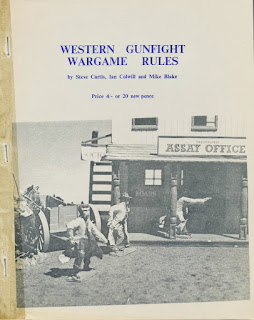
Rules were again those venerable old Western Gunfight Wargame Rules, and again I used v1..  I like them, they are simpler than the v2 one's.. but for the next game I will get my head round the v2 nuances and have a go with them..


Great fun...

~~~~~~~~~~~~~~~~~~~~~~~~~~~~~~~~~~~~~ 

 Laters, as the young people are want to say...

Saturday, February 24

"One Hour Wargames" - Scenario 23 - "Defence in Depth" - Set Up and Game

Slight (well massive, actually!) deviation from the usual format this week... 

DG and I are currently playing this scenario (albeit virtually via Battle Chronicler [clicky] and with an extended hiatus currently so DG can replace an ailing PC) but there's no comparison with getting some actual metal men on the table, and for a quick solo game there's no beating One Hour Wargames, and as I was au fait with the scenario, I decided to play it in parallel...... (and if that wasn't enough "ands" I also wanted an opportunity to play this years John Corrigan Memorial Game [clicky]

Decision made, the little metal men of the American War of Independence project would march again..

This is an interesting scenario; in essence/summary, a slightly smaller defending force seeks to stop a numerically superior attacking force from exiting the defenders end of the table. Things are complicated for the attacker in that there are only three access methods (bridges) to the defenders end of the table, and of these three bridges one is accessed only via a farm/built up area, one is effectively blocked as it opens into a wood (that for scenario reasons the attacker doesn't have access to), and the third is the furthest away from the exit point - interesting conundrum!

Forces for each side were diced for on the relevant table in the book, the only change being to ignore the skirmisher column and substitute regular foot. As I was playing on a 6' x 4' table, I also doubled the number of units for each side by just throwing twice on each table. 

  • The British/attacker threw a 3 and a 4 giving them 8 Foot, 3 Cavalry and 1 piece of Artillery (which was decided to be of the Light type) - 12 units
...the sharper eyed among you will have noticed that the fog of war has already struck, and I am missing a unit of cavalry - suffice to say I never noticed until.. errrr... about now..  ๐Ÿ˜‚
  • The American/defender threw a 5 and a 6 giving them 7 Foot and 1 Cavalry - 8 units..  specific scenario requirements are that the defender needs to swap half of there troops for irregulars, so they chose to  swap 3 Foot and the 1 Cavalry - the replacement troop type were Indians, so they ended up with 4 regiments of Foot, and 4 warbands of Indians.

Rules were my go-to Will McNally ones (details as ever in the AWI Project page in the side bar) - fifteen moves (50% more than the book, due to the size of the table)

Table set up as follows:


Attacker enters from top left table edge..  exit point for attacker is the road on the bottom right edge.. The only significant terrain features (ie. everything else is just table dressing) are:
  1. the road which crosses …
  2. the river, just behind - not crossable anywhere except at ...
  3. the three separate bridges
  4. the built up area/farm
  5. Woods - classed as light - bottom left of the picture, and then two woods top centre, either side of one of ...
The farm dominates the bridge behind it - the only access to that bridge is via the farm - a hard fight, if the defender does what you expect him to. Similarly the woods dominate both entrances to the middle bridge and given there is a specific scenario rule denying the attacker access to any of the woods (due to "lack of local knowledge"), that bridge is of assistance only to the defender; you can understand why the third bridge becomes more and more attractive.๐Ÿ˜

American/defenders set up first:


No surprises really:
  1. One regiment of regulars in the farm, with another behind ready to either reinforce them, or defend the road, as required
  2. One regiment of regulars in shelter dead centre - ready to reinforce either flank
  3. One regiment of regulars  in shelter behind the 'middle bridge woods' to give assistance to their gallant Indian allies, or to cover the third bridge
  4. The Indians are placed, one each, in the woods either side of the middle bridge and the other two warbands are covering the third bridge..
On to the game...  following is about move 2 or 3

Ave, John...  Lofty C. overlooks his little metal men still striving away after his passing..

The British "plan" (plan... ๐Ÿ˜‚) was to:
  1. put a holding force in place to stop any incursion from the farm - that job fell to von Donop's (yellow flag bottom left in the picture above) - in effect they were a sacrifice to protect the rear of the army.. it would be unlikely that they could get to the exit point in time
  2. get the cavalry across the third bridge as quickly as possible with a view to discombobulating the enemy by manoeuvring in their rear - this they've done at this stage - you can just see them beyond the wood top right
  3. two regiments and the artillery to drive off the Indians north of the river
  4. the rest to rush the third bridge
Couple of moves later:


The British cavalry are fulfilling their job, but as a result of some quite astonishing American dice throws, the plan to rush the bridge with the rest is not going as well as I had hoped..  in the right conditions, and with the right dice, Indians can be a tough proposition... here, their musketry was effective, and the British morale throws were rubbish. The first two British regiments across the bridge have been sent packing and are reforming behind the next two regiments into the meat grinder. In the meanwhile the Americans are bringing up reinforcements and the war whoops of the Indians are ringing out across the battlefield..

Couple of moves later, and as John looks on in interest (he always did enjoy watching a game rather than  playing in it.. ๐Ÿ˜Š) we see the British disaster unfolding..  von Donop's have been left to their own devices as everyone else streams west to the third bridge - even at this stage of the game I had a pretty good idea the British had already lost..


British morale throws were catastrophic, and my Brigadiers and the CiC are busy helping where they can (see following - yellow dice means shaken, red dice means they're routing)..  thinking back I am fairly sure the Americans didn't do much physical damage - all the main damage was as a result of the British then failing to recover morale..


Next - apologies for the interesting yellow tinge, clearly not enough light..  anyway, three British regiments are across - two still in column of march and one of which is still on the bridge.. they are looking to drive the Indians away so they can turn right with safe flanks...  in the meanwhile the American tactic is to slowly drop back, always keeping themselves between the British and their exit point, but always just out of musket range..  the British cavalry have exited the table


Same move, but further east:


Finally across (following)! All far too late, and in too small numbers, unable to concentrate - one regiment routing (middle left) and one shaken (centre right)

Damn sightseers on the river! ๐Ÿ˜€

Last throw of the dice (next), as things are desperate - von Donop's try to force the bridge and fail (repeatedly) - brave mensch!!


End game - next - frontally attacked and flanked, the Brunswicker's have been sent packing (top right - red dice = routing)


At least two moves away from the exit point, and on the final turn, the British concede a game that in all truth they had already lost half a dozen moves before - they needed to get six units of the table but had only managed two.

Once again the Neil Thomas book delivers in spades..  best ten'ner I ever spent.. ๐Ÿ˜€

========================================

Lastly - by way of a bit of fun - what do the following have in common??


Answer next week... ๐Ÿ˜

Saturday, February 17

"Firing into the Brown" #40 - Schomberg's, Mary Rose and stuff..

"So Carnehan weeds out the pick of his men, and sets the two of the Army to show them drill and at the end of two weeks the men can manoeuvre about as well as Volunteers. So he marches with the Chief to a great big plain on the top of a mountain, and the Chiefs men rushes into a village and takes it; we three Martinis firing into the brown of the enemy".

Kipling "The Man Who Would Be King"

Time for another update..

~~~~~~~~~~~~~~~~~~~~~~~~~~~~~~~~~~~~~

First off, a 'catch up'..

My regular reader (singular ๐Ÿ˜) will know that more than anything I do like to look up (errr..  do exhaustive research) to investigate the history of the regiments and commanders that I paint for my armies, but sometimes, I don't have time - and so it was I noticed that I hadn't had chance to do this for three or four regiments in the War of the Spanish Succession project.. 

I suspect in this case because they pre-date the blog! I intend rectifying this over time and on an irregular basis, and this week the first of those is Schomberg's (nicknamed "The Black Horse" after the colour of their facings) 

So without further ado, another 'regiment of renown' graces the blog

Origin and History

  • 1688 - the year of the so called Glorious Revolution - following the landings by the Prince of Orange, William, Lord Cavendish, Earl of Devonshire with a small armed retinue travels to Derby, and then Nottingham, raising troops on behalf of the Prince. 
  • On his succession the Prince of Orange (now William III) commissions the Earl of Devonshire to raise a regiment of horse from these recently raised troops, plus Protestant soldiers previously belonging to the five regiments of horse raised by James II. The new regiment was styled “Devonshire’s Regiment of Horse”.
  • 1690 - the regiment is ranked as 9th Horse in order of seniority. 
    • In April, the Earl of Devonshire was succeeded in the colonelcy by Meynhardt (or Meinhardt) Schomberg, and for the first time the regiment became known as the “Schmomberg’s Horse”. 
    • In July, it was at the Battle of the Boyne (after which Schomberg was created Duke of Leinster for his part in the battle) and in spring of 1691, the regiment became known as “Leinster’s Horse”. 
  • 1692- during the Nine Years' War (1688-97) the regiment was sent to the Netherlands where it joined the confederate army. 
  • 1693 - was part of the attack of the Lines of the Scheldt. The same year, after the death of his brother, Meinhardt became the 3rd Duke of Schomberg, and the regiment was once again “Schmomberg’s Horse”. 
  • Meinhardt himself.. Painted by John Baptist de
    Medina...  apparently he had a bit of a temper..
    1694 - ranked as 8th Horse, a rank that it would retain until 1746. 
  • 1695 - formed part of the covering army during the siege of Namur.
  • 1698 to 1701 - stationed, generally, in the south of England.
  • 1702 - the War of the Spanish Succession - the regiment was sent to the Dutch Republic. Later that year it provided cover for the sieges of Venloo, Roermond and Stevensweert. 
  • 1703 - employed in covering the sieges of Huy and Limbourg. 
  • 1704 - took part in the battles of Schellenberg and Blenheim. For the attack on the Schellenberg (which formed the original basis for my project), along with Wyndham's, Cadogen's and Lumley's regiments of horse - 10 squadrons of Britain's finest - they were under the brigade command of Lieutenant-General Cornelius Wood
  • 1705 - the forcing of the French lines at Neer-Hespen and Helixem
  • 1706 - Battle of Ramillies, the capture of Antwerp and the blockade of Dendermond
  • 1708 - Battle of Oudenarde, the siege of Lille, the passage of the Scheldt and in the relief of Bruxelles
  • 1709 - the siege of Tournai, the Battle of Malplaquet, and the siege of Mons
  • 1710 - the sieges of Douai, Bรฉthune, Saint-Venant and Aire
  • 1711 - passage of the lines at Arleux and in the siege of Bouchain.
  • 1714 - ordered home from Flanders and then proceeded to Ireland where it's establishment was reduced to peace time levels.
By the by, in 1788, it was retitled the 7th (The Princess Royal's) Dragoon Guards, then amalgamated with the 4th Royal Irish Dragoon Guards, to form the 4th/7th Dragoon Guards in 1922, and then amalgamated with the 5th Royal Inniskilling Dragoon Guards, to form the new Royal Dragoon Guards in 1992. I think I remember reading, that they are the only one of those regiments of horse that James raised to still survive, albeit in a much amalgamated manner!

Schomberg himself was created Knight of the Garter in 1703, and Queen Anne appointed him Commander-in-Chief of the British forces sent to Portugal for the War of the Spanish Succession. Once in Portugal though, he was largely ineffective in command, and his dreadful temper attracted universal disgust: neither Peter II, King of Portugal, nor Charles, claimant to the throne of Spain, were prepared to accept his behaviour and he was sent home in disgrace. Schomberg died in 1719, and as his only son had predeceased him (though he had three daughters), all his titles also died with him..

Further references:


Painted in that spurge of painting I did to kick off the period late 2006 - 8 horse - figures are Dixon

~~~~~~~~~~~~~~~~~~~~

As mentioned a few posts ago, I bought a ticket for all the features* in the Portsmouth Historic Dockyard a few weeks ago..  best of all it allows unlimited re-visits for a year, and all for only £44. I intend to make VERY good use of it, but for my first visit, and also for the first time ever (which is why I bought the ticket to be honest), I went to see Mary Rose..

Just a few pictures - there's plenty on the web, but these are mine, and as is my way they are the things that caught my eye..

First off - the entire ship looking forward from the stern...  absolutely, completely, and utterly mind blowing..  the period where they were having to continually spray her so as to stop her decomposing is now over, so the view is unobstructed. They have also displayed her side on, so it's like a cutaway diagram; you can see all the details of the decks... What you see is the whole of the starboard half of the ship, minus the castles that would have been at each end. These castles, and the port side of the ship had disappeared over the time she was resting on the bottom (430+ years)..


Everything in the museum is original to, and from the wreck site.. Mary Rose is important because she spanned that period of Naval warfare where the focus shifted from close range, grapple, and then board to the newer methods of longer range, gun and cannon offensive. Mary Rose had a major refit in 1536 to keep her current in naval attack methods - gun ports and broadsides were very new technology at the time..

Talking of guns, there are a surprising number of cannon, and what interested me most was that there is very little commonality - would have been a pain in the posterior making sure the multiple types of ammunition was available..  this one (next) is one of the newer, bigger, bronze guns - a  lower deck culverin..


...and this is one of the lighter, wrought iron, upper deck, pieces of ordnance..  a form of breech loader so quick to reload but not able to take as big a charge as the cast bronze guns..


Both types side by side..  


Despite the fact that Mary Rose was increasingly being developed and refitted, and rearmed for the anti ship role, she was still also equipped for the older, more traditional, anti personnel role and what stunned me was the sheer quantity of long bows ..  boxes of them were discovered on the wreck and are displayed as such..


..but look at the thickness of those bows! No wonder that numbers of the skeletons recovered show the abnormalities that drawing the war bow from an early age would have caused..


..but for me the star of the day was the ship itself..  very much recommended if you get a chance to visit.


Next on the list for me is a visit to Gosport to see HMS Alliance and the Submarine Museum..

* Features include Mary Rose, HMS Warrior, HMS Alliance (and the submarine museum), HMS Victory, M33 (a WW1 Monitor), the Royal Navy Museum, and also The Explosion Museum of Naval Firepower...and if that's not enough it also includes the water bus to get you to the exhibits in Gosport, and a Harbour Tour boat!!
~~~~~~~~~~~~~~~~~~~~

Laters, as the young people are want to say...

Saturday, February 10

"Firing into the Brown" #39 - Light boxes, dioramas, girders and stuff..

"So Carnehan weeds out the pick of his men, and sets the two of the Army to show them drill and at the end of two weeks the men can manoeuvre about as well as Volunteers. So he marches with the Chief to a great big plain on the top of a mountain, and the Chiefs men rushes into a village and takes it; we three Martinis firing into the brown of the enemy".

Kipling "The Man Who Would Be King"

Time for another update..

~~~~~~~~~~~~~~~~~~~~~~~~~~~~~~~~~~~~~
Bit of fun.. 

Whilst taking photo's of various bits and pieces for the blog recently I have struggled a bit with lighting - I'm not a fan of the flash as it gives a very artificial, over bright, light with significant shadows..  I like/prefer to use a tripod and rely on the stability that gives to take pictures without flash, but it still requires good light and in the winter, even with artificial lighting it's a bit gloomy..

Reading some of my fellow Bloggerati's musings however, and they mention the delights of a light box.. a peruse on the monolithic online shopping experience would indicate these are not much more than a box with either a lot of, or a single big, bulb(s) in the top - white surrounds to reflect and concentrate the light - so I decided to make my own...


This is phase one.. a simple box, taped along the edges and then lined with white foam board - to provide the light source (phase 2) I bought two metres of USB powered self adhesive LED ribbon coming - similar to the following:


Which I then stuck to the foam board in the top of the box


With space for USB cable to exit ..


...and here it is all lit up..  

Be interesting to see if this works - if it doesn't the LED ribbon will be used elsewhere - probably on the boat! ๐Ÿ˜

~~~~~~~~~~~~~~~~~~~~~~~~~~~~~~~~~~~~~ 

 Recently invested in an all features/exhibits ticket for the Portsmouth Historic Dockyard - basically you buy the full ticket and it then gives you unlimited access and visits for 12 months. Only £44 which I consider to be astonishing value when you consider what it gives you access to for an entire year..  I shall be making good use of it!

First visit was the weekend just gone where for the first time ever, despite living in the city almost my entire life, I mainly (and finally!) went to see Mary Rose (HMS Driftwood as she's kindly known in some RN circles ๐Ÿ˜), but having explored her*, I wandered through the separate Royal Navy Museum and happened to spot this - which is just glorious....

Fictional boat attack on a Mediterranean fishing village c. 1810

40 or 54mm scale I think, but modelling at its very finest... 

* standby for some pictures taken on the day - it was an awesome exhibition/display..

~~~~~~~~~~~~~~~~~~~~
The girder bridge is complete..  

Grey epoxy primer (won't do that again ๐Ÿ˜) with a wash of inks - used the old Citadel Armour Wash, and then a diluted down Rowney black draughtsman's ink. 


Had to go back and give a fair chunk of it a coat of Vallejo Grey Black as the primer was not taking the ink washes well..  


.. a coat of Vallejo Smoke for the plank surface..


Then finally some Rowney Deller "Red Earth" ink for the rust 'splots' - which I am most liking..


Coat of PVA and either flock or sharp sand for the surface of the ramps, and the bases of the bridge..

The models are 12mm/N gauge Minifigs for scale - happy with that...

~~~~~~~~~~~~~~~~~~~~

Laters, as the young people are want to say...