Saturday, July 27

"Firing into the Brown" #55 - Souastre foo-bar, Wesencraft and stuff..

"So Carnehan weeds out the pick of his men, and sets the two of the Army to show them drill and at the end of two weeks the men can manoeuvre about as well as Volunteers. So he marches with the Chief to a great big plain on the top of a mountain, and the Chiefs men rushes into a village and takes it; we three Martinis firing into the brown of the enemy".

Kipling "The Man Who Would Be King"

Time for another update..
~~~~~~~~~~~~~~~~~~~~~~~~~~~~~~~~~~~~~

Another in the occasional "regiments of renown" series featuring the histories (such as they are in some cases, and notably in this one) of various regiments painted in haste at the beginning of a project but not documented here for posterity.. so we come to French cavalry regiment "Souastre" part of my War of the Spanish Succession collection..

Probably already known to the aficionados (which covers my reader for sure😏), but unknown to perhaps the majority, but in 1671, a royal order instructed that the French cavalry were to have buff leather coats, cloaks and good boots, and be "dressed in good grey cloth lined in the same colour" (except for the royal units, these were to "be dressed in dark blue..."). 

This order was followed well into the 18th century, but with the buff coat becoming a waistcoat by the time of the War of Spanish Succession. The vast majority of these "grey regiments" then adopted red as the facing colour (coat cuffs mostly) but a few regiments were distinctive as they used the livery of their colonel as the facing colour, and the colour for the saddle cloth and housings (ie. the cloth pistol covers on the saddle) and this regiment was chosen purely because of this, as I wanted a change from all the grey and red hordes, and they had the blue facings you see here..  

..and the foo-bar? Well this regiment never served in the War of the Spanish Succession - they were one of a few 'seven year wonder' regiments that Louis raised in 1691 for the Nine Years War (very much the appetiser for the later war), and the regiment was then disbanded at the end of the war (actually, a year later.. 1698) but was never reconstituted when the War of the Spanish Succession opened a mere three years later...  ah, well..  never mind...  😀

I know nothing about the service of the regiment during the war - orders of battle for the Nine Years War are very few and far between - but my assumption is that they would have been raised near the town of the same name in the Pas de Calais area (north east France - so think Calais/Channel ports) and therefore I'm guessing they would have served in the campaigns in Flanders - might have been at Steenkirk?? maybe??

I did manage to find this however, which provided a delightful rabbit hole to disappear down for a few hours...

Actual commission of company captain of the Souastre cavalry regiment for Jean-Guillaume Fruict, awarded at Versailles on 16 December 1691. Fruict had previously been a captain in Guines regiment; thanks to this promotion he became captain of the Souastre regiment.

So what do we know of Msr. Fruict? Not so much, just a few snippets... 

He was baptized February 23, 1653 in St-Étienne (Lille), so would have been about 38 or 39 when he got the commission, which would have put him in command of a company of troops counting somewhere between 40 and 60 men; three companies would then make a squadron, and most cavalry regiments would have had about 6 companies, so 2 squadrons so ~260-340 men in total. By 1698 when the regiment was disbanded he'd be late 40's and I would have thought that was getting old for such a demanding role, and it may account for their being no further mention of  him in any military sense..  he simply retired/disappeared..

He died at at the age of 64, on April 1, 1717. Sounds like an enterprising gentlemen as he married late, in 1711, to a lady called  Marie Joseph Butin, who was 26 years younger than him..  they had two daughters born in 1707 and 1709, so both were legitimised by the marriage!😁

I think the regiment was under the overall command of a Mestre de Camp (Colonel) Wallon (NB. not Walloon) and have found reference to him being the oldest Colonel in the army at the time the regiment was disbanded..  he was not without influence, as he was married to one of the daughters (name unknown) of the immensely rich and powerful Étienne Chérade, Comte de Montbron, but I know nothing more about him than that..
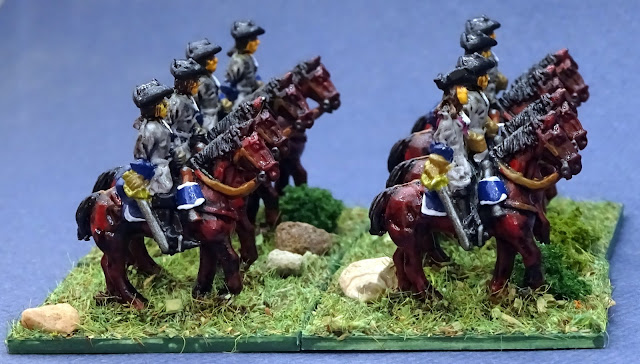
Regiment painted some time in 2007 (pre-Blog!) and comprising 15mm Dixon Miniatures..

Sources:

~~~~~~~~~~~~~~~~~~~~~~~~~~~~~~~~~~~~~~~~~~

..just finished reading (again) this Charles Wesencraft book I managed to get on eBay "With Pike and Musket: Wargaming the 16th and 17th Centuries" and decided to put up a review...

Book is 185 pages long plus 2 or 3 pages summarizing the rules described in the book.

The actual rules section of the book comprises approx. 50 pages, the rest of the book is about army organization (he uses a few sample armies of the period focusing purely on Elizabethan, Elizabethan Irish, English Civil War, and the New Model), and typical weapons of the period. The two chapters are interesting (I hadn't realized the importance of the halberd in the earlier par of the period) but pretty basic - no in depth analysis as you would expect in what is primarily a wargaming book - he does have a good and extensive bibliography for more detail on these aspects.

The rules are interesting - considering that they were written in the mid-70's, there are a number of concepts that are not unheard of in some of the more modern rules.

In summary:
  • Figures are single mounted
  • Movement is pretty normal and as you would expect
  • He deals with weather in some detail as given the armaments of the time it was important - matchlocks are particularly susceptible to wet… to track weather in the game he postulates a weather gauge. Throw a dice at the beginning of the game to decide the opening weather and then a dice throw each move will either move a counter up or down the gauge, or not - making the weather better or worse depending on where the starting position on the gauge is…
  • Movement is alternative - Mr Wesencraft explains in detail why he thinks it is the better approach and I don't disagree with him! Each move comprises:
    • Side A move
    • Both sides fire
    • Side B move
    • Both sides fire
  • Then we have a chapter on an element of gaming not touched on much at this time - Charles describes how each unit has an efficiency rating that effects how it will perform in the various actions it will take in the game (firing, melee, morale checks, etc.) The efficiency rating is diced for and kept secret from the enemy, and from that point is reduced as the game continues reflecting the decrease in efficiency of the unit. It can temporarily improve (eg. as a result of a staff officer joining the unit, being under cover etc.) but can also temporarily decrease (eg, by attack in flank or rear) or get permanently reduced as a result of casualties or running away from a melee… much food for thought in this chapter!
  • Then he explains the role of the staff officer (primarily efficiency improvement) and the standard bearer (also efficiency improvement - something for the enemy to try and capture as taking it away will result in an automatic deduction in efficiency!)
  • For infantry firing he uses a casualty table explaining why he doesn't throw a dice per man, or a dice per number of men - well explained… artillery strength is decided by number of crew (typically 3 crew men when full strength representing a battery of three guns) artillery throw one dice per crewman/gun - using the same table..
  • For melee he has a pre-melee reaction test for both sides - and when melee is enjoined he has a mechanism based on the efficiency of the unit, their weapon, and the number of figures, which then re-uses the firing table… very effective…
  • He finishes off with a section on how to work out which figures are removed as a result of a unit taking casualties, and a final chapter in the unit record sheet - which he then uses to maintain records for each of his units describing how they fought, what battle honours they won, etc. Really nice idea..
The rest of the book - 100+ pages - is general descriptions of battles in the period, but described in terms of his rules, figure scales, etc. Irrespective of their historical context, there are some excellent sources of scenario's here..

... on the whole I would say this was well worth the money, and at the time must have been quite cutting edge in terms of some of the concepts he describes. It was a good read and I would still wholeheartedly recommend it..

~~~~~~~~~~~~~~~~~~~~~~~~~~~~~~~~~~~~~~~~~~

Laters, as the young people are want to say...

Saturday, July 20

"Firing into the Brown" #54 - Corp, Zeke and their boys gets some duds...

"So Carnehan weeds out the pick of his men, and sets the two of the Army to show them drill and at the end of two weeks the men can manoeuvre about as well as Volunteers. So he marches with the Chief to a great big plain on the top of a mountain, and the Chiefs men rushes into a village and takes it; we three Martinis firing into the brown of the enemy".

Kipling "The Man Who Would Be King"

Time for another update..
~~~~~~~~~~~~~~~~~~~~~~~~~~~~~~~~~~~~~

Lord above..  paint has been splashed about...  

Long overdue, and these are the first ACW figures I've painted since February '21, so kind of overdue on that front. Even more so as these figures have already had two games in the buff! 😏 Yup - time for Corp, Zeke, Zack, Buck, Robbie and Seth to "get some duds", and as the horses from the last scenario were already out I decided to do them as well..

On the painting table.. I went with a fairly typical uniform for both sides..  usual black undercoats all round, very heavy dry brush of white, and then painting over the top of that not being too careful about colouring up to the lines as the black provides the shadowing..  Vallejo acrylics all round apart from the Union dark blue which was Rowney dark blue ink, and all the black which was Rowney black ink.. 


Went with standard confederate grey for Zeke and his boys, though I did diverge for their trousers/"pants" which in this case were in two different shades of butternut for the boys, but Zeke has managed to liberate a pair of Yankee ones ('only one previous owner, lightly used, and only worn to go to church on Sundays').

 As befits being from the rich North, Corp and the boys are in standard Union uniforms, yellow frogging and all..  the dark blue ink dries shiny so all these guys then had a coat of Testors 'Dullcote' which you can see drying in the picture


As can be seen from the horse collars, these are artillery draft horses rather than cavalry horses, but they have saddles, and will almost certainly feature in a future scenario, so why not.. 😏


Based and finished...


Then the Union boys..  quite pleased with the corporals stripes on Corp at the back (#1), then Seth (#2) and Zack (#3)


...and the Confederates..  Zeke right (#1), Robbie centre (#2) and Buck (#3)


That yellow trim and cuffs on grey makes for a handsome uniform...


Job done..  keen to get them on the table now!


Figures are 20mm, by Newline, and painted July 2024..

~~~~~~~~~~~~~~~~~~~~~~~~~~~~~~~~~~~~~ 

 Laters, as the young people are want to say...

Sunday, July 14

Going underground..

"I'm going underground (going underground)
Well, if the brass bands play and feet start to pound
Going underground (going underground)
Well, let the boys all sing and let the boys all shout for tomorrow".

"Going Underground" - Song by The Jam 

Time for another update (finally - apologies, been busy elsewhere in the interim ⛵😀), and I think time to put this little project to bed....

~~~~~~~~~~~~~~~~~~~~~~~~~~~~~~~~~~~~~

A few months ago I joined the (absolutely excellent) Palmerston Forts Society [clicky], mainly because of my interest in the Lines, but also the many other "follies" Mr Palmerston built in the area for the defence of the Dockyard and surrounding area's against the expected depredations of the 'dastardly French'.

Shoot forward a few months though and I was more than a little interested then when I heard via email that the society was planning to do a hosted walk of the Lines, and even more excited at the wordage "bring a torch"..  got my name on the list, and last weekend I finally got to close out those last few difficult items that were on my Lines bucket list...

Format for the walk was to first have a look around the gun platform/forward facing/upper floor in one of the still occupied bastions... a number of the bastions are still used, one of them (far west end) is used by the school whose sports grounds are just behind it, one of the bastions has a WW1 memorial museum in it, this one, #4, has a café [clicky] in what I guess would have been the old catering area for the bastion, the messes for the men are all used as rehearsal studios (😏) the gun platform/gallery though was used by a shooting club and they'd allowed us access to have a look..   as a reminder, this is a cross section of how the bastions would have looked..

Front face to the right, rear to the left.. accommodation/kitchens/ablutions to the left (lower level), gun platform/gallery to the right (upper level)

Going to start with this one which is a view down the gun gallery.. the gun openings are to the left..


Gun opening..  bricked and barred now, but still in astonishing condition - the blocks/surrounds are granite...


Vaulted/blast proof roofing and ventilation/extraction hole..


Further gun position details - tracks still in place..


Original notice by the side of one of the positions - reads something like RBL (Rifled Breech Loading)  7" and a number XVI


Entrance to the gun gallery - following - remember the format of those steps for later in the post..


Everything is curved in these buildings for blast proofing..


Having left the bastion we then proceeded via the footpaths to the top of the Lines - open to all, there are plenty of paths to follow..  over the age of the Lines there were many developments in the design but when it was first built there was an expectation that a lot of the guns would be mounted on top - not surprisingly therefore there are lots of "expense magazines" (basically -  a protected position for convenient access to ready use ammunition for the guns) dotted around - first one was almost directly above the café..


Bottle aside..  note the ventilation at the back, vaulted ceiling (again) and it is half buried into the ground for extra protection..   six rows of bricks in the arch..


Proceeding further along the top we then ticked off one of those items on my bucket list - this is one of the six Moncrieff counter-weight disappearing gun pits for 7-inch RML and 7-inch RBL [clicky] that were added in the late 1880's..


Solid concrete but scored to look like blocks..


...and built in the days before ferro concrete so this one has suffered from subsidence and has cracked completely through on one side..


Climbing back down to ground level behind the lines we then got to tick off another bucket item..  this is the East Centre Curtain wall..


...and you can get in to it courtesy of generations of "yoof" who have removed the gates previously closing it off..  there's them steps again - different place but same function as these also provide access to a gun gallery..


Not so pleasant as the last one - sandy/soil floor and lots and lots of soot and graffiti - but stunning for all that - history at your finger tips..   

Gun position - granite again - the expense that must have been incurred building them beggars belief - and the Lines were never even used!


Looking down into one of the barracks rooms..


Barracks on lower floors were separated from the gun gallery by these corrugated metal walls each with it's own window/opening - that corrugated metal is original - they built things to last..


I think these are expense magazines for the gallery


Sorry - best I could do with a torch, but here's a long view looing back along the gallery.. shows at least four barracks to the left..


Gun opening with curtain walls either side..


Steps down to main magazine..


They they are again...  I am convinced that everything in the Lines was built to a War Office standard so you see multiple identical features all over the place, not the least being these steps, but also the brick arches over the entrances comprising the same number of rows of bricks..


Main magazine - note the ventilation slit - this would have had a raised wooden floor


Note the line of bricks to the left that would have supported the floor joists..


Feed hole - ammunition would have been assed through there - the expense magazines are just the other side, so it would have been stored there for immediate use..  no evidence of how the ammunition was shifted - I'm going to guess as the Lines were never used, it was never considered..


Gun carriage guide..


Evidence of shelving still in situ..


...and amazingly - multiple examples of original wood frames and doors still in place..


...the west wing/side was in considerably better condition - it may well have been used for filming recently??  Jury's out..  but note..  six rows of bricks in the arches.. 😏


..one of the barracks even had it's original fireplace - the only one I saw all day...wonder how many are now installed in various desirable residences across the country courtesy various architectural recyclers?? 😏  Gives you an idea how high the wooden floor would have been above ground/soil - that brick on the right is sitting on the line of bricks providing the joist support..


Visiting that was the highlight of the day that was for me..  having exited though, a walk further along the curtain towards the railway entry showed these two large rooms - going to guess offices, but they may well have been galley/kitchen - no access, or opening, to the gun gallery..


Big fireplace.. and entry to the next room..


Also big...


..with a major fireplace too - opposite side of the wall to the one in the first room so sharing a chimney..


...at which point it was back on to the top via this glorious staircase..


..original hand rails - sad git that I am I was much taken with these - how MANY hands have gripped these over the 150 odd years of their existence..  and they're still there, and still solid..


...walking east another expense magazine - small as it is, note the 6 rows of bricks in the arch.. 😏


...then back to the beginning of the walk via the sally port, before returning home via The Sir Loin of Beef for a couple of pints  ..  

Hugely enjoyable afternoon, and without a doubt I'll go back at a future date and have another look around - but for now, this little project is closed, and it's time to start looking for the next project..

~~~~~~~~~~~~~~~~~~~~~~~~~~~~~~~~~~~~~ 

 Laters, as the young people are want to say...