Saturday, May 31

Shootout at the Sierra Corral - Preamble, Setup and Game

Time for another update..  a game report for a change..

~~~~~~~~~~~~~~~~~~~~~~~~~~~~~~~~~~~~~

Preamble..

As the sun rose over a sleepy Cedar Gulch and gradually lit the Sierra Corral and its sales office, the inhabitants of the (normally) sleepy town little knew what a rude awakening they were about to experience..

Wes Alsop, the owner of the Sierra (which was situated just outside the town), had taken delivery the day before of some new horses for the local ranch, the "Lazy C". Chaz Bishop, senior hand on the ranch, had taken the opportunity to ride over to pick the horses up, and at the same time have a coffee and a yarn with his old friend. 

As they sat there in the office, the rich smell of coffee filling the air, neither of them knew that they were to be the cause of their local citizens rude awakening, for unbeknownst to them, the horses had also attracted the attention of some of the local bad men.

'Deadeye' Cooper and Fred Early had been in town the day before drinking in the 'Silver Dollar' ("Whiskey, Beer and Rooms") when someone had happened to mention the arrival of the horses. Looking out the window at their own beaten up old nags, the victims of one too many escapes and hard rides, the looked at each other and words unspoken, lifted their glasses to each other in salute. As the evening went on they got into conversation with Gus Farley, a saddle tramp, who also invited himself in on the "party". One more gun would never go amiss...

Dramatis Personae

The number is the characters toughness rating - the lower the number the tougher the hombre..

Table and Scenario Specific Rules:
  • I'm using Ruthless [clicky] again - Ruthless-Fastest-Rules-in-the-West-3.pdf (fireballforward.com) [clicky] ..they're free gratis, but more importantly they drive a fantastic narrative 
  • Top of the picture following is North
    • Deadeye enters at 2/.
    • Fred and Gus at 1/.
    • Wes and Chaz are in the front of the office come bunk house at 3/.
  • Neither Wes or Chas can react until one movement in view of any of the bad guys, and even then Wes is cursed with a sense of fairness and won't open fire until shot upon
  • The horses are unsaddled and in the Corral, and for any of the bad guys to get them away they need to expend 4 actions/two complete turns doing absolutely nothing else - after that they move at foot rate in any direction the bad guys wishes to take them (there are gates in the fence so I'm not going to make it any more difficult for them than it already is 😏)
  • Winner is the side that either has the horses in (the good guys) or out (the bad guys) of the Corral
  • The "Skeddadle" dice is a D6 rather than a D10 due to the small size of each group 
  • Any move that includes shooting will result in the horses moving D6" in a direction decided by a direction dice
  • All ground is good going except rocks, hills, fences, scrub/inside building which counts as rough. Scrub/fences count soft cover, building/logs/rocks hard cover. Hills/rocks/building block line of sight

The Game

[Move 1] 

Start of move..

As the sun slowly rose over the horizon, and a new day burned its way into the retinas, at the  far end of town Wes and Chaz, breakfast over and coffee in hand, are chatting, laughing and reminiscing about previous misdeeds, narrow escapes, ladies loved and lost, the best brands of sipping whiskey and the favourite horses of their respective youths [their cards are discarded as they require one full move to react to any sighting]. 

Across the way Fred gets the drop on his compadres and runs across the open ground to join up with Deadeye who moves into the cover of the fallen logs closer to the office. Gus, the most trepidous of the three, moves to the cover of bushes north of the corral.

The horses snicker and move nervously [no shooting so no movement].

Skeddadle dice not required (no casualties/unconscious or lily livered...  yet... 😏)

[Move 2]  Wes spots Fred running across the clearing the other side of the Corral and something about his furtive manner makes him drop his coffee cup, pull his iron and drop down to get the full cover of the window shouting a warning to Chaz.

Deadeye, cursing the stupidity of his partner at being seen so soon, sprints to the side of the cabin nearest him coming to a rest next to the window, back to the wall while Fred runs to the fence line, using the horses to cover him from the cabin. Gus, screwing up his courage, runs to the scrub at the north east corner of the Corral.

Chaz is slow but pulls his iron drops down to the other side of the window and snaps off a shot at Gus. [One shot only to allow for the other actions - not aimed - can ignore long range - target in soft cover - but not surprisingly perhaps he misses]

Sitrep End Move 2 before horses move

The horses snicker and move nervously towards the cabin [dice(s) give 3" to the East]

Skeddadle dice again not required (yet.. 😏)

[Move 3]  Gun still in hand, and Gus still visible, Chaz takes advantage aims and squeezes off another shot at him across the way [long range but that be ignored because of his character trait, soft cover but the aimed shot counters that] and is rewarded with the sound of a shout of pain from  Gus - "hit 'im" he grunts to Wes.. better.. he's fairly sure Gus is going nowhere soon [he was right - Gus failed his subsequent morale test and becomes "lily livered"..  'shaken' in other words] but his optimism is rudely rewarded with a couple of shots in return from the wounded Gus, splintering the wood work around the window but doing no other harm..

Across the corral, Fred jumps the fence and moves towards the horses, still keeping them between him and the office. At the side of the office Deadeye turns and jumps to the side window intending to fire off a shot at Wes in the room. out of the corner of his eye Wes sees him and quickly snaps off a shot at him before he can fire. Deadeye grunts in pain and drops out of sight - shot untaken.[Interesting passage of play from a rule perspective and shows their flexibility - so Deadeye had the initiative, but the rules allow a character who is about to be fired at, but who hasn't activated yet this turn, to "get the draw" - overwatch if you like. Wes tested (at -1 as I allowed Deadeye his "stealth" bonus), but won, and managed to get a successful shot off  before Deadeye could shoot - Deadeye then failed his subsequent morale test so I adjudged that the wound - which was serious - plus the failed morale test would have meant him dropping out of sight pronto]

End Turn 3 - just prior to the failed "Skedaddle" test - yellow pins indicate "lily livered"/shaken

Fred shouts "I'm getting out of here!" and runs for cover (and the town), and is swiftly followed by both Deadeye and Gus..  looks like the beaten up old nags are going to have to suffer yet another hard ride.. [with two characters now on failed morale the bad guys needed to get over 2 on a D6 or fail the skedaddle test - needless to say they threw a 2 😏]

Post Match Analysis:
  • Short, sharp and sweet - like a good Tequila (or so I understand... πŸ˜€) - but another fantastic short story delivered by this set of rules..  you can just smell the heat, the dust, the sweat and the cordite when you play...
  • Not a lot of lead thrown, but Wes and Chaz were very accurate, both hitting and hitting hard with their few shots..             

~~~~~~~~~~~~~~~~~~~~~~~~~~~~~~~~~~~~~ 

 "Laters", as the young people are want to say...

Saturday, May 24

"Firing into the Brown" #80 - King George (or Quay) Gate, Appearances and stuff...

"So Carnehan weeds out the pick of his men, and sets the two of the Army to show them drill and at the end of two weeks the men can manoeuvre about as well as Volunteers. So he marches with the Chief to a great big plain on the top of a mountain, and the Chiefs men rushes into a village and takes it; we three Martinis firing into the brown of the enemy".

Kipling "The Man Who Would Be King"

Time for another update.. and another gate.. 😏
~~~~~~~~~~~~~~~~~~~~~~~~~~~~~~~~~~~~~

"...to the Quay or King George's gate a noble structure in the rustic style adorned with massive pillars and entablature [we like that word! πŸ˜€] of grand proportions. Above are various apartments formerly the offices of the Governor and on the inner side a large Guard house, a lofty stone wall completes the circle of defence. Before the erection of the present Quay gate sixty years since the entrance was through an open arch in the wall twelve feet southward towards the Cage traces of which are still discernible, and at the extremity of Crown street was a small wicket now closed by stonework but the shape of which may be still discovered...." from "The Chronicles of Portsmouth" written by Henry and Julian Slight and published in 1828. 

First a little orientation... the King George Gate (for that is our topic) is ringed red in the map following, and labelled "Quay Gate" (which is it's earlier name, as a gate/opening had been there in one form or another since Elizabethan times). The King James Gate (our last topic) is ringed blue to show how close it is.. 


What it shows us is that the whole of the Point (the name of the finger of land with the Cambers on one side and the Harbour on the other) was in effect totally separated from the city/Portsea by these two gates - there are a few defences on the Point but clearly the thinking was that in the event of a landing it was seen as largely sacrificial..  possibly not enough room there to construct significant defences?? 

In the 17th/18th and 19th Century of course, being a Naval town, the Point was where the pubs, taverns, eateries and brothels were.. 

"Portsmouth Point", an etching by Thomas Rowlandson.. "You will never find a more wretched hive of scum and villainy"... indeed.. 😏

..it may well be though, that one, the city authorities quite liked the idea of some gates between them and the lawlessness of the Point, and that two, maybe they thought the good ladies of the Point might put up a far better defence against any invading Frenchman than a few extra 64pdr Armstrong's..  😁

There had been just an opening there in Elizabethan times..


..but this was supplemented when they built the Quay Gate in 1734 - so both coexisted until the fortifications were completely removed in the mid 19th Century

Engravings perspective is of the frontal aspect..  so harbour/Camber behind the artist.. you can just see the Cathedral tower in the background with the older Elizabethan opening in line with it..

I can't find a decent engraving or photograph of the landward side of the gate but the 3D Model project gives a pretty good impression and a much clearer idea of what the Governors offices and apartments would have looked like..


...and here is the front in all of it's glory..  long, long gone..  they didn't even bother trying to save this one unlike the King James and Landport Gates as it's a glorious aspect..

Copy of a photograph. Ref: Gates,W. City of Portsmouth Corporation Records 1835 - 1927" - photo probably taken 1850's..

So all these photo's would have been taken from the outer/seaward side..  the artists/photographers would have had the swing bridge and Camber behind them

King George's Gate (Quay Gate)
by Edward Robins (1854–1909)
Image Credit Portsmouth Museums and Visitor Services

...and all of it long gone now - though there are hints - but we still stand in the footsteps of our forebears even when it's currently a fish market.. 😏

The Inner Camber - the King James Gate location is off to the left behind the row of houses/flats in the distance - best guess the two pointy roofed one's.. the front face of the King George or Quay Gate would have been behind me..

The junction of King Street and Lombard Street - a square now and indeed as it was then - the inner side of the gate would have been just behind me


...and this is where the Gate would have been - 175 years ago I would have been looking through the opening of the gate, to a swing bridge, and wondering if the Bridge Tavern was open for a beer.. as you can see it's still a working fishing port which is a good thing..  the big modern building in the middle by the way is Ben Ainslie's America's Cup HQ (or was 😏)


..the swing bridge would have been here, between the two sides - the pub is named for it, and the Outer Camber is just round the corner (where the ferry is)

Further reading/background:

~~~~~~~~~~~~~~~~~~~~~~~~~~~~~~~~~~~~~ 

[Montalbano has been summoned by a senior member of the local church to answer some questions the Bishop has about a case Montalbano is investigating...]

"You don't believe in appearances. Inspector"

"My job forces me not to. If I did believe in appearances I wouldn't be a very good policeman.. "

"So what do you believe?"

"Well.. For example, l believe in what's there but can't be seen"

"Could you explain?"

Montalbano thought about this for a moment. 

"You know that famous photograph of Tiananmen Square?"

"The one of the young man stopping a tank all by himself? Yes"

"Well, your excellency, with those very words you are showing me that you let yourself be persuaded by appearances"

The bishop looked at him, not knowing what to say. 

"You said the young man 'stopped' a tank. But in reality the youth is unable to 'stop' anything at all, and the tank can't come to a stop all by itself. The tank, in fact, was stopped by the soldier driving it, who we don't see because he's inside it. Well, what's of interest to me is the soldier inside, who's invisible but who nevertheless exists in that moment, disobeying his orders, and engaging in an act at least as courageous as that of the youth standing in front of his tank."

"That's an excellent explanation", said the bishop. Then, after a moment's silence: "They arrested him, you know"

"Arrested who?' asked Montalbano... 

"The soldier driving the tank in Tiananmen Square. They shot him almost at once; such insubordination could not be tolerated. I informed myself on the matter. And, as you can imagine, it was extremely difficult to get an answer, and it took a very long time. But, as you can see, I too, at the time, did not let myself be taken in by appearances. I was and am very interested, perhaps even a little more than you, in what is there but cannot be seen."

From "Riccardino (published 2021 and Book 28 in the Inspector Montalbano series - the final one😞) by Andrea Camilleri 

..and  why did I put this excerpt in?? Simply because it is typical Camilleri - clever on so many levels..

By the way - does anyone else feel a deep sense of loss when they finish a book series of such excellence as this one? It quite discombobulated me for at least a couple of days, and then I realised I can read them again any time I want to.. 😏

~~~~~~~~~~~~~~~~~~~~~~~~~~~~~~~~~~~~~ 

 'Laters', as the young people are want to say...

Saturday, May 17

"Firing into the Brown" #79 - Yapton, Royal Commissions and stuff...

"So Carnehan weeds out the pick of his men, and sets the two of the Army to show them drill and at the end of two weeks the men can manoeuvre about as well as Volunteers. So he marches with the Chief to a great big plain on the top of a mountain, and the Chiefs men rushes into a village and takes it; we three Martinis firing into the brown of the enemy".

Kipling "The Man Who Would Be King"

Time for another update..
~~~~~~~~~~~~~~~~~~~~~~~~~~~~~~~~~~~~~

Yapton Beer Festival come and gone again - another year gone..! 😏🍻

Picture courtesy http://devoursussex.co.uk

The sun shone, the beer flowed again, and Yapton worked it's usual magic and we got mildly sun burnt and enjoyed some decent (but not outstanding) ales... another small turnout from the jolly boys (the bunch I go drinking with) this year, a feeling I think that beer festivals for them may have had their day?

Beers were still cheap - I think in 2019 we were paying £1.70/ £1.90 a half and this year it was £2/2.10, but still excellent value. Unfortunately I thought the choice of beer was down this year (again) so that may be the price for that cheapness.  

So why the apathy? I think the beer drinking culture in the UK has changed significantly since we first started going to festivals (and we've been going to this one for 20+ years) - put bluntly I think CAMRA (the Campaign for Real Ale pressure group) has achieved their aim, and there are now micro pubs (some brewing on premises) and real ale pubs in every town and city, and we are now spoilt for choice. 

An example, one of the pubs I go to in Portsmouth ("The Hole in the Wall" in Southsea) has just put on tap it's 170th different ale this year - their target for the end of the year is 500 different ales served. They charge the same price per pint as were paying at the festival. The rest of the guys I think look at that, then the fact it's local and easy to get to, that they can save the ticket price and then put it over the bar there instead.. 😏

Anyway - what did I drink?

  • Roosters Brewing Company - "Pangea" - 5.2%
    • "A fusion of three styles of IPA (Traditional English, West Coast & New England), brewed using British, Australian, NZ and US hops, as well as being co-fermented with West Coast & New England yeast strains. The beer pours with the clarity of a classic IPA, while displaying the juiciness associated with the New England style".
    • Poor choice for a first beer - too strong - but in my defence I didn't have my glasses on and had just arrived hot and thirsty and this was a free half included in the ticket price.. 😁  It was OK but not outstanding
  • Goldmark - "Citra Smash" - 4.3%
    • "Single Hop and Single Malt pale ale classic, generously dry hopped with Yakima Valley Citra hops".
    • Drinkable but again not outstanding
  • Langham Brewery - "Victory Ale" – 4.5%
    • "Offering floral notes intertwined with light fruity esters from the English yeast, this beauty has a pleasing amber colour and a slight citrus palate, overlaying a light biscuit-malt back bone, and a more-ish bittersweet finish".
    • Now I'd had a couple of pints of this in the pub earlier in the week, and in the face of pages and pages of brewers in the programme I had not heard of (and if I don't know the beer I go with the brewer as that is usually the safe bet) I seized upon this as a life belt in a stormy sea..  and then proceeded to drink it for the rest of the festival..  an above average pint definitely

~~~~~~~~~~~~~~~~~~~~~~~~~~~~~~~~~~~~~

 "[Item #]76. With a view to secure Portsmouth from capture by land, lines of defence have been constructed at different times during the last two centuries; those immediately covering the dockyard and town were commenced in the reign of James II., and were continued at intervals until near the end of the last century, when the works at Portsea were completed. The earthworks and wet ditch on the Gosport side, enclosing the victual- ling yard, were constructed about the year 1678, and were extended to Priddy's Hard [we've been there - clicky] about 1790.

These lines have long been considered a most inefficient protection, not only on account of the limited space enclosed by them, and the obstruction caused by the spread of buildings round them: but also on account of their having no influence whatever in protecting the naval establishments and harbour from bombardment.

We are nevertheless of opinion, that as these works exist, they ought to be maintained in a state of efficiency, to protect the naval establishment
[so they were already thinking of maintaining the Dockyard defensive walls only, as there's no mention of 'town'] from capture in the event of an enemy forcing a landing in their immediate neighbourhood ; and we recommend that the right of the Portsea Lines, which is now open, should be closed by being joined to the left of the Town Mount Bastion of the Portsmouth Lines [in other words they were advising a continuation of the walls at Hilsea Lines all the way down the west side of the harbour to join up with those that already existed - suffice to say this was never done], and that when this is done, all the fortifications from that bastion round to King James's Gate should be removed [ and there's the confirmation - see map]. This would add considerably to the strength of the lines, and the expense would be insignificant as compared with the value of the land, above 37 acres, which would thus be enclosed by the fortifications and rendered available for the exten-sion of the Government establishments".


..from the Royal Commission Report of 1860..  my highlights..  interesting, eh?

More reading:
~~~~~~~~~~~~~~~~~~~~~~~~~~~~~~~~~~~~~

Laters, as the young people are want to say...

Saturday, May 10

One Hour Wargames Scenario 27 "Disordered Defence" - Setup and Game

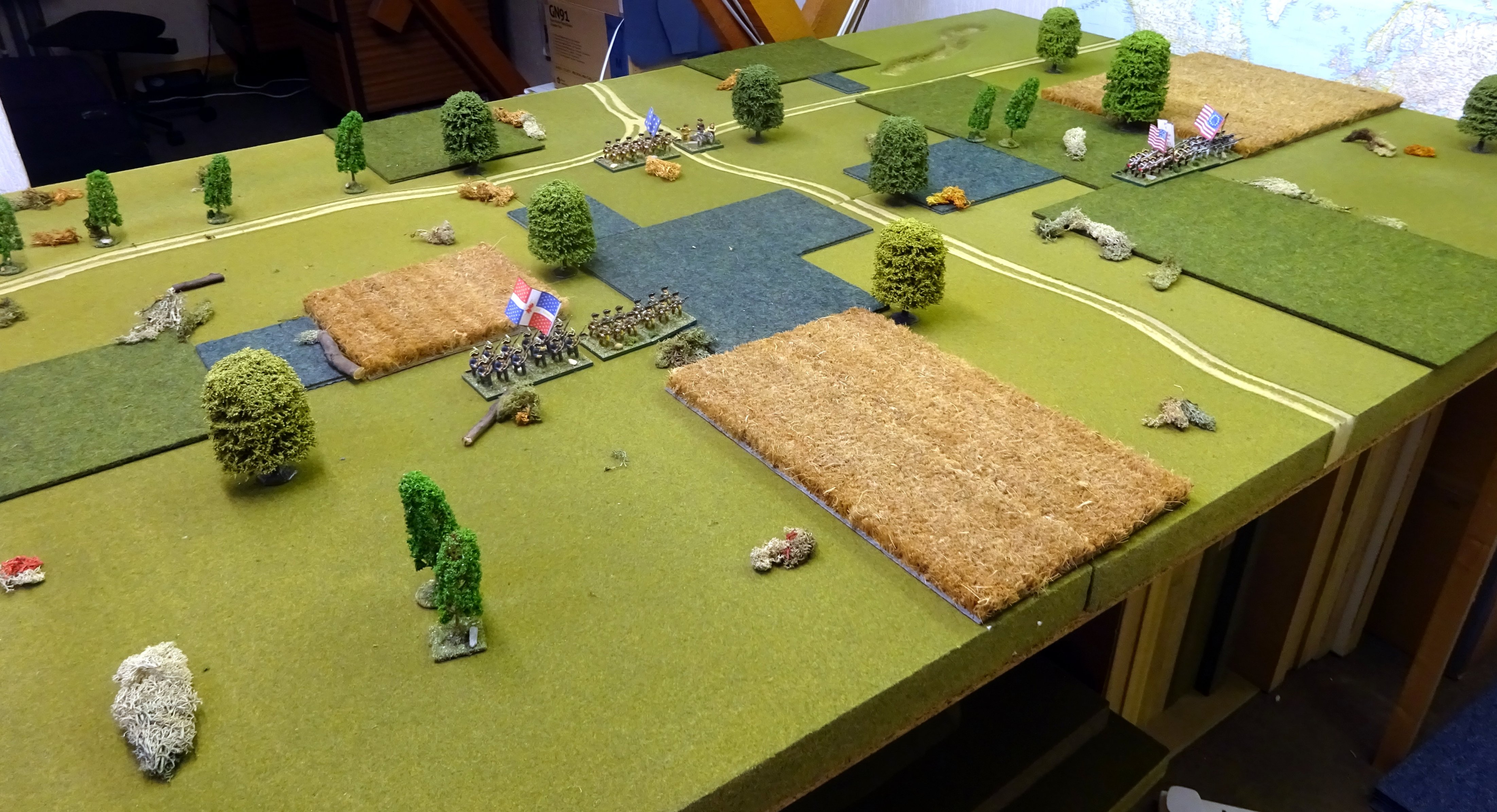
Time for the little metal men to march across the table in slightly more numbers than has been usual recently, and as there's no beating One Hour Wargames for scenario ideas, and as I also wanted an opportunity to play this years John Corrigan Memorial Game [clicky]) I opted for the next one in the series, which is #27, "Disordered Defence"..

In summary, a small attacking army has launched a surprise attack on a (potentially) bigger defending army positioned to protect a cross roads..  the question is can the attacker beat enough of the defending enemy to win the battle before the defenders reinforcements arrive.. 😏

As mentioned this is the Memorial Game so our battle will be set in the American War of Independence using those glorious little metal men that John painted and gifted to me all those years ago. I just have this feeling that this is one of those games where the smaller attacker screams out to be British/Hessian, so they will be the attacker. 

Setup:

  • Each side was diced for as per the tables in the book, but as the table is 6' x 4' I will roll twice for each side doubling up the numbers..  the only change being to ignore the skirmisher column and substitute regular foot, all artillery will be light. 
  • All units for both sides get maximum Strength Points/SP's (ie. 6) and are classed as regular with no morale modifiers - there are also no national modifiers, so both sides units are equal in fire/melee...
  • The scenario in the book is 15 turns and American reinforcements arrive on turn 8.
  • The side occupying the crossroads at the end of the game is the victor.

OOB Blue/Anglo Hessian Attacker:

For the sake of organisation they are divided into two brigades of equal size - each with a Brigadier, and under the overall command of a C-in-C

Unit/Base No.

Notes/
Type

MP's

SP’s

New York Loyalist Artillery #22

Light Art

0

6

5

4

3

2

1

πŸ’€

Brunswick Jaegers #3 & 4

 Infantry 

0

6

5

4

3

2

1

πŸ’€

Brunswick Jaegers #5 & 6

Infantry 

0

6

5

4

3

2

1

πŸ’€

Battalion von Barner #8 & 9

Infantry 

0

6

5

4

3

2

1

πŸ’€

New York Loyalist Artillery #2

Light Art

0

6

5

4

3

2

1

πŸ’€

17th Foot #36 & 37

Infantry 

0

6

5

4

3

2

1

πŸ’€

23rd Foot (Royal Welsh Fusiliers) #38 & 39

Infantry 

0

6

5

4

3

2

1

πŸ’€

71st (Frasers) Foot #40 & 41

Infantry 

0

6

5

4

3

2

1

πŸ’€


Red/American Defender:

The American's have the greater force, but the tactical problem of deciding which half of their units to deploy first, and which half to hold back as their reserve. Given they are a defender though, and given they have to hold until the reserves arrive I decided to deploy the artillery and five of the foot regiments first.
  • Holding Force:
Three separate commands - one per each deployment point as defined in the scenario but under the overall command of a C-in-C assisted by a Brigadier.
 

Unit/Base No.

Notes/
Type

MP's

SP’s

Connecticut Artillery #28

Light Art

0

6

5

4

3

2

1

πŸ’€

Green Mountain Boys - 1st Battalion #1 & 2

Infantry 

0

6

5

4

3

2

1

πŸ’€

Green Mountain Boys - 2nd Batt #3 & 4

Infantry 

0

6

5

4

3

2

1

πŸ’€

New York Regiment #9& 10

Infantry 

0

6

5

4

3

2

1

πŸ’€

9th Pennsylvania Regiment #11 & 12

Infantry 

0

6

5

4

3

2

1

πŸ’€

1st New York #39 & 40

Infantry 

0

6

5

4

3

2

1

πŸ’€


 Americans start deployed in three isolated positions - I opted to put the American gun where it could cover both flanks - it's light but it it has the range..
  • Reinforcements:
Organised as one Brigade..

Unit/Base No.

Notes/
Type

MP's

SP’s

4th Dragoons #37 & 38

Cavalry

0

6

5

4

3

2

1

πŸ’€

Lauzun's Legion #43 & 44

Cavalry

0

6

5

4

3

2

1

πŸ’€

2nd New York #41 & 42

Infantry

0

6

5

4

3

2

1

πŸ’€

Maryland State Marines #24 & 25

Infantry

0

6

5

4

3

2

1

πŸ’€

Bourbonnais Regiment (1st. Batt.) #31 & 32

Infantry

0

6

5

4

3

2

1

πŸ’€

Saintonge Regiment #47 & 48

Infantry

0

6

5

4

3

2

1

πŸ’€


The American reserves wait patiently..

Table:

A crossroads - American reserves enter from top - forward positions in place.. British deploy within 4" of the bottom table edge.. the table is flat - no hills and the fields are purely for visual effect - no impact on movement/visibility..

The Game:

The British plan (hah! "Plan" indeed.. 😏) was to pile drive one of the two forward positions with everything they had - looking to defeat them in detail before the other American units (and indeed the reserves) could spoil the party..

An Anglo Hessian "piledriver" (a pfahlramme apparently) - as you can see I opted to go for the American forward position on the right 

The British advance was on a very concentrated front - each brigade with two battalions up and one in reserve (to protect them from small arms/cannon fire), each brigade giving enough room for the artillery to pound the Americans,,


The American response was three fold, 
  • the brigade under attack retiring on the crossroads
  • the brigade at the crossroads moving to support them directly, while
  • the second of the two forward brigades pivoted with the aim of launching a flank/delaying attack on the exposed Anglo Hessian right 
End turn 4 and under the watchful eye of  Lofty C the American flank attack is forming to the left while the first American position has been driven in.. the British reserve battalions are moving to cover the flank

It took the Allies a while as every time they got within charge range American fire either caused them to delay or they retired out of range again, but as you can see following - turn 5 was a  bit of a game changer for the Allies - both American regiments in the flank attack have taken damage, and both regiments from the primary forward position are routing (note red dice) towards the American edge. 

It hasn't gone all the Allied way however - they are leaking valuable SP's they need to save for when the American reserves turn up..  in my heart of hearts I knew they were never going to pull this off

End turn 5

...and so it transpired - as one Hessian regiment bravely charged the gun in order to take it out of the equation before the imminent arrival of the American reserves - and was handled badly - one of the two routing American battalions recovered and poured in a withering volley on the 17th Foot.. both Allied Battalions now shaken, and also on worrying strength levels...

...and then the reserves arrived...  😏

End Turn 8 and look at the massed horde of reserves... 

..and then to rub dirt into the wound, both those Allied battalions fail morale checks and rout, allied firing is ineffective, and with a whoop that could clearly be heard across the table the American 4th Dragoons put spur to flank and charge into the side of one of the two routing regiments causing them to surrender, and then (almost unheard of) the other routing Allied Battalion is found to be within their second charge reach - it throws successfully to not surrender (brave boys!) but fails a test to stand (unsurprisingly) and dies to a man were they stand - the Dragoons triumphant.

End Turn 9 - very, very, messy for the Allies

With another Allied Battalion already routing, the Fusiliers exposed, shaken and about to go the same way - the British General orders 'sauve qui peut' ('rettet euch', perhaps 😏?) and withdraws from the field..  

Post Match Analysis:
  • a crushing victory for the Americans, but to be honest that is a very difficult scenario to win for the Blue/Attacker - the size of the battlefield is such that the three outposts can fairly easily reinforce each other, which gives them a strength of 6 to 8 fairly quickly - more than enough to fight a delaying action until their other 6 units arrive on turn 8. Even if none of the defenders survive, when the reinforcements arrive it will be 6 fresh against whatever is left of the attackers 8
  • alternative tactics? 
    • The attacker could consolidate and 'defend' - it's 8 vs 12 but it's always difficult to press home an attack on a stationary defender, but the scenario calls for you to take the crossroads to win, and the defenders already have it, so at some point you will need to attack/advance
    • attack both forward positions at the same time so no flank defence is possible?
  • I think the Allied plan was good but one of the other unintended problems with doubling up units is being able to concentrate or focus the "pfahlramme" (😏) of a large force on a comparatively smaller one - put simply, only a third of the piledriver could get close enough to do any damage the others were either too far away or blocked by their compatriots! πŸ˜€ The second of those two "alternative tactics" would address this problem?
  • The Allies were badly in need of some cavalry - but that's the luck of the dice
  • Scenario modifiers? 
    • at the risk of going on about it (but I will 😁), the forces in the book are 6 vs 4 (initially 3 vs 4), so doubling up does give the attacker an extra (unfair ?) advantage (instead of two they have four extra units in hand), I suspect I have badly skewed it in their favour by doing this, and what I should have done is prorated the increase in each side in some way, so as to maintain a narrower advantage. Perhaps maintain the two unit advantage so give the Allies/defender another couple of units making it 12 v 10 (rather than 8)
    • there is no benefit of surprise for the attacker - it might be worth considering giving them a one or two move benefit before the Americans can move but with firing allowed
Either way it was good to get the guys out again for a run out - before I remove the terrain I may well play this one again but this time with 12 vs 10...

Saturday, May 3

"Firing into the Brown" #78 - King James Gate, flags and stuff...

"So Carnehan weeds out the pick of his men, and sets the two of the Army to show them drill and at the end of two weeks the men can manoeuvre about as well as Volunteers. So he marches with the Chief to a great big plain on the top of a mountain, and the Chiefs men rushes into a village and takes it; we three Martinis firing into the brown of the enemy".

Kipling "The Man Who Would Be King"

Time for another update..

~~~~~~~~~~~~~~~~~~~~~~~~~~~~~~~~~~~~~

Second of the gates in the occasional series of local history posts on the gates of Old Portsmouth [clicky]

This time we have the King James gate - built in 1687, and with the design and building works supervised by de Gomme himself (who we've also met already), this is the original gate, but not in it's original magnificence (though it's not too shabby!) and not in it's original position..  in fact it's been moved twice from it's original position since the 1860's/70's when the rest of the fortified walls of Portsmouth were removed..

It's current location is just across the way from the Landport Gate [clicky], where it currently provides access to the United Services Grounds (and where back in the day I saw Hampshire play cricket once).. the two side arches are much later additions, not original, and involve a lot of wishful thinking 😏

Still magnificent, but not as magnificent as it once was..


...and this is where it would have stood - following - between the corner of battlement/steps you can see on the left, and the other side of the road - the Camber (the inner harbour you can see on the map above) is just behind that first big white house on the right. 

The picture is taken from what would have been inside the gate looking out (as it's purpose was to protect Portsmouth, not the small bight of land north, known round here as The Point) and there would have been a bridge and moat between the gate and where that same big white house is...

...those steps - left - are mostly original and would have lead up to the top of the gate (they are slightly longer than originally as they now lead to a more modern promenade on top of the wall that is slightly higher than the original gate)..

...this is excellent and from the Portsmouth History page...  it dates from 1861... note the gate and arches centre... you can also see the building labelled "Master Gunners" which I guess were his quarters as there is also a kitchen labelled - it has a courtyard in front
 and the steps are those in my photo... I would have been standing in what would have been that courtyard to take my photo... isn't history amazing..πŸ˜€


...and here is its position on the de Gomme map..


This picture - following - was taken probably 1850's, before the gate was removed from it's original location, and shows how grand it would have been originally* - all that huge decorative pediment is now gone.. the picture is taken from the opposite perspective to mine - so this is outer side, and the photo was taken from the Point, looking through the gate into the town - 

Note/comments 
  • the moat/drawbridge with side rails. 
  • When de Gomme was building the gate and new walls, he also utilised earlier Elizabethan walls - that's them, the rougher ones, to the left and right of the gate. 
  • The Master Gunners building with those steps I mentioned would have come on to the battlements on the far right..
(* Sources indicate that a lot of the ornate elements of the gate would have been errr.. "mislaid" (ie. stolen and or sold) during its two moves - huge shame, but them's the breaks.. 😏)


"The Lower or King James Gate is a structure in the Venetian stile with double Corinthian pilasters on each side the archway, an entablature supporting a circular tower and ball and ornamental spires on each side. The inscription is IACOBVS SECVNDVS A R III AN DOM 1687. On the key stone are the initials IR surmounted by an imperial crown with the date 1687 and below the Ordnance arms three cannon on a shield. A heavy drawbridge is in front. The ancient batteries near this gate have been for some time under repair. About forty five years since during a tempest the marble ball fell from the summit of the tower of the gate and split into fragments at the feet of two ladies who were passing at the time (😁). The gateway remained in a very dilapidated state till 1826 when being under repair in March we addressed a letter to the commandant relative to the inscription which was nearly obliterated and on May the 3d it was restored. On June 29th the repairs were completed and the present immense marble ball placed on the summit." (from "The Chronicles of Portsmouth" written by Henry and Julian Slight and published in 1828.)

Other sources:

~~~~~~~~~~~~~~~~~~~~~~~~~~~~~~~~~~~~~ 

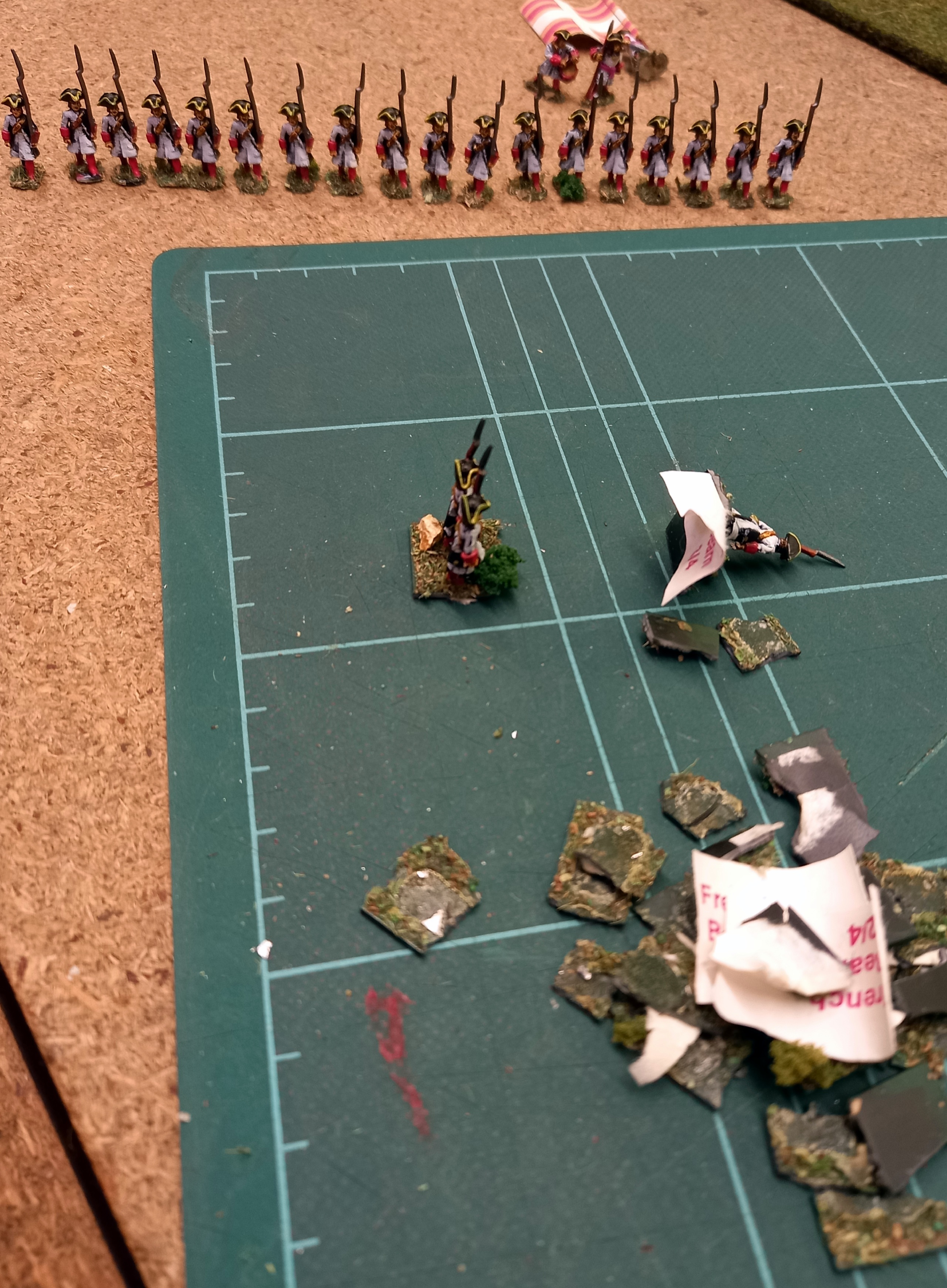
 Works in progress

Never a pretty sight half way though.. 😏

Nice new flag.. !

80% done..

Needed to wait for the glue to dry and then I flocked them to match the rest of the project..


Done!

~~~~~~~~~~~~~~~~~~~~~~~~~~~~~~~~~~~~~

Laters, as the young people are want to say...