Friday, February 3

27th Virginia Infantry

Colonel John Echols
commanding officer
27th Virginia Infantry
Steve the Wargamer is having a veritable painting frenzy...  2012 has started well....

Next off the chocks some more reinforcements for the ACW project... first on the side of the Confederacy

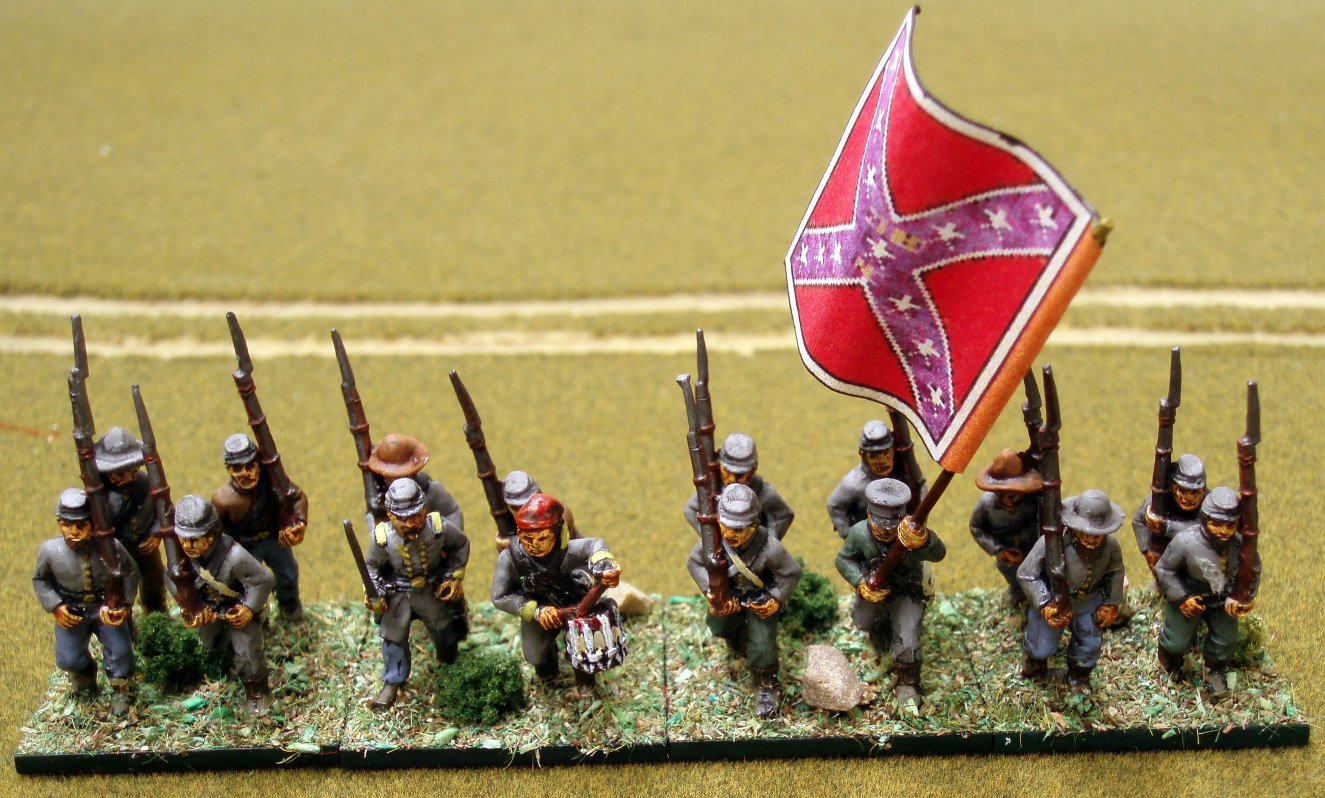
These guys represent the 27th Virginia Volunteer Infantry who at Kernstown were commanded by  Colonel John Echols (that's him to the left) who was severely wounded at the battle.

The regiment served in the Stonewall Brigade along with fellow regiments the 2nd Virginia Infantry [click here], 4th Virginia Infantry [click here], 5th Virginia Infantry, 33rd Virginia Infantry, Rockbridge Battery, West Augusta Battery, and Carpenter's Virginia Battery [click here]....

John Echols had formed the "Monroe Guard" in 1859 following John Brown's raid at Harper's Ferry, they were part of the Rockbridge Militia company. The company came from Monroe County, Virginia and left Union, the county seat, on May 13, 1861 under the command of Captain Hugh Tiffany. Company D joined six other companies at Harper's Ferry to form the 27th Virginia Infantry Regiment. The regiment was organized in May, 1861, and accepted into Confederate service in July...

Quite pleased with the motley look that these guys have - Reb regiments were far more varied in appearance than their Union opponents.....

The 27th fought at First Manassas, where it earned the nickname “the Bloody 27th” because of its losses, Kernstown, and in Jackson's Valley Campaign. It then participated in the campaign of the Army of Northern Virginia from the Seven Days' Battles to Cold Harbour, moved with Early to the Shenandoah Valley, and was active around Appomattox.

The regiment reported 57 casualties at Kernstown, and only 1 officer and 20 men surrendered at Appomattox.

Theoretically, they had 300 men at Kernstown - clearly they were still low on numbers following the events at Manassas, as even by Confederate standards this was a small regiment...  in Fire and Fury Regimental terms, at 40 men per stand, that's about 8 bases - I mount my figures on double bases, hence 4 stands....

Echols himself - the yellow represents a triumph in itself being my first use of the Valejo yellow I bought at Warfare - superb!! Echols was heard to have words with the drummer ...  clearly he's spent far too long hanging around with those rough zouave types!

So... 16 figures, all Newline Designs 20mm for a total of 16 points - next up a Union regiment - the 84th Pennsylvania I think....

Wednesday, February 1

"Black Watch" - a review..

The parents in law bought me this for Christmas, and as someone who has been disappointed in the past with some presents people think I will like because of my hobby, this one was an absolute cracker, and read pretty quickly... so what's it about??

Well this is another personal account by a young soldier who fought in the British army from D Day to the armistice, but unusually this time, is from the view of a soldier in one of the veteran Highland regiments..

Tom Renouf joined as a 19 year old, and served with the Black Watch, who were part of the famed 51st Highland Division who had fought from Dunkirk (where they were mostly captured), reformed, went to the Mediterranean where they fought from Alamein to Italy before being withdrawn for refitting for the Normandy landings...

After initial training he landed with them in Normandy on the 7th and spent his formative soldiering fighting against the likes of 12th SS Panzer Division Hitlerjugend ("Hitler Youth")

After spending a brief period supporting 3rd Canadian Infantry Division, the division was sent across the Orne River, and spent two months supporting the 6th Airborne Division in its bridgehead. During this period it fought many difficult actions at places such as Breville (11–12 June) and Colombelles (11 July).

Its performance in Normandy was, overall, considered disappointing, which lead to them getting a replacement commander, Major-General Tom Rennie, who had served with the division in North Africa and Sicily.

On 1 August 1944 the division, became part of First Canadian Army and fought in Operation Totalize, before advancing to Lisieux. It then continued east over the river Seine and headed for Saint-Valéry-en-Caux, which had been the scene of the division's surrender in June 1940 and a particularly poignant moment. The division's massed pipes and drums played in the streets of the town, and a parade included veterans of the 1940 campaign.

Leaving St Valery, 51st Division was engaged in Operation Astonia, the battle for Le Havre. After the successful capture of the town, the division went on to take part in the Battle of the Scheldt in October 1944, finally passing into reserve and garrisoning the Meuse during the Battle of the Bulge, now as part of XXX Corps. It was not involved in heavy fighting during the early stages of the battle and was deployed as a stopgap in case the Germans broke through.

In January 1945 the division, helped to cut off the northern tip of the German salient, linking up with the US 84th Infantry Division at Nisramont on 14 January. Following this, the division was involved in Operation Veritable, the clearing of the Rhineland and the later Rhine crossings, ending the war in the Bremerhaven area of Northern Germany.

As an interesting aside Renouf was involved with the capture of Himmler himself (and he still has the Gestapo commander's watch) & was a witness to the horror of the concentration camps which the unit helped to liberate.

Seriously wounded and later decorated with a Military Medal for gallantry, Tom Renouf describes the events well, he's quite good on the battles and although none of the views are particularly controversial one's - even of Monty bringing in Rennie as the replacement commander - he's well worth a read....

Steve the Wargamer rates this one a six out of ten...

Sunday, January 29

Raid on St. Michel - Game 5 - "Heading Home" - set up..

..and here's another bunch heading home after
a bank raid
...as I was reading through my old campaign diary for the "Raid on St Michel" mini campaign (5 linked "teasers" by Charles Grant and Phil Olley...) I suddenly noticed that there was no game report for the final battle of the campaign... Smiley

I hoiked out my ancient and now slightly battered copy of the campaign book and read through it; for some reason, lost deep in the midsts of time, we never fought it - so the campaign conclusion remains undecided...!

For those with an interest the previous campaign battles (four of them) can all be found at the top of this page on the War of the Spanish Succession blog [click here] but in summary a British raiding force (who represent the forces of the Vereinigte Freie Stadte or VFS in the campaign) has marched deep into French territory (representing the forces of Lorraine), captured the treasury from the town of St Michel, and are now heading back to the border and safety just as fast as their feet will carry them..

In the previous game (no.4 - a hideously lopsided affair) the British failed to halt the French flanking force from re-taking the bridgehead so effectively the route home is now closed..  the British will have to fight through if they are to get the treasury across the river and home safe..

The first complication is to make head and tail of my previous casualty returns so I can figure out what the orders of battle are...

First the British then:

All the forces left over from the battle of St Michel (teaser no.3) which as the write up showed, was the death of the British cavalry - DG is very light on horse..  just a half squadron of cuirassiers..

I'm going to make one change, and that is to allow the British an extra transport piece - they will start with 3 wagons..

I'll also allow DG to consolidate his regiments, to make them more effective..


Next the French...  these comprise the forces left over after the previous battle, and in addition the French cavalry from the Battle of St Michel are shadowing the returning British force so can also expect to make an appearance:


Hmmmm...  much more evenly balanced!

Battlefield is as follows..  the French main force deploys this side of the road, the British columns arrives on the table in the far corner - behind the church. The French cavalry shadowing force arrives on the road to the right (theoretically on move 4, but I may make it dependant on a dice roll after move 4)..


Victory conditions; the British have to get two thirds of the treasure across the bridge, the French must stop this. Both sides need to ensure that their forces are not completely destroyed - so no sacrificial blocking by the British.. 

Promises to be good fun...  not sure when we'll fight it but I'm already looking forward to it!

Thursday, January 26

Egyptians

Back in August 2008 I painted enough figures for my first unit of Egyptian regulars in the Sudan project - this is they (looking far too shiny for my tastes)

With the rules I was using at the time (and may still return to to tinker with) these two bases represented a company which is the operation manoeuvre unit for the rules...

In the Good Dusting rules the manoeuvre unit is slightly higher (battalion/regiment), so I've taken to representing battalions with four bases - another two bases of Egyptians were therefore required to allow me to represent them on the table top. Happily I had enough figures in the painting pile to do the job - in order to give them some focus I also gave them an officer and piper... it is a curious thing that Egyptian regiments have a bagpiper but an interesting browse on Wikipedia tells me:

"The [highland bagpipes] also spread to parts of Africa and the Middle East where the British military's use of pipes made a favourable impression. Piping spread to Arabic countries such as Jordan, Egypt and Oman, some of whom had previously existing bagpipe traditions. In Oman, the instrument is called habban and is
From the excellent Savage and Solder site..
used in cities such as Muscat, Salalah, and Sohar. In Uganda president Idi Amin forbade the export of African blackwood, so as to encourage local bagpipe construction, during the 1970s."

Got to love Wiki - who would have known Idi had a domestic bagpipe industry in Uganda....???

Anyway - the Egyptian army had it's (re)birth following the battle of Tel el Kebir in 1883, it started off eight battalions of foot, but by the time of Omdurman was up to nineteen. These were comprised of separate Egyptian and Sudanese troops.

My copy of Asquith's "Wargaming the Sudan" tells me that each Egyptian infantry battalion comprised four companies of 200 men up until 1898.

In order of seniority they had regimental numbers of 1st through 8th, and 15th through 18th (the Sudanese would have been numbered 9th - 14th) and the general opinion at the time was that the Sudanese were the cream of the army, with the Egyptian regiments often being placed in the second line as they were seen to be lacking in fighting spirit, or what our French colleagues would call panache...

Either way - here's the first picture of the new recruits...  the officer is typical (see bottom of this post for a cracking contemporary photograph), and for the Egyptian regiments were usually British - British officers seconded to the Egyptian any were given a commission of one or two ranks above their own.


The Egyptian (and Sudanese) infantry were armed with the classic colonial weapon, the Martini-Henry rifle and triangular socket bayonet.

Opinions on the fighting quality of the Egyptian regiments changed markedly after the battle of Ginnis, when the Egyptian regiments cleared part of the village in stiff hand-to-hand fighting and captured four Mahdist guns - clearly the training had paid off - from that point on the Egyptians were seen as "steady" while the Sudanese were seen as the shock troops....


...and here's the entire regiment deployed as one.... the two new bases in the middle with the originals on the wings....  I applied a layer of Dullcote to the original regiment which has matted them down nicely, but I think I'm also going to re-base them as the new MDF bases are considerably better....


So there you have it - either two company's of the 1st Egyptians, or the 1st Egyptians, depending on which rule set I use.... figures are 15mm and (I think) largely Peter Pig, not sure about the officer/piper, he may be Lancashire from the first big bag of figures I bought way back at the start of the project...

So 12 painting points, thank you very much - next on the painting table a regiment of Confederate infantry for the American Civil War project..

...as promised a contemporary photograph - if this doesn't show a certain insouciance I don't know what does!

Anglo Egyptian army officer - from the Soldiers of the Queen web site..
Other sources:

The Egyptian Army 1880 - 1900 the Savage and Soldier magazine article by Doug Johnson


Saturday, January 21

Conquerer - a review..

The fifth in the series and one of my favourites - this and the first one (about Genghis himself) are unputdownable...

Conqueror tells the story of Kublai Khan one of Genghis's many grandchildren and by far the most famous of the Mongolian khan's alongside Genghis himself.. 

His early life was a somewhat book'ish boy and at the end of the previous book his older brother (who is cast in the old school) sends him off to fight the Chinese, with his own army & advisors - a Mongol version of "sink or swim" if ever there was one..

At the end of the previous book Mongke is killed by assassins and this books deals with Kublai's rise to power, and the Mongol nations first civil war caused by Kublai's other brother, Ariq Böke, declaring himself Khan in Kublai's absence..

 Kublai is campaigning against the Song Dynasty in South China when he finds out - he immediately gives up on his Chinese campaign and gathering his supporters declares himself the Great Khan in opposition. The book deals with the campaigns, treaties, bribes and politics and the eventual final battle where for the first time Mongol fights Mongol, and Kublai wins..

Gripping from beginning to end...  Steve the Wargamer rates this 9 out of 10 - read it!

Somewhat surprisingly (to me anyway) this turns out to be the last book in the series, I was expecting at least one more book with further detail on the life of Kublai, who was the fifth Great Khan of the Mongol Empire, reigned for 30+ years, founded the Yuan Dynasty in China, and who met Marco Polo...  in the afterword Iggulden says that he decided not to, as just for once he wanted to end a series where the major player lived...   can kind of understand that!