Sunday, April 7

Salute 2019

Painting glorious'ness - not my cup of tea,
but 'recognise skill when you see it' is my
watchword..
Wow....  just, "wow!"

Day after Salute, and my knees know it, the feet still ache, but what a fantastic and amazing show...  the inherent contradiction however, is that I'm not not sure I could do it every year, though! 

So...  thoughts, comments, purchases, and the inevitable countdown of favourite games bit before I do Farcebook, and the bloggerati have posted in detail elsewhere, and the pictures there are also stunning and recommended ..  always good to get other peoples views...

For the first time this year, DG and I attended by train and despite getting comprehensively lost on the DLR on the way too the Excl (which isn't difficult as despite the shortness of the line there are a surprising number of routes and stations in it -  I can however advise the walk to Tower Gateway station is stupendous - where else could you walk to a station with the Tower to your left?) on the way back we demonstrated that you can teach an old dog new tricks and got on the right one... 

The general view was that this was a far better way to attend the show than by car despite being slightly more expensive.. if (when) we attend again we'll definitely repeat ..  decent beer at Victoria Wetherspoons, and the ability to relax and read a book, beats all the possible convenience of car travel..
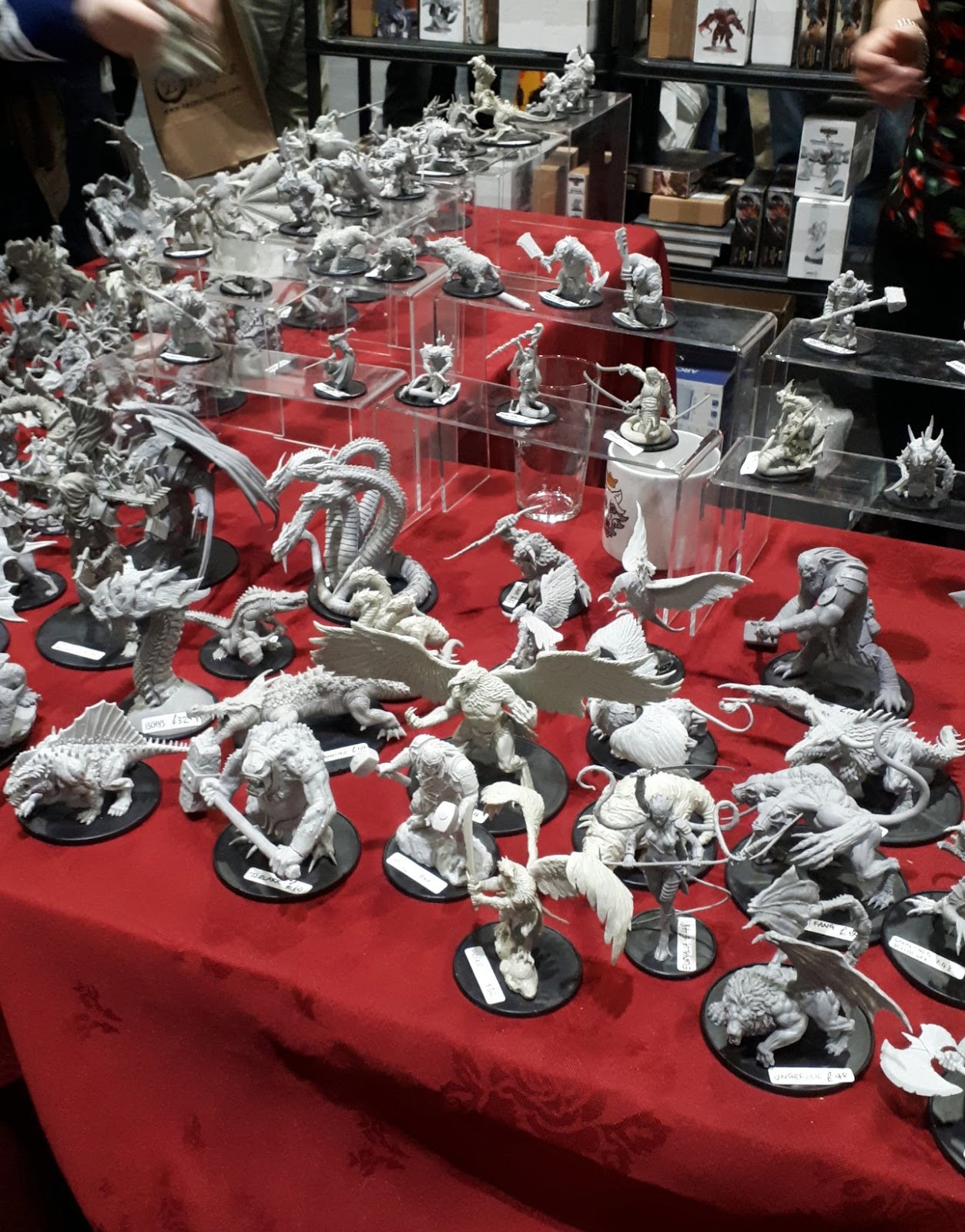
Mad, just gloriously mad...
Arrived about half eleven/twelve, and of course no queues (why do people arrive so early???  it's not like the show is going to close early or go anywhere else!) picked up the goody bag - which was absolutely stuffed this year by the by, free D6 dice, free figure, free kickstarter figure of some warlock (grandson will get that) and a dice based game that had a good selection of dice in it that will definitely get "re-purposed" and in to the show...

First thoughts, still as huge as it ever was...  second thought, "yee gods it's warm", third and final thought, "they haven't improved the lighting any I see"..

General thoughts and comments..

  • don't let anyone tell you that this isn't primarily a fantasy based show..   the sheer number of bijou traders selling esoteric and different versions of wizards/elfs/ogres/zombies/dwarfs/demons and everything else in between continues to grow..  as I've noticed previously, their marketing is absolutely top of the range, but I've never heard of them, and you wonder how long they can maintain a presence as it does seem to me that the ranges they sell are specifically geared to a game system, and the game systems do seem to come and go with alarming speed
  • on the historical side I specifically noted that the Perry's were there, Essex (in a part of the hall so dark I resorted to phone torch to have a look at the figures), Old Glory (Andy was counting purple notes, always a good sign ), Donnington (I liked their TYW range and may look to bolster numbers n the ECW project with them..), Emperess, Baccus, Pendraken and a number of others so the fantasy crowd didn't get it all their own way..  apologies for any I missed or more likely forgot..
  • small games were a heavy feature, Osprey skirmish type games, figures individually based and about 50-100 of them a side..
  • Warlord were featuring the next game system to follow 'Cruel Seas' which I got mildly excited about enough to take pictures..   I really like the movement markers they use, and will steal the idea for my ACW ironclads but I would make them in clear plastic to make them less obvious...  the models were stunning..


  • there seemed to be a lot of open space on the cafe side of the hall? Given the costs of hiring a stand, versus the fact they have already hired the hall it would seem there might have been an opportunity to give the traders a little more free space?? Most of the stands were two and three deep, and given the light, and the fact I need to wear reading glasses it was enough to out me off...  on the plus side seating has been massively improved...

....and that's enough blathering for now...  purchases? I had a good spending day for once...  first stop was Pendraken where Leon has been doing seriously gentlemanly like things over the lash up that was Blitzkrieg Cammander v3, he offered to replace any copies of v3 with a free copy of v4 - I am most impressed with this, told him so, and took delivery of my new book - well done Leon/Pendraken! Next stop was Art of War [clicky] for a tshirt..  I first learned about these from Big Lee Hadley [clicky], and have been buying them ever since...   this is my fourth I think and as I'm off to Greece for holidays this year, this was a must have! Thoroughly recommend these tshirts by the way, good quality, stupid cheap, and a thoroughly nice bloke running the company..

....next was Peter Pig, for the artillery for the ECW project..   four culverins (the medium field piece as we now know ) and two packets of artillery crew will do for this initial stage of the project* - if I need limbers, and I'm not sure I will, I will use those from the Marlburian project as they are sufficiently generic to be re-used.....  and last of all back to Pendraken to complete a paint order, it's nice to be in a position were I have to buy it! Five pots bought - one is an orange as I foresee more Parliamentary sashes,  I also got a splendid purple (looking forward to using that), two more flavours of blue, and  more realistic buff colour..  shopping done it was on the the games...

* I am following the 4-2-2 idea (as in units of infantry-cavalry-guns) that I read about elsewhere on the web, and struck me as eminently sensible, to get me to critical mass on this project - the idea being that this is the minimum required to fight your first decent game. After that the project can be allowed to grow over time..  but the first push is two sides of 4-2-2..  the guns will complete the artillery requirement for the first phase of the project

In reverse order....

Lego Flash Gordon - what is NOT to like!!


Utterly mad..  but the kids absolutely loved it...   and it's here in honour of my grandson!


Next - the Warlords game - lovely, and it would have featured higher but for two things..


..I wasn't keen on the bases/sabot's..  and the strap line for the game was "what would have happened if pilum met pike" like it never happened, but as we know it did happen - at Cynoscephalae - but I'll give them the benefit as those are clearly Imperial Romans rather than Republican..  (oh Lord I'm turning into a geek...  )


Next - Too Fat Lardies "Fall of Singapore" game using "Chain of Command" rules.. I arrived just as the game was ending (Japanese repeated history) but what a lovely table.. the palm trees were the best I've seen..

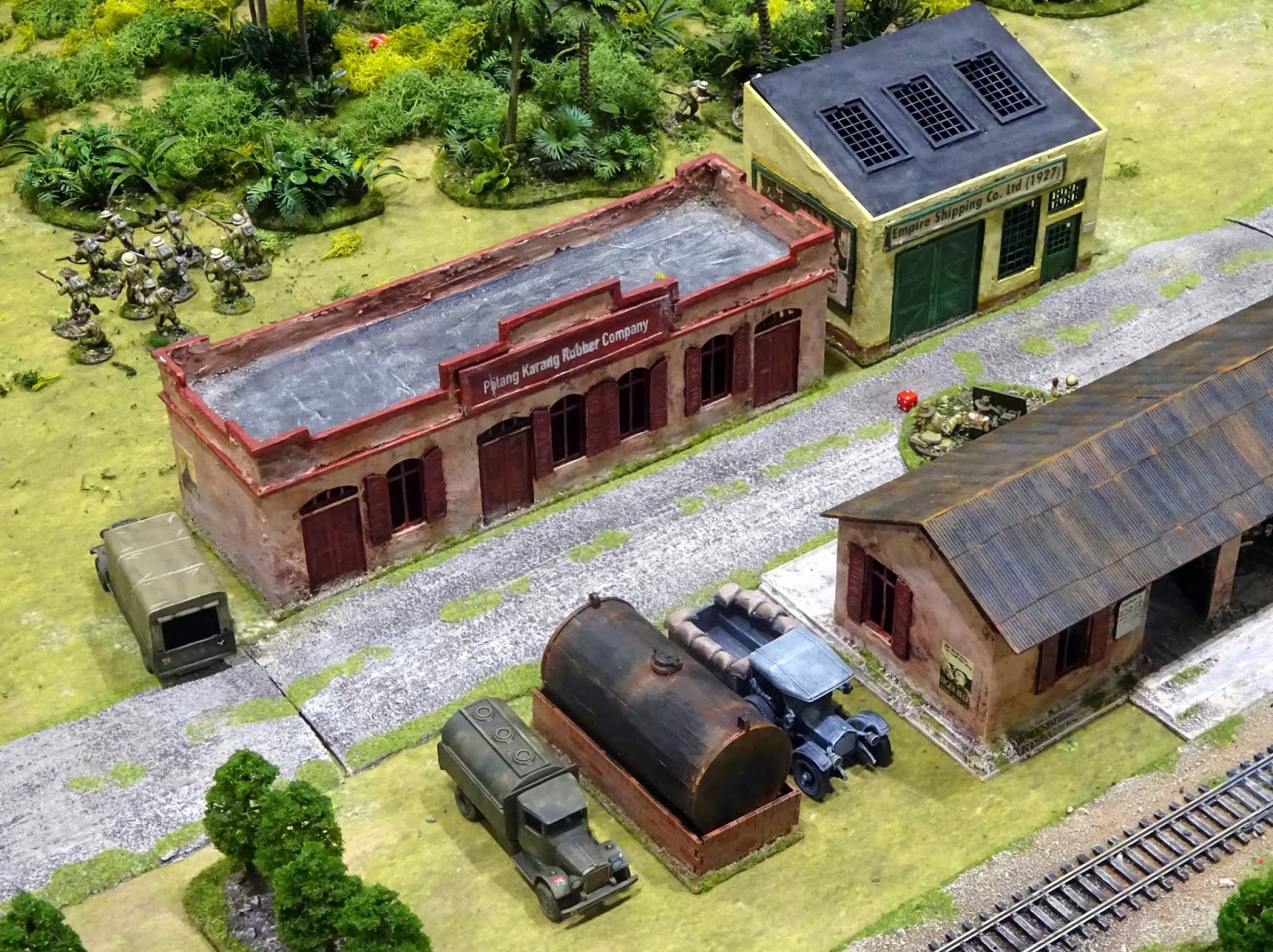

...and Japanese tanks.. lovely..


Next - "To The Strongest" Rome and Ancient Britons game..  lovely, and going full pelt - there must have been getting on for 12 to 15 people playing it..  had to pick my moments for pictures..


...this would also have scored higher, but I'm not keen on the playing cards..?


Last but one...  the Battle of Lutzen put on by "The Friends of General Haig" using Pike and Shotte rules..


Fantastic, and still came in second despite the extraneous clutter on the table - and they didn't offer me a chocolate finger biscuit for the vote...   I'll forgive them them the clutter given the game was clearly being played...  


...and in top spot - a clear winner - knew it the moment I saw it, before even seeing the other games...  I'm a sucker for a black powder period game but when it is as good as this...   Williamite Wars in Ireland, this is a representation of the Battle of Aughrim put on by Crewe and Nantwich Wargames Club, and is in a word..  exquisite...


...this one is my favourite shot...  superb...


....there you go...  lastly, by way of a last tasty morsel...   not my cup of tea, and not a game, but the modelling and spectacle can't be denied..


....onwards and upwards...  looking forward to a further Salute, but maybe in a few years time! 

Thursday, April 4

"One Hour Wargames" - Scenario 18 - "Counter Attack" - Setup

Amidst all this painting (and also on a slightly larger scale elsewhere [clicky]) and preparing for the ECW project, two things of note should be mentioned..

One, this weekend coming is SALUTE in the UK, the nations biggest wargame show (allegedly), and after a three year hiatus, Steve the Wargamer will be attending, tickets are bought..

Two, one of the reasons for going (and I had tickets last year and didn't end up going for one reason or another - lethargy, mostly) is that DG is also attending after the same three year hiatus, always more pleasant to wander a wargame show with a mate so you can swap anecdotes, let them know things you've seen they haven't and vice versa, so there is more than a chance I may actually make it this year, and dare I say it, I'm quite looking forward to it...

The other thing of course, is that because DG lives in deepest darkest Wales, up a mountain, the easiest way for him to attend the show is to visit his daughters family and grandchildren who live not far away from me, and if he's going to do that it would be damn foolish not to fit in a game..

DG contacted me earlier this week and asked what period we wanted to play, so I gave him the opportunity and he replied 'American War of Independence'..  it occurred to me that this would be an ideal opportunity for the 2019 John Corrigan Memorial game [clicky] as I might not get to see DG again in any reasonable amount of time.  Thoughts turned to scenario's and I've returned to the 'best ten pound I ever spent book' and in our gentle meander through the scenario's we are now at #18 "Counter Attack" - it looks interesting, so that will be the game for the evening..

Scenario setup will be as per the book (go buy it, by the way ... it's remarkable value at less than £7 on Kindle at the moment) except for the following..
  • forces will be diced for on the random table, but will be rolled for twice - so 12 units a side
  • any rolls of 'two cavalry' will have one cavalry swapped for a line infantry - it was a cavalry light war so its is more realistic
  • any artillery will be "light"
  • no national characteristics will apply, no morale bonuses.. 
Table as follows..

Primary terrain features for the scenario are the bridge and the "town"..


I diced for forces ahead of the game and both sides threw the same dice so forces are (against all the odds!) identical and comprise:
  • 8 Line Infantry Battalions
  • 1 Light Infantry Battalion
  • 1 Cavalry Regiment
  • 2 Guns (according to the random table that should be three guns, but I think that may be a bit artillery heavy, so I swapped one for infantry)
Scenario is supposed to be 15 moves long but I'll play that by ear as a move in my rules only represents approximately 10 minutes - winner is the side that controls the bridge and town..

Tuesday, March 26

English Civil War cavalry notes..

Your troopers are most of them old decayed servingmen and tapsters; and their troopers are gentlemen's sons, younger sons and persons of quality; do you think that the spirits of such base and mean fellows will ever be able to encounter gentlemen that have honour and courage and resolution in them?
Cromwell in a letter to John Hampden after Edgehill

Time for another of my informal and occasional notes/articles, this time on the cavalry of the English Civil War. Before we start there will be a couple of exceptions/omissions - I won't cover Dragoons (as they are basically just mounted infantry, and I'll do a separate research article on them), it also doesn't cover Lancers as they were primarily used by the Scots, and they weren't present at Edgehill...

Organisation:
  • Cavalry were organised in troops - a similar organisational grouping as an infantry company.
  • A troop was commanded by a captain and had somewhere in the region of thirty to one hundred men. The senior/leading troops would have been lead by the colonel of the regiment, and a major (his second in command)
  • Cavalry troops could operate independently, but usually they were grouped into a regiment of around six troops under the command of a colonel (when I was doing my research on Fielding's regiment at Edgehill, I read that an independent troop under Sir Samuel Luke served with the regiment for the battle, and afterwards until 1643).
Types:

Harquebusiers

By far the most common cavalry type, though the descriptor 'harquebusier' [clicky] is not very well known/used (at least to me )..

In summary, and mostly from the very excellent British Civil wars wiki, but with other bits and pieces added from other sources...
  • Originally, a harquebusier was a foot soldier armed with the arquebus (or harquebus), but  during the French religious wars of the 16th century, they became mounted (I wonder if originally that was a dragoon role), and by the early 17th century, they had evolved into the standard light cavalry of western Europe (though I would be more inclined to call them medium due to the equipment they wore, and their style of fighting).
  • originally they were armed with a carbine/harquebus, a pair of pistols and a sword but during the civil wars, the carbine was likely to be carried by officers only.
  • defensive armour consisted of a light breast- and back-plate and pot helmet, sometimes with a "gorget" to protect the throat. A thick leather buff-coat was usually worn underneath the armour, and often replaced it altogether. A distinctive feature of the English cavalry was the three-bar pot helmet with articulated neck-guard - it is entirely possible that the cavalry would wear a soft hat with an iron "secrete" (helmet liner) underneath to give protection (8 and 9 in the picture left in the following)

Found on Pinterest but clearly copyright Osprey

Cuirassiers

Comparatively rare/scarce (expensive to maintain, and they required a heavier/stronger horse to carry the weight) - the best examples in the English Civil War were probably Haselrig's Lobsters [clicky], and perhaps Charles's Lifeguards (just a troop strong) and the Lifeguard of the Earl of Essex - either way, they were rare and classed as heavy cavalry.

Cuirassiers wore a suit of articulated plate armour reaching from the head to the knee. A long boot protected the lower leg and the back of the thigh.

Originally armed with the lance, they became increasingly through the 16th Century and into the 17th re-armed (after the wheel lock pistol was invented) with the pistol/carbine and of course the sword - later on the pistols would be early model flint lock.


Also found on Pinterest but clearly copyright Osprey


Tactics:

Positioned on each side of the infantry were the cavalry, with a right-wing led by the lieutenant-general, and a left-wing by the commissary general; the main goal of the cavalry was to rout the opponent's cavalry and then turn and overpower their infantry.

Two main tactics
  • the Dutch style - to advance at a quick trot until in range of the enemy. The men in the front fired, then wheeled away. In their second charge they advanced at full gallop using either a short sword or cutlass.
  • attributed to the Swedish under Gustavus - his cavalry would charge at full speed into the opponent's infantry firing their pistols either just before impact, or in the melee.

"at the start of the wars the Royalists (generally) adopted the Swedish style and the Parliamentarians the Dutch style. But by 1645 they were all working, to a greater or lesser extent, on the former" (Lipscombe - link below).

In the early years of the war at least Parliamentary cavalry tended to receive charges at the stand - depending on their fire power to disrupt the attack (the Dutch model - described in more detail in the Wanklyn book - "Deployed 6 ranks deep.. Dutch cavalry did not charge the enemy they waited for the enemy to charge them relying on firepower to disrupt them... if they were disrupted they would counter charge but at a trot rather than gallop... if the enemy wasn't disrupted then the 6 rank depth would absorb shock and the casualties inflicted on the enemy would give them the benefit in the ensuing melee")


Royalist cavalry tended to charge home directly with the sword, not using firearms until the melee. The Parliamentarian cavalry retained the use of firearms in the charge until later in the Civil War, but by the time of the New Model Army, had largely adopted the direct charge with the sword.

Royalists, under Prince Rupert's direction, began the Civil War using the Swedish three ranks-deep formation but the Parliamentarians retained a six-deep formation until late 1643 or early 1644 when they also moved to the shallower formation.

..from the Wanklyn book...
A cavalry unit drawn up in a shallow/Swedish formation would outflank a similar sized unit arrayed in a deep formation, a considerable tactical advantage.

Royalist cavaliers usually charged at speed, the English Parliamentarian Ironsides (later war then)  charged at a slower pace, troopers keeping together knee-to-knee, in order to retain their formation.

Basically thick firepower, versus thin fast shock then..

Sources:

https://en.wikipedia.org/wiki/Harquebusier
https://en.wikipedia.org/wiki/London_lobsters 
http://bcw-project.org/military/units 
"Combined Arms Tactics in the English Civil War" - Nick Lipscombe
"A Military History of the English Civil War: 1642-1649" By Malcolm Wanklyn, Frank Jones