Thursday, May 2

Sir John Gramson's Regiment of Horse..

The man himself (caught in perhaps one of the
first selfies), while serving in the low countries
By way of a bit of fun..  here's the next regiment to join the Parliamentary ranks.. 

Bawdy, cowardly, and courageous by turns, Sir John (known to his closer acquaintances, and a fair few ladies, as Lee) Gramson was a seventeenth century gentleman who over the course of his lifetime was caught between, and served,  various allegiances, and who at separate times had to either bludgeon, lie, or bed his way out of a number of troubles.

Born in 1601, Sir Lee's family’s fortunes came from his Scottish father’s boyhood friendship with King Charles, and as the heir to Gramson House, the family mansion on the Thames near Richmond, he always believed himself  destined for greater things.

As a young man, he was sent to Oxford University, where he spent three years deciding that he was not interested either in continuing academic life. or entering one of the professions—law, the Church, or medicine. An uninspired scholar, his time appears to have been sent mostly at "The Vulgar Unicorn", a public house of ill repute where he was usually to be found (when not upstairs with Meg, Lill, Kate, and/or Beth) in a corner of the bar with friends.

While he was at university, his father died and he inherited..

Sometime around 1626 (his memoirs are unclear, possibly due to his life-long prodigious appetite for Sack and Malmsey), he lost the house and inheritance in a game of Cribbage. Subsequent accusations that the game was rigged were unproven, yet resulted in a life long enmity for the man  he believed to have deprived him of his fortune (Sir Mamaduke Forstescue).

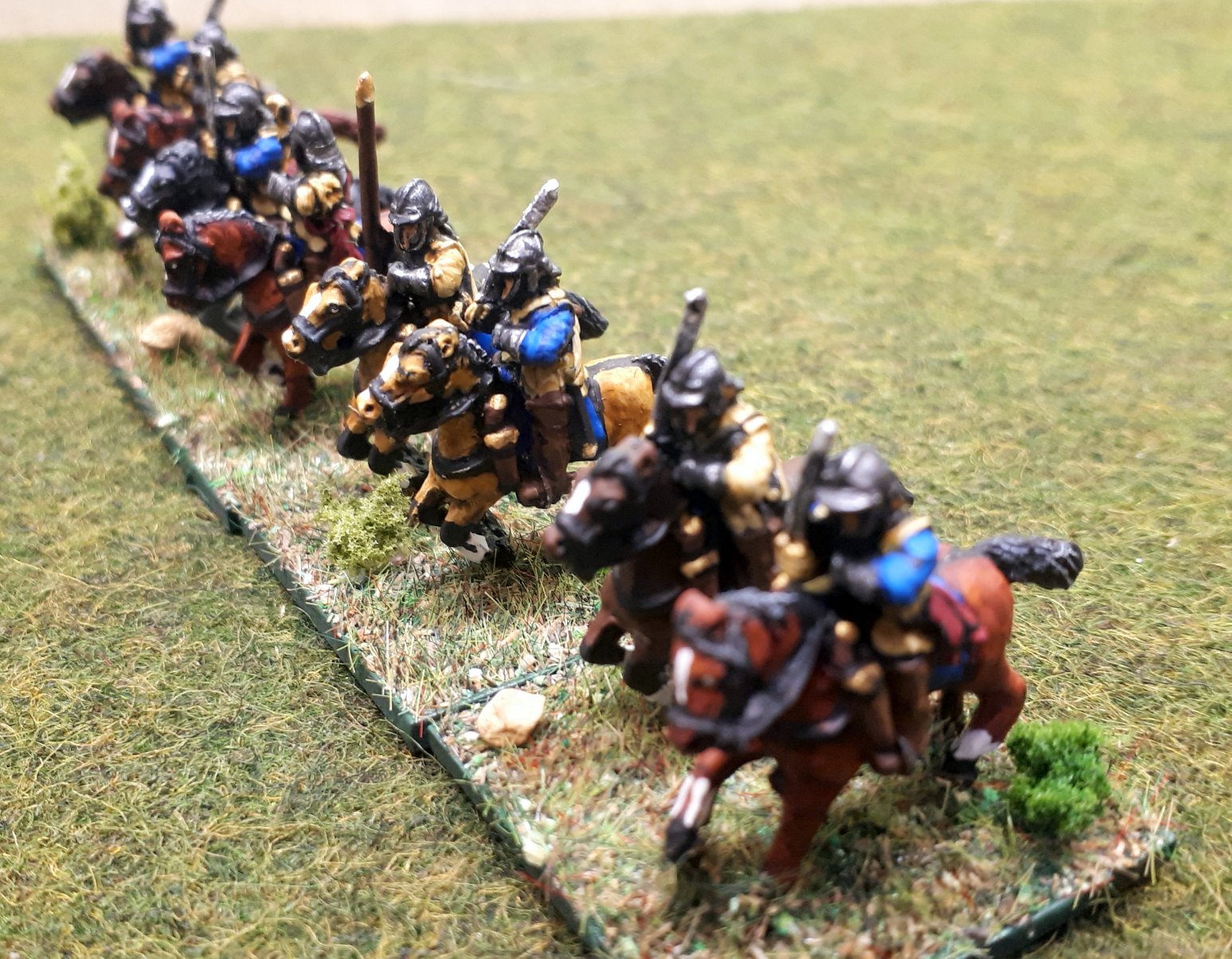
Much taken with the two "yellow duns" (really..) in the middle..

With no money, and pursued by debtors and ladies of ill repute, Gramson crossed the Channel and after minor adventures on the road, arrived in Paris. Facts are unclear but his subsequent early departure from Paris may have been due to him killing a man in a duel and needing to avoid the authorities.

He journeyed to Italy and travelled there for some time, arriving in Vienna in 1631 and then going on into Bavaria. In Germany, he was witness the fighting between the Protestant Germans, led by the Elector-Duke of Saxony, and the Catholic forces headed by Emperor Ferdinand. Needing money he took a commission as a volunteer officer in the Protestant forces and was present at the siege of Magdeburg where the Gramson coffers were replenished again by the looting that followed.
Love that uniform blue..

After the fall of Magdeburg, Gramson was introduced to Gustavus Adolphus, King of Sweden, who had joined the Protestant Germans against Emperor Ferdinand and was apparently impressed enough that he took service with the Swedes as a gentlemen volunteer and was present (but not conspicuous) at both Lutzen and Breitenfeld, and where the coffers were added to again.


On the death of Adolphus he again surrendered his commission, and returned to France via Holland, before eventually returning to England, when the news of the troubles (that were to lead to the English Civil War) reached him.

As a hardened veteran of the wars in the Low Countries, his memoirs also make clear that he is still also seeking revenge on Forstescue, the man who he believed cheated him, but who is serving Charles. Driven by revenge then, rather than a conviction to serve Parliament’s cause, he takes service with Parliament and is given a commission to raise a regiment of horse, and passes the time while doing this, cheating at cards, living off his wealthy and attractive mistress, and plotting the death of Forstescue.


Gramson died in 1662, childless, possibly as a result of cirrhosis of the liver following a lifetime of Sack and Malmsey intake (right up to his death his usual breakfast was a dozen oysters washed down with a jug of Malmsey).

Forstescue outlived him ()

Figures Peter Pig - painted March '19 (but not by me - as can clearly be seen!) - love them, cheers, Lee!

The real stuff:

The vast majority of the above is of course scurrilous nonsense, but it was fun inventing it, and I wanted a way of marking Lee's kindness in painting these two regiments of horse for me and this seemed as good a way as any.. 

The following however, are actually true..

Sunday, April 28

Sir John Byron's Regiment of Horse

The man himself.. stunning picture - fans of Stuart Reid
may recognise this from the cover of his book..
the scar on his cheek was a legacy from a skirmish in
January '43, when he was wounded by a halberd
More cavalry joins the project..  and thereby hangs a tale..  or should that be tail?

While talking to ex-pat Lee [clicky], about the progress of the English Civil war project (which Lee has some experience of, having painted an astonishingly good collection you can drool over here [clicky]) he mentioned that he would quite like to paint up a couple of regiments of horse, as I was using Peter Pig, and he loves the sculpts (as do I).. It didn't take 30 seconds for me to get an order in to Mr. Pig and soon enough, there were enough figures for two regiments on their way to deepest darkest sunny and brightest Spain...  and back, stupidly quickly considering, came this bunch (half of the haul!) - absolutely exquisite....

There's not a huge amount of information on the regiment itself as they are kind of overshadowed by their commanding officer, but the Byron in question was the eldest of seven sons of Sir John Byron (who died in 1623) - somewhat interestingly (ie. I am a geek and found it fascinating) I read somewhere that all seven of them were present and fighting for the King at Edgehill...

Potted CV. He was educated at Trinity College, Cambridge, and was elected as MP for Nottingham in 1624 and 1626. He was knighted in 1626 and was then elected as knight of the shire (MP) for Nottinghamshire in 1628. Charles created him Baron Byron in October 1643 after he'd distinguished himself at the First Battle of Newbury.

Byron was a Royalist from the very beginning of the First Civil War. He was commissioned colonel of this, the first Royalist cavalry regiment to be raised, in August 1642, and was sent with it to secure the city of Oxford in the King's name - which he did.

For the lack of anything to say otherwise I agreed with Lee we would go mix of red coats and buff for this regiment..
 At the approach of superior Parliamentarian forces, Byron, whose force was loaded up on looted college silver and plate, retreated to Worcester with the aim of getting to Shrewsbury to rejoin the King and the army mustering there, where the cash would undoubtedly have been welcomed. Rupert covered Byron's withdrawal from Worcester, resulting in the first significant skirmish of the English Civil War at Powick Bridge.


The following month, Byron's regiment took part in the battle of Edgehill - their strength is noted as 250 men in 6 troops ("Edgehill: The Battle Reinterpreted By Christopher L. Scott, Alan Turton, Eric Gruber von Arni").

The regiment was posted in the second line of Prince Rupert's (cavalry) command, on the right of the Royalist line, where they were in line with the Lifeguards and behind Rupert's regiments in th first line...  a number of sources I have read indicate that Byron could be held partly responsible for the Royalists not winning this battle, as during the initial opening moves of the battle when Rupert charged, Byron and the second line went with him rather than holding back as the reserve they were meant to be..  OK Rupert might also be held accountable for not having good instructions, but Byron was no new'by and should have known.. it looks like either he got carried away, or the Royalist horse under his command got carried away, and an opportunity to have had a good  reserve of horse for the later stages of the battle was lost...  lessons learned by both sides, and notably Byron, in time for Roundway...


The regiment (under Byron) went on to serve throughout the war before eventually surrendering at Carnarvon Castle in 1646 - they were present at Roundway Down, 1st Newbury, Marston Moor, and Rowton Heath, but were involved in and present at a score of other smaller actions and less well known battles...  true veterans.


Lord Byron died in 1652, childless, in exile in Paris, and was succeeded by his next eldest brother.

Figures Peter Pig - painted March '19 (but not by me - as can clearly be seen!) - love them, cheers, Lee!

Monday, April 22

Dragooners...

"They ought to be taught to give fire on horseback, but their service is on foot,"

..next in a very occasional series..

The name possibly derives from an early weapon, a short wheel-lock called a 'dragon', because the first dragoons raised in France had their carbine's muzzle decorated with a dragon's head.

It has also been suggested that the name derives from the German "tragen" or the Dutch "dragen", both being the verb "to carry" in their respective languages.

(By the by, slightly less believably, I have also read that the name is descended from the Latin Draconarius - the standard bearer in Roman cavalry carrying the Draco, the open mouthed dragon headed standard, and also I've read that they got their name from the fact that a galloping infantryman with his loose coat and the burning match resembled a dragon ).

The practice of mounting musketeers for greater mobility probably originated during the late 16th century in the French Huguenot armies of Henri of Navarre. Dragoons were used in the Dutch armies of Prince Maurice of Nassau

Monck recommended that an army have as many troops of dragoons as regiments of horse (ie from one-fifth to one-quarter the strength of the horse)

"Uniform"

If we've learned anything by now it's that uniforms weren't ..errr... uniform..  

Their usual attire would have have been that of an infantry musketeer, apart from the fact they would have worn boots and spurs instead of shoes. Helmets were sometimes worn, but even so, not much protection, and they were unsuited to cavalry on cavalry action.

They had swords, but only the officers carried pistols, the rest having either a 'dragon' (a musket-bore firelock with a 16 inch barrel) or a shortened but wide-bore firelock musket, both were normally slung from a swivel on a broad leather shoulder-belt. Ideally these would be firelocks/flintlock/wheel lock, but occasionally they would be match lock (more likely on the Royalist side) and this would affect the ability to fire from horseback.

Dragoons rode small horses or 'cobs' to move into position and then fought on foot.

Reenactor pic courtesy Wars of Louis
XIV blog link below..
Supplied with inferior horses and more basic equipment, the dragoon regiments were cheaper to recruit and maintain than the expensive regiments of cavalry.

Their standards or 'guidons' were a cross between infantry colours and cavalry cornets - about two feet square - and the fringes which some of them feature. What made dragoon guidons really distinctive, however, was their swallow-tailed shape.

Organisation

Early dragoons were not organised in squadrons or troops as were cavalry, but in companies like the infantry: their officers and non-commissioned officers bore infantry ranks.

The basic building block was a file of 11 men, of whom ten dismounted to fight while the 11th held their horses. A company (I have seen them also called troops despite the previous statement) numbered approximately a hundred and ten men each - five troops seem ordinarily to have sufficed for a regiment, but the New Model (being different) had ten - see below..

Dragoon regiments used drummers, not buglers, to communicate orders on the battlefield.

The New Model had one Dragoon Regiment, with ten 100 man companies, it played a significant role in the early stages of the battle of Naseby by disrupting Prince Rupert's cavalry on the Royalist right wing. In most major encounters of the Civil War each side had one or two Dragoon regiments. 

Initially, dragoons were organised in distinct regiments, but as the wars progressed, the practice grew of attaching a company of dragoons to some of the larger cavalry regiments to provide supporting fire in action and to act as sentries.
From Pinterest but clearly copyright Osprey

Tactics/Usage

Dragoons were mounted infantrymen who rode small horses or cobs to move into position and then fought on foot. Typical dragoon actions during the civil wars were to cover the approaches to a position or to guard the flank, screening flanks or retreats, seizing strategically placed patches of cover ahead of the main army, or giving mobile fire support to the cavalry..

In the closing stages of the Battle of Naseby Okey's Dragoons, who had started the action as dismounted musketeers, got on their horses and charged, possibly the first time this was done.

A single dragoon troop or company was sometimes incorporated into a cavalry regiment, though separate regiments, usually of five or six troops or companies, were probably more usual.

Dragoons were trained to 'give fire on horseback' and very occasionally did deliver mounted charges, but they were still essentially mounted infantry and had not yet managed to assimilate themselves into the cavalry. Without pikes, they would have also had a hard time trying to stand against attack on foot.

Not surprisingly, dismounted behind a hedge was their favourite battlefield station.

Enough I think..  I'm planning to add at least a regiment per side for this project..

Sources

Gush Renaissance Warfare [clicky]
http://warsoflouisxiv.blogspot.com/2017/05/english-civil-war-dragoon.html
http://bcw-project.org/military/units
http://wiki.bcw-project.org/_media/notes/articles/ecw_flags_article.pdf

Stay tuned - Brooke's is on the painting table, and I have regular cavalry at the basing stage..

Monday, April 15

"One Hour Wargames" - Scenario 18 - "Counter Attack" - Game

A portent of things to come...! My first throw... there's
a 0.08% chance of getting that result ..apparently... 😏
...so a little delayed (I blame Salute, and getting Sparrow ready for the water), but herewith the results of the game DG and I played on Salute-eve, the setup of which was described in this post [clicky]..

So by way of a quick recap - American War of Independence - 12 units a side (1 cavalry, 2 guns, 8 line infantry, 1 light infantry) - objective for the winner is to control the town and the bridge..

DG opted to be the "defender" with the Anglo Hessian force, I was the 'damned Colonials'..

As nominal "attacker" I have three advantages - one I start the game with all my forces on the table (the defender only has two units on the table at start),  two, I am aware of the existence of, and can use, the two fords, and three, I can occupy one of the two objectives - the town - immediately (on the plus side for the defender, they hold the other objective).. my plan of attack was 'divide and rule' since DG's starting force blockades the bridge, and he can't be in three paces at the same time, the fords are key..

We decided on the evening to dice for DG's main force arriving from turn 3 with a reducing throw required of 5 on turn 3, 4 on turn 4 etc. so theoretically ( 😀) I had 4 moves to play with..

Dividing my line infantry into two brigades the plan was to use one of them to demonstrate against the bridge and keep/hold DG's forces there, while the other column used the ford on my right to (hopefully) outflank..   I sent the lights and the cavalry to the ford on my left..

I would say about move two or three..  DG is about to start dicing for the arrival of his main force..

Same move, other flank - cavalry hoping to make a nuisance of themselves..

Damn sightseer's...

My centre brigade coming on nicely - bridge and defenders in the background..

At which point - tea consumed - and the Americans in a relaxed frame of mind, it being turn 3, DG threw for the arrival of his main force, and they turned up that move...  the dice gods had turned, and my first throw was not a portent for me, but DG..  😏

First he moved his cavalry to the ford where mine were, effectively blocking mine from crossing - with finite resources its an even throw, and I didn't want to waste my cavalry, so there they stayed..


Focus switched to the other flank..


Four battalions crossed the ford on my right, swung wide, and then lined up to roll up the British flank...  to give DG something to think about I launched my central brigade across the bridge in column - always a risky manoeuvre, but I was hoping to suck in some of his infantry so that they weren't facing the flank attack...

Bridge assault!
On the other flank - DG had reinforced the cavalry with a couple of battalions of foot...   my cavalry and lights were holding up two line and his cavalry - I considered that a fair deal..!  😀  Both sides artillery, throughout all of this pounded away on targets of opportunity..

A Proper Job indeed... high water mark of the American effort..

...and then it all started to unravel for the American's..  in the centre despite limited success, poor morale throws led to all three battalions being thrown back in disarray and rout..  I managed to dislodge one of DG's battalions, but the other hung on grimly...

One down (routing - top left), one to go - but he was a sticker and my battalions are about to melt away like snow on a sunny day...
I had high hopes on the right flank - four against two - fair odds and I thought a good demonstration of how my multiple attacks had caused DG to spread his units thinly....

Four against two..  what could possibly go wrong..?  😀
Left flank (next picture) - still a stand off - but DG has sent one of the two foot battalions to where it is needed more...


...and so (next picture) I do the same with my lights and throw them into the bridge assault - last throw of the dice as the first two battalions stream past in rout....


...and on the right flank (next picture)? First charge goes in and is held, as are all the others, and then poor morale throws, and my assault is no more.. I think one of the charges actually went home but was thrown back..  superior musketry on DG's part and poor morale throws on mine did for it in the end..


End of game - it was late so we ended (we had an early start to get to Salute) - both sides battered but on balance I think DG could win this game fairly easily in half a dozen moves by just standing off and pounding my remaining units with his artillery, so in my mind he has the victory..

....and meanwhile, faithful to the end..   
Post Match Analysis
  • a toast was drunk - RIP, John...
  • the fords are an interesting and tactically important part of the scenario - inevitably the town player becomes attacker, purely because of them and the fact all his units start on the table at the beginning... 
  • the fact that the fords are only available to the attacker is something DG struggled with throughout the game - he couldn't understand why he couldn't use them after 'I'd showed him where they were'..
  • my plan was good - I still think that - it was however one of those evenings where Lady Luck was dining out in my case (over at DG's place!) and my assaults fell apart mostly through poor morale checks  more than anything else..
  • beer on the evening was the excellent "Proper Job" - a citra based American IPA style ale - snacks were Salt and Vinegar Hoola Hoops (other starch based snacks are available)

Thursday, April 11

Sir Henry Cholmley's Regiment of Foot..

The man himself painted by Sir Peter Lely
The latest regiment to join the ranks.. I  finished the basing and flocking on these last weekend, while undercoating the next regiment, and assembling the artillery park I bought at Salute..  clearly Salute lit the fires under Steve the Wargamer...  

These represent Sir Henry Cholmley's (or Chomley or Cholemely - various spellings found, but all pronounced 'Chum-lee', I think..) Regiment of Foot..

Cholmley was the second surviving son of Sir Richard Cholmley of Whitby and his first wife Susan Legard (his brother, Sir Hugh Cholmley, fought for the King by the by, but Henry remained on good terms with him).

He entered Inner Temple (lawyer) in 1628 but was expelled in 1634 after the "Christmas disorders" (I think that was to do with the publication of a pamphlet called the 'Histriomatrix' by a chap called Prynne, basically it was a puritan denouncement  of  the theatre in general and the pagan nature of Christmas festivities).

By 1640 he was lieutenant-colonel of Sir Hugh Cholmley’s regiment of the Yorkshire Trained Bands, leading that regiment to Durham during the Second Bishops’ War.

In January 1641, Cholmley was elected Member of Parliament for Malton in the Long Parliament, and was knighted on 27 December (nice Christmas present!). Perhaps not surprisingly he supported the parliamentary cause during the war, but I suspect, and reading between the lines, more for religious reasons than who he believed had the ultimate right to govern the country.

My go to web site [clicky] for the period notes that the regiment were issued with blue coats in August 1642 (ref. "ECW Flags and Colours 1: English Foot" by Stuart Peachey and Les Prince) so given this was a mere 2 or 3 months before Edgehill I've assumed the regiment would have looked more uniform than most, so the greater majority of the unit are shown in blue, and as I had a flag in the same colour and no specific standard is noted, they also got that..

So here they are...  the blue is different to the one I used last time - it's still a wash/ink but this time from a set made by Cote d'Arms that I bought years ago..  more a 'true blue' than the navy blue I used last time..  very effective I think


Two sources give the same estimated number in the regiment at Edgehill, so I am assuming their source is the same, of 1128 rank and file ("The Earl of Essex and Parliament’s Army at the Battle of Edgehill: A Reassessment. War in History 17(3) 276–293, 2010" by Aaron Graham, and "Edgehill: The Battle Reinterpreted  By Christopher L. Scott, Alan Turton, Eric Gruber von Arni").

After the battle they were down to 724 (that's 36% losses!),  and they were down to 552 in the returns of November!


Apparently Sir Henry’s regiment became notorious for looting and fled at Edgehill. This may have been one of the reasons for why the regiment was reduced (ie. disbanded, and the men distributed to other regiments in all likelihood) in June/July 1643


I can only hope these little guys will fight better! 


After their all too brief appearance on the field of Mars, and during the second civil war (1648-9), Cholmley went on to raise, and lead, a regiment of horse.

In October 1648 he was in command of the (largely militia) forces besieging Pontefract castle. He seems to have been a fairly forceful man, as during the siege he protested to the Commons against Cromwell’s appointment of Thomas Rainsborough (or Rainborowe) to command the siege, which over-rode his own appointment by the York militia committee, and basically he refused to hand over command. Due to the standoff caused by Cholmley’s refusal to recognise his command Rainsborough retired to Doncaster, and his murder there (allegedly by four Royalists during a bungled kidnap attempt) sorted the matter for good..

Cholmley was an active figure in parliament, being closely involved with political Presbyterians such as his brother-in-law Philip Stapleton and Denzil Holles and in December 1648, he was secluded from parliament under Pride’s Purge (when troops of the New Model Army under the command of Colonel Thomas Pride forcibly removed from Parliament all those who were not supporters of the Grandees in the New Model Army and the 'Independents', basically it was a coup d'etat by the army). As a Presbyterian I am assuming Cholmley was part of the Parliamentary faction keen to see firstly a rapprochement with Charles, and by that, secondly a limiting to the powers of the New Model, and that was why he was excluded..

Chomley was considered to be a Royalist in sympathies by the end of the Rump Parliament having supported Thomas Fairfax, in overthrowing the military style junta created by the New Model. He was arrested by order of the restored Rump Parliament (February 1660) but three days later he returned to the House of Commons.

He was active in local politics in Yorkshire, and as a JP, until his death in 1666 which was in Tangiers where he had been  persuaded to deputise for his nephew (not brother), Sir Hugh Cholmley in superintending harbour works although he quarrelled with the authorities there. It is reported that the deputy governor, Henry Norwood, found his 'excessive zeal and uncontrollable temper intolerable'.

His body was brought home for burial in his private chapel at West Newton Grange on 30 June 1666

Sir Henry was described by his brother Sir Hugh as ‘a kind well natured man and loving trew friend valliant and ingenious and a good solliscitor in law businesses’.

24 figures - Peter Pig 15mm - painted March/April 2019