Thursday, February 28

War of the Polish Succession...

...as per my last post, as I'd never, ever, heard of the War of the Polish Succession, and my interest (as usual!) was piqued, I decided to go off and have a research one lunchtime - thought you might be interested in what I found out. For those of you who know the war intimately, however, my apologies.... J

So what did I find out?? Well, the war lasted about five years from 1733 to 1738 and was started as a result of their being no clear successor to Augustus II, the then King of Poland (known as "the Strong" he was also Duke Elector of Saxony).

After he died the Polish governing body (known as the Sejm) elected Stanislaus I Leszczynski to be king (that's him, to the left), a minority however, elected Augustus III the son of the previous king. Stanislaus was interesting as this was the second time he was elected king of Poland - he'd also been king 30 years before as a result of political manoeuvring at the end of the Great Northern War

The war started out then, as a purely civil war but soon escalated (as is all too common at this period of time) into a European war of quite astonishing political complexity!

France came in on the side of Stanislaus, as firstly Louis XV was his son-in-law, but also because France was looking to balance Russian and Austrian power in Northern and Eastern Europe. Spain supported France (Philip V was Louis' uncle), as did the Kingdom of Sardinia.

Austria came in on the side of Augustus (that's him to the right) not because he was their first choice, apparently they found him "irritating"(!), but because he was the only credible alternative. They were supported by Russia, Prussia and Saxony (by dint of Augustus being Duke Elector).

Britain and the Netherlands, Bavaria (by dint of treaty with France), and Sweden remained neutral in this war.

I would recommend a read of the Wikipedia entry for a little more detail on the politics, which are complex in the extreme, but basically, the rapid expansion of the war was due to France (supported by her allies and supporters) using the succession issue to "have a go" at Austria (supported by etc etc etc.). Deep down in the bowels of this was their ultimate aim which was to wrest the Duchy of Lorraine away from the Austrians.


Spain was after territory in Italy - controlled by Austria at this time..

Not surprisingly given this spread of underlying aims, the war had four main theatres:

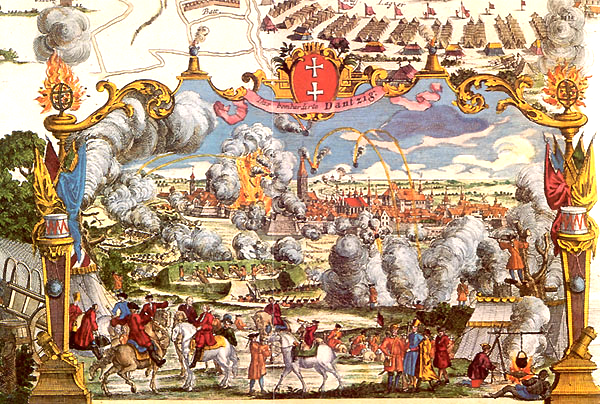
~ in the Polish theatre of war (and the picture is of the siege of Gdansk) the Russians quickly took Danzig (June 1734), effectively ending the war in this theatre. Stanislaus fled to France.

~ on the Rhine the French took Philipsburg (July 1734) and went on to occupy the Duchy of Lorraine and the Habsburg Netherlands. By the by, Philipsburg marked the first major engagement of the young Frederick the Great, and the last major engagement of Eugene..

~ in Northern Italy, a French-Sardinian army occupied Milan, fought an Austro-Prussian army at the battle of Parma (June 1734 - indecisive result - approx 50,000 per side) and again at Guastalla (September that year - approx 40,000 per side). This latter was a Franco-Sardinian victory, credited largely to the Sardinians.

~ in southern Italy, Spanish forces defeated the Austrians at Bitonto (May 1734) in the Kingdom of Naples, they then went on to occupy Naples and Sicily.

...all in all then, the war was a disaster for Austria, but the arrival of Russian troops on the Rhine resulted in the French party opening peace talks, which were agreed with the Treaty of Vienna in November 1738.
By it:

~ Augustus was confirmed as king of Poland, Stanisłaus being compensated with the Duchy of Lorraine (clever that - you may remember who his son-in-law was, and with no other children guess who Lorraine would pass to on his death!)

~ Spain was forced to give up Tuscany & Parma (which passed to Austria) but Charles was compensated by being confirmed as king of Naples and Sicily (& Tuscany and Parma were regained by the Spanish after the War of the Austrian Succession, anyway!)

~ Austria ceded a strip of western Milan (with the city of Novara) to Piedmont. The succession in the Grand Duchy of Tuscany was promised to Francis, the ex-Duke of Lorraine - little bit like a roundabout at this point..!

So bottom line - not much changed... the French and Austrian power base shifted slightly; overall the war was regarded a French victory, but the settlement wasn't lasting. The War of Austrian Succession (which I have heard of!) was soon to follow, again seeing France and Austria opposed to each other.

Things to read - these two are probably the best:

http://en.wikipedia.org/wiki/War_of_the_Polish_Succession
http://www.zum.de/whkmla/military/18cen/polsucc.html

Monday, February 25

Régiment de Nivernais..


...it's been a while since my last update, but here's some proof that I've not been idle in my absence...


..these guys are the latest regiment to join the forces of Louis XIV as part of the ongoing War of the Spanish Succession project - in fact the entire month has been a bit of a War of the Spanish Succession moment in time! J

As per Nettancourt, this regiment is solely made up of Minifgs 15's - the flag is from the excellent Warflag site..


..I'm quite keen on making sure that my armies are not full of Guards regiments, Household troops, or elite formations, and I'm happy to say that these guys fulfil that criteria quite nicely.. not that they're to be sniffed at!


The regiment was created on September 17 1684 and took the name of the province of Nivernais - and apart from this there is precious little information about the regiment.

They were one of 30 (!!) new regiments that Louis XIV raised between September 1st and 30th for home defence as a result of his fears at the time of a new coalition being formed against him.

By raising one regiment a day, he avoided any problem of precedence among these new regiments; suffice to say that during the Seven Years' War, the regiment ranked 86th - not 'elite' then!

The regiment carries no battle honours during the War of the Spanish Succession, but were obviously present at the action on the Schellenberg (as that's my starting point for the regiments I'm currently painting), where they were brigaded with Regiment Bearn (who had two battalions present), under the command of Brigadier de Montandre.. they were in the second line though. I guess I'm going to have to take to the books and see what I can find there - I'm assuming they would have been present at some of the other major engagements as well.

The regiment went on to serve in Italy during the War of the Polish Succession (which was new war to me - and one worth of a separate post I think).

During the War of the Austrian Succession, the regiment initially served in Flanders (1742) and the Lower Rhine (1743) before being sent back to Flanders (1744/1745) and finally Genoa where it was stationed in 1747 and 1748.

So there you have it - evidence if any were needed that not all regiments lead the assault, carried off the enemies flags, and featured prominently at the schwerpunkt - some were destined to serve failthfully in the line, largely un-noticed, but important none the less..

By the by - during the French Revolution, on March 4 1790, the region of Nivernais was renamed Nièvre named after the Nièvre River - it's now part of the current region of Bourgogne (which is well known for its white wine, Pouilly Fumé).

Monday, February 18

Infantry Regiment Goor

As promised here are some pictures of Infantry Regiment "Goor".

My reading on the excellent Dutch military history site would lead me to believe that this is Infanterie Regiment 671d a regiment founded in March 1671, by the splendidly named gentelman Moise Pain et Vin (Bread and Wine?) Up until that time he had been a Major in Infanterie Regiment 665d (Regiment van Wittgenstein), having taken that post in 1665.

As usual, in 1704 the regiment was known by the name of their colonel, who at the time was Johan Wijnand van Goor - he had taken command in February 1695, but for the previous fifteen years he was a major in Regiment Wallen (Infanterie Regiment 600a) having taken that post in February 1680 - promotion was not what you would call meteoric, but the excellent spanishsuccession site (click here) has a good potted history of his career during this time, and it's clear that he was not idle...


Goor was promoted to Generaal-Majoor in August 1701, and in April 1704 he was promoted Luitenant-Generaal en Meester-Generaal der Artillerie.


Unfortunately, as I mentioned in the history/background to Sturler's in a previous post, this promising career was cut short at the attack on the Schellenberg where he was a very early casualty leading the opening infantry assault...

The regiment however went on, and was present at the following engagements

1704 Schellenberg, Hochstadt
1706 Oostende, Meenen
1708 Wijnendael
1709 Malplaquet
1711 Bouchain

The regiment was in Beinheim's brigade for the attack on the Schellenberg, so will be brigaded with Beinheim's and Sturler's (which I've already painted) - just Rechteren (Dutch), Hirzel (Swiss/Dutch) and Heidebrecht (Ansbach) to go, to complete the brigade.


Figures are all 15mm Dixon's - with the exception of two Minifgs figures that I had to draft in to make up numbers. I'm still not too sure about the sculpting on the Dixon figures, they're a little dumpy compared to the more elegant Minfigs - in the picture above, the Minifigs are in the front rank at far right, either side of a Dixon.

I'm not sure their colonel would have carried a carbine, but just for once I wanted a little fun - and have represented him as a "Sharpe" like character, looking ready for anything the French can throw at him!

The flag is entirely unsound - there are no references to what flag they carried so I decided to give them one from one of the other Dutch infantry regiments (colonel's colour Waes Infantry Regiment)

Friday, February 15

...map editor....

..just a short post this time..

You've probably realised by now that I'm a great one for little pieces of software that help me in my wargaming - those of you who are of the same mind, and who also enjoy campaigning, may want to (should!) make their way to the Frivolous Fusileers (click here) blog where Andy Mitchell describes a handy little map editor program that he's created, and made available for free..


How would I use it?? Well as I commented on his blog, I'd use it at the strategic level:

1/. I would use it to create the campaign map, making full use of the very handy random function
2/. Then I'd use the country populator program (there's a link for in my "resources" table just over to the left) to add a little more detail on the towns/populations/economy of the country I just created..
3/. Then I'd load the map into "Berthier" (ditto the link information) where I could use it to map my troop movements...

...and lo and behold, I'm at least three quarters of the way to a workable campaign!

Andy says he's going to develop the "tactical" level benefits of the program next - but that's where I see GameMapper fitting, and as a contented user it's less of a benefit to me (though the random function may be!)

You can get the program here. You may need to be a member of the Old School Wargaming group to get at it - but my only response to that would be, "why aren't you already!?" J

More later on the following activities:

~ I've just completed another regiment for the Wars of the Spanish Succession; Dutch this time. I'll post pictures on one I've finished the basing...


~ I've also just taken delivery of some Minifigs 12mm WWII stuff, that I ordered from their excellent new website. More detail on these as I finish them, but just a "heads up" that I spotted they now accept payment via PayPal, which seems optimal - I can clear out my "rubbish" (not my description, but certainly that of the current Mrs. Steve the Wargamer) from the loft, on to EBay, and then pass the proceeds direct to Minifigs - how elegant and symbiotic is that, eh?.... J

Tuesday, February 12

Régiment de Nettancourt...

Régiment de Nettancourt were formed in 1695, and were known by that name until 1704 (from 1704 to '08 they were then known as the Régiment de Mailly).

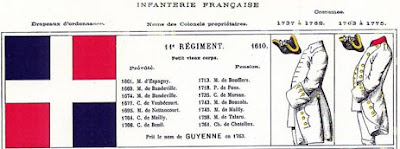
They were formed from the old regiment of Vaubécourt who were raised 1589 by Henri de Nettancourt, Count de Vaubécourt, in Lorraine. They were admitted into the service of France on April 24, 1610. (The graphic by the way is from the beyond excellent, and travelling towards the sublime, website "Praetiriti Fides" - click on it to go there.. a must for all WSS/WAS/SYW wargamers with French armies)


The most senior regiments in the French army were known as the Vieux Corps and comprised three regiments each raised in 1569; Picardie, Piémont, Champagne. After these were the "Petits Vieux"; lower in seniority, but still in the higher echelon of the army, and Nettancourt were one of these regiments, ranked 11th in seniority.


All "French" regiments of the army had royal, princely, or territorial titles, or took the name of their colonel. In the case of Infantry Regiment Nettancourt it was the latter, and they were named after their colonel (presumably an ancester of their founder). I've not managed to find out any information about why the regimental name changed, but one is forced to the assumption that given the change of Colonel was in 1704 then he may have perished at either the Schellenberg, or Blenheim??


The regiments of the Vieux Corps and the Petits Vieux remained on the establishment up to 1791, when the Army was reorganised by the Revolutionary government and all the existing regiments received numbers in place of their traditional names. Regiment Nettancourt becoming the 21st Regiment of the Line - they served in various guises until the regiment was disolved in 1963.

The figures are 15mm (of course), Minifigs in their entirety (lovely!), and unusually for me, feature a front rank in the firing position. I don't normally like this pose, as they look a bit strange marching across the table in firing mode, but I hate waste, and I had enough of them to create a firing line, so why not! The flag, as ever (and the guy deserves a knighthood) is by Warflag (link to the left)..