Friday, April 2

"Game 1" - Post match analysis..

If you have a look at the following (perhaps after clicking on it to enlarge it!), then by all the usual mores of wargaming one would probably agree that the Rebs have "shot their bolt".. 

Now if I was playing DG I would, of course, struggle on to an Appomattox type conclusion, but in this case my job is done ... what I wanted to do was give you a flavour of "Regimental Fire & Fury", and why I'm almost convinced that this is going to be my rule set of choice for the burgeoning American Civil War collection...

My primary requirements for this rule set choice was brigade level, with focus on the regiment, and these rules do that in spades but so do a number of other rule sets - what swings it for me is the level of detail/complexity which is not stupidly anal, but neither is it airily simplified... I think you'd agree that for this very simple game, historical tactics were followed, and the outcome was what you'd expect - equal sided forces where one has the benefit of a hard wall to stand behind will usually result in the "wall skulkers" (oh dear, am I giving away my preferences here!) winning, which they did...

The eagle eyed among you will have seen that I said "almost convinced" - what are my concerns?? To be honest they are slight....

First and foremost is (was?) the variation of results caused by a single D10 dice throw, but as Jim Walkley & Ross Mac [click here] and John Preece [click here] commented in the last game post, over the course of the game then multiple dice throws are going to "even out"... I like Jim's analogy of the shooting which deserves repeating...

"May I give a suggested rationalisation of the varied shooting scores - probably be shot to bits myself but hey ho.
Good volley - first volley in action - we're all loaded, gotta shoot the enemy.
Bad volley - ouch, they're shooting at us - let's keep down behind the wall if we can.
Excellent volley - officers and sergeants encouraging return fire, they haven't hit too many of us, got to get out of this."


I can live with that...

My only other concern is the amount of movement and shooting calculations that may need to be done. In a multi unit game this will become more of an issue - I suspect that any more than a couple of brigades/six regiments and it may all become a bit onerous. At the moment my thoughts are turning to a system of small plastic covered cards that can stay with the unit and retain the modifier calculations so that a quick check will see if they stand for this turn, and save you having to do it again..

Either way - the troops are now heading back to their box - to echo one of John's last comments, I can't believe how much pleasure I got from manoeuvring two units of foot round a small table with a single wall in the middle... a couple of hours tops, including this record keeping, but great fun! I shall be doing that again when the cavalry are done so look forward to "Game 2" sometime later this summer...
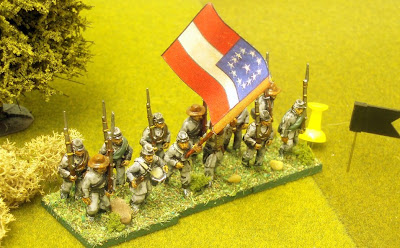
Bloody but unbowed - the 2nd Virginia will rise again!

=====================================

Just a quick update to announce that I have set up a separate blog for the sailing posts - I'd been thinking long about it and came to the conclusion that the posts don't make a huge amount of sense to be kept here in what is predominantly a wargaming, beer and music blog... I'll put in a comment here whenever I've added a post, but if your interested in my sailing exploits and adventures, may I steer you towards the Yacht Papillon [click here] blog...

Wednesday, March 31

"Game 1" - Move 4

Union Movement Phase:

OK – with three full descriptive moves behind us I think I owe you a break so I’ll cut down on the full description of all the modifiers going forward..

Union commander throws 7 for his brigade dice when deciding move distance.. which, with modifiers comes out as 9 – both units are disordered so check on the “Disordered Troops” part of the manoeuvre table.. they get “Rally” results, so they remove the disorder condition and can then move half..
  • 14th Indiana: unit moves up on the 8th’s flank – mostly behind the wall.
  • 8th Ohio: decides to stand behind the wall – no move.

Union Firing Phase:

Confederate Defensive fire:
  • 2nd Virginia 4 bases – all firing at 8th Ohio
  • 4th Virginia 5 bases – 1 base firing at 8th Ohio, the other four bases will fire at the 14th.
Casualties:

8th Ohio: 5bases/9 stands @ 3”- 6” (1FP) range = 9FP’s = +2 Modifier; -2 for the fact that the 8th Ohio are behind the wall plus a dice throw of 9 (!) means they score a 9 – “Galling fire” first Union casualties and also disordered.

14th Indiana: 4bases/8 stands @ 3” - 6” range = 8 x 1FP = 8FP’s = +1 Modifier; -2 for the fact that they are (mostly) behind the wall plus a dice throw of 5 means they score 4 – no effect…

Union Offensive fire:
  • 14th Indiana – all 4 bases will fire at 4th Virg.
  • 8th Ohio 5 bases – 3 bases at 2nd Virg., the other 2 bases will fire at the 4th Virg.

Casualties:

2nd Virg.: 3 bases/5 stands @ 3”- 6” (1FP) range = 5FP’s but unit is disordered so half FP’s = -1 modifer; D10 of 10 means they score 9 which results in a “Galling Fire” – second blood of the engagement – they lose 1 stand & are disordered (yellow pin). The score of 10 on the dice means that there is a chance the unit will be “low on ammunition” – but a dice against the chart shows “no effect”… because this is the second stand lost one whole base is removed..

4th Virg.: 6 bases/12 stands @ 3”- 6” (1FP) range = 12FP’s but four of the stands are disordered which ends up in a modifier of +2; D10 = 8 means they score 10 which results in a “Galling Fire” – further disorder, and another Confederate stand lost!

Some quite outstanding shooting by the Union troops and thereby hangs one of the issues with these rules - I'm no historical simulationist when it comes to my wargames - I know they're just games - but I do like to be able to rationalise the results I see when a dice is thrown; these single D10's introduce a massive range of possible results. DG and I have done away with it for the movement phase by using 2D10/2 but at the time I said I didn't want to do that for musketry, it's clear however that the dice is a massive part of the calculation - I may want to change my mind! Based on what we've seen in this game so far, for example, we see the Union troops firing a good volley, a bad volley, and then an excellent volley - but what would cause this variation in "real life"? They've been under fire throughout, disordered for most of it, the only change is the variation of the dice and what is that modelling?

Union Charging Phase:

None..

Move 4 - Confederate Movement Phase:

Again, the Brigade Commander within 9” of both so they share the move dice

D10 = 6, which gives a modified result of 8. Both units are disordered so they both get a “rally” result – disorder removed and half move. The rebel yell rings out across the table as they both surge forward towards the enemy held wall …

Confederate Firing Phase:

Union Defensive fire:

7 bases at the 4th, 2 bases at the 2nd…

2nd Virg.: 2 bases/3 stands @ 0 - 3”(1FP) range = 3FP’s but unit is disordered so half FP’s = -2 modifier, no other modifier, D10 = 7, so result is 5 – just enough to disorder them, but not enough to stop them closing!

4th Virg.: 7 bases/14 stands @ 0 - 3” (1FP) = 14FP’s = +3 modifer, no other modifier, D10 =8, so result is 11! A “galling fire” – disordered, one stand removed, but still not enough to stop them…


Ouch!!

Confederate Offensive fire:

None – I reserve my fire for a “cold steel” bonus in the melee

Confederate Charging Phase:

In we go…

First combat was against 8th Ohio

Confederate modifiers:
+2 for fresh troops; -1 for trained troops;+1 for “cold steel”; -1 disordered; D10 = 2 – overall result of 3 (gulp….)

Union modifiers
+2 for fresh troops; -1 for trained troops; -1 disordered; +1 for the wall; D10 = 8 – overall result of 9..

A difference of 6 – the worst possible result! 2nd Virg. lose a stand and retreat a full move disordered… 8th OH hold.


Second combat against the 14th Indiana

Confederate modifiers:
+2 for fresh troops; -1 for trained troops;+1 for “cold steel”;-1 for a lost stand in the firing phase; -1 disordered; D10 = 3 – overall result of 3 (gulp….)

Union modifiers
+2 for fresh troops; -1 for trained troops; +1 for the wall; D10 = 2 – overall result of 4..

A difference of 1 – the attack falters, 4th Virg. move back a half move and end up disordered – no casualties

Definitely not what was wanted - looks like the Rebs left it too late to launch the attack, the concern now is that casualties are significant and the 2nd Virg. is now "worn" (due to the casualties)...

Position at end of move:


Monday, March 29

"Game 1" - Move 3

As usual - current orbat - no change from last turn... click on this or any other graphics for a bigger view...

Onwards and upwards with move 3...

Union Movement Phase:

Decide move distance - as per last move, the Brigade Commander is still within 9” of both so they share the move dice.

D10 = 8 (NB. 2D10/2...and that's the last reminder, honest..)

Modifiers remain the same:

+1 for an Able Commander (Kimball)
+2 for fresh troops
-1 trained troops

Modified dice = Dice +2 = 10 (whoo hoo!)
• 14th Indiana: “Quick Time” – unit moves move and a half – they move by the flank (sideways) for half move, and then use the rest to move up on the 8th’s flank..
• 8th Ohio: “Rally with Elan” – the unit recovers from disorder and can move a whole move.. it closes up on the wall.

Union Firing Phase:

Confederate Defensive fire:

• 2nd Virginia 4 bases – Will fire at 8th Ohio
• 4th Virginia 5 bases – 1 base at 8th Ohio, the other four bases will fire at the 14th.

8th Ohio: 4bases/8 stands @ 3”- 6” (1FP) range & 1 base/2 stands @ 6”- 9” (0.5FP) 8 x 1FP + 2 x 0.5FP = 9FP’s = +2 Modifier.
Other modifiers:
-2 for the fact that the 8th Ohio are behind the wall
D10 =6
The modified dice score = Dice + 0 = 6 which results in a “Harassing Fire” - no casualties but the 8th Ohio end up disordered again (yellow pin).


14th Indiana: 4bases/8 stands @ 6” - 12” range = 8 x 0.5FP = 4FP’s = 0 Modifier.
Other modifiers:
None..
D10 = 7
The modified dice score = Dice + 0 = 7 which results in a “Harassing Fire” - no casualties but the 14th Indiana end up disordered (yellow pin).


Union Offensive fire:

• 14th Indiana – all 4 bases will fire at 4th Virg.
• 8th Ohio 5 bases – 3 bases at 2nd Virg., the other 2 bases will fire at the 4th Virg.

2nd Virg.: 3 bases/6 stands @ 3”- 6” (1FP) range = 6FP’s but unit is disordered so half FP’s = 0 modifer
Other modifiers:
None..
D10 = 9 (blimey!)
The modified dice score = Dice + 0 = 9 which results in a “Galling Fire” – first blood of the engagement – 2nd Virg. lose 1 stand & are disordered (yellow pin).


4th Virg.: 6 bases/12 stands @ 6” – 12” (0.5FP) = 6FP’s but both units are disordered so half FP’s = 0 modifer
Other modifiers:
None..
D10 = 4
The modified dice score = Dice + 0 = 4 which results in a “Desultory Fire” – no effect.


Union Charging Phase:

None..

Move 3 - Confederate Movement Phase:

Brigade Commander within 9” of both so they share the move dice

D10 = 3
+1 for an Able Commander (Garnett)
+2 for fresh troops
-1 trained troops

Modified dice = Dice + 2 = 5 = “Tardy”

This result is applied in two different ways as one regiment is disordered:
• 2nd Virg. are disordered – so they get a “stand fast” order ie. they reform, and the disorder is removed, but they can’t move.
• 4th Virg. are not disordered – they get a “tardy” order from the same dice result – this is a half move… which they use to move by the flank (sideways) at half move rate.

Confederate Firing Phase:

Union Defensive fire:

Basically the same as the last time they fired..
• 8th Ohio 5 bases – 3 bases at 2nd Virg., the other 2 bases will fire at the 4th Virg
• 14th Indiana – all 4 bases will fire at 4th Virg.

2nd Virg.: 3 bases/6 stands @ 3”- 6” (1FP) range = 6FP’s but unit is disordered so half FP’s = 0 modifier
Other modifiers:
+1 Target Disordered
D10 = 3 (not so good this time!)
The modified dice score = Dice + 1 = 4 which results in a “Desultory Fire” – no effect..


4th Virg.: 6 bases/12 stands @ 6” – 12” (0.5FP) = 6FP’s but both units are disordered so half FP’s = 0 modifier
Other modifiers:
None..
D10 = 4
The modified dice score = Dice + 0 = 4 which results in a “Desultory Fire” – no effect.


Pitiful!!

Confederate Offensive fire:

• 2nd Virginia 4 bases – Will fire at 8th Ohio
• 4th Virginia 5 bases – 3 bases at 8th Ohio, the other two bases will fire at the 14th.

8th Ohio: 4bases/7 stands (NB. 2nd Virginia had lost a stand) @ 3”- 6” (1FP) range & 3 bases/6 stands @ 6”- 9” (0.5FP) = 7 x 1FP + 6 x 0.5FP = 10FP’s = +2 Modifier.
Other modifiers:
-2 for the fact that the 8th Ohio are behind the wall
+1 for the fact target are disordered
D10 =5
The modified dice score = Dice + 1 = 6 which results in a “Harassing Fire” - no casualties but target disordered – as they are already, no effect.


14th Indiana: 2bases/4 stands @ 6” - 12” range = 4 x 0.5FP = 2FP’s = -1 Modifier.
Other modifiers:
+1 for the fact target are disordered
D10 =7
The modified dice score = Dice + 0 = 7 which results in a “Harassing Fire” - no casualties but target disordered – as they are already, no effect.


Confederate Charging Phase:

None.. which brings the move to an end..

Position at end of move:

Stay with me for move 4, a report on the WWII desert game DG and I recently played... oh, and the boat has been launched!

Friday, March 26

"Game 1" - Move 2

As usual - current orbat - no change from last turn... click on this or any other graphics for a bigger view...


Move 2:

Union Movement Phase:


Decide move distance as per last move - Brigade Commander is still within 9” of both so they share the move dice

D10 = 5 (NB. 2D10/2 rather than a single D10)

Modifiers remain the same:
+1 for an Able Commander (Kimball)
+2 for fresh troops
-1 trained troops

Modified dice = Dice +2 = 7 Brigade is ‘well handled’ and moves its full rate… 12” in line

The 8th Ohio ends up a little more than an inch from the wall with the 14th Indiana in echelon about 6” behind and to their left..

Union Firing Phase:

One of the things I like about these rules is that both players are involved in each turn – and this is the first example as in Fire and Fury Regimental (F&FR hereafter) the firing phase in each move consists of a round of defensive fire combat (from the other player) followed by a round of offensive fire combat (your guys).

Defensive fire:

The Union infantry is now in range of the Confederate rifled muskets (maximum range 18”) so they’re going to have a pop…

Arc of fire is 15’ either side of straight ahead so I run the little guide I have along the front of the Confederate regiments firing to find out who’s in arc – my target is the 8th Ohio; both Confederate regiments will fire at it so it’s a single firing procedure. I use the centre of each stand to measure angle from, and as long as any of the enemy unit is within the arc they can fire (feel free to tell me if this is wrong anyone!) Having done this I can see that 4 stands can fire – three from the 2nd Virg. and one from the 4th Virg.

Range is between 6” and 12” – four stands equates to 8 bases (remember I have double base stands) & fire points at this range, according to my charts, are 0.5pt so 8 bases x 0.5 = a total of 4 firing points, which a quick check tells me is a 0 modifier

Other modifiers:

+1 for the first volley (so a bit of a waste for the 4th Virginia as only one stand is firing!)
-2 for the fact that the 8th Ohio are behind the wall (they aren’t but they’re very close to it so I'm going to count it)

D10 = 6

The modified dice score therefore = Dice - 1 = 5 which when the target is “trained” (ie. different quality of troops react differently to fire) results in a “Harassing Fire” - no casualties but the 8th Ohio end up disordered (yellow pin).

Offensive fire:

The Union regiment has an opportunity to fire back – they spilt the fire (because of the arc rules); 3 stands will fire at the 2nd Virg and 2 stands at the 4th Virg.

1st Fire @ 2nd Virg:

Same range, so we know that's a 0.5 FP. 6 bases x 0.5 = 3 FP’s, but because they are disordered we halve these => 1.5 FP’s, or 1FP as fractions are rounded down which is a -2 modifier (uh-oh!)

Other modifiers:

+1 first volley
Modified Dice = Dice – 1 = 3 (bugger!) which is “Desultory Fire” ie. no effect

2nd Fire @ 4th Virg:

All mods are the same so an overall -1
Dice was 8
Overall result of 7 which with a trained target results in a “Harassing Fire” result – no casualties, but 4th Virg are disordered.

Union Charging Phase:

None..

Move 2 - Confederate Movement Phase:

Brigade Commander within 9” of both so they share the move dice

D10 = 2 (oops!)
+1 for an Able Commander (Garnett)
+2 for fresh troops
-1 trained troops

Modified dice = Dice + 2 = 4

This result is applied in two different ways as one regiment is disordered:

  • 4th Virg. are disordered – so they get a “stand fast” order ie. they reform, and the disorder is removed, but they can’t move.
  • 2nd Virg. are not – they get a “tardy” order from the same dice result – this is a half move… which they use to wheel and close on the wall.


Confederate Firing Phase:

Defensive fire:

The Union regiment (8th Ohio) has another opportunity to fire back – they split the fire as per the previous move - 3 stands will fire at the 2nd Virg and 2 stands at the 4th Virg.

1st Fire:

2nd Virg are closer so range modifiers have improved we now have 2 stands at 1 FP and 1 stand at 0.5FP = 4 bases x 1 + 2 x 0.5 = 5 FP’s but because they are disordered we halve these => 2.5 FP’s or 2FP as fractions are rounded down which is a -1 modifier

No other modifiers

Modified Dice = Dice – 1 = 3 which is “Desultory Fire” ie. no effect

2nd Fire:

All mods are the same as the last time they fired so an overall -1; dice was 4; an overall result of 3 another “Desultory Fire” result.

Pitiful!

Offensive fire:

Both regiments are going to fire at the 8th Ohio

  • 2nd Virg. have now manoeuvred such that all their stands are within arc, and they are also closer.. 3 stands (6 bases) are under 6" away so get 1FP, plus the end stand (of two bases) who are just over 6” and on 0.5FP = 7FP’s in total
  • 4th Virg. Haven’t moved so just one stand for them (2 bases) at beween 6” and 12” range band which is 0.5Fp = 1FP’s


A total of 8FP’s which gives a dice modifier of + 1

Other modifiers:

+1 as the 8th Ohio (the target) are disordered
-2 for the fact that the 8th Ohio are behind the wall

Modified dice = Dice + 0 = 6 a “Harassing Fire” result – no casualties, but target is disordered – given they are already, no effect.

Confederate Charging Phase:

None..

Position at end of move:


The Union player (me) needs to get the 14th Indiana up and into the firing line soonest, otherwise the Confederate player (also me!) is going to defeat the Union troops in sequence..

Stay tuned for move 3 some time next week

Thursday, March 25

"Game 1" - Move 1

...and we're off...

Here's the orbat I've knocked up - I'll be modifying this as we move through the game - status codes are pure Fire & Fury, they signify at what stages troops drop down the fatigue scale, so as an example, when the 2nd Virginia lose 3 bases they'll be classed as "worn" as opposed to fresh (it may say 4 but remember my bases are double ones)...


On to the game - first off, I needed to decide who'd move first, so in time honoured fashion a D6 was thrown - Union win and move first.

Move 1:

In Fire and Fury Regimental, each sides move is in 3 phases - move/fire/melee

First off then the Union move phase and we need to decide the move distance which is dice and modifier driven.

Union Move:

The Brigade Commander is within 9” (command range) of both regiments so they share the move dice - increased level of control if all units are moving same possible distance..

D10 = 7 (DG and I use 2D10/2 rather than a single D10 as we found that with the single dice the possible range of results gave unrealistic results – a unit could be moving at the double one turn and in the very next turn stood halted just because of the dice throw)

Mods:
+1 for an Able Commander (Kimball)
+2 for fresh troops
-1 trained troops

Modified dice = Dice +2 = 9 Checking the chart this means the Brigade is ‘well handled’ and will move it’s full rate… (which is 12” in line)

Regiments in line can only move in straight lines backwards of forwards – moving obliquely therefore requires two wheels with a straight bit in the middle.. character smileys

Union Firing phase:

No firing as they are out of range (rifled musket has range of 18”)

Union Charges/melees etc.:

None... same reason.

Confederate Move:

Brigade Commander within 9” of both so they share the move dice

D10 = 5
+1 for an Able Commander (Garnett)
+2 for fresh troops
-1 trained troops
Modified dice = Dice +2 = 7 Brigade is ‘well handled’ (just – one less and we would have had a “tardy” result) and move it’s full rate… 12” in line

Confederate Firing phase:

No firing (as per Union move)

Confederate Charges/melees etc.:

None...

End Move Positions:


So that's the end of move 1 - as we go through further moves I'll start dropping all of the above detail so it should be quicker to write, and read... it's fairly clear that the wall is the major defensive position on the table - looks like the Confederacy should get there first (who knows though?! character smileys)